

Artisans of Cantonese Opera costumes in Hong Kong and on the Chinese mainland are working hard to bring the ancient craftsmanship back to life by promoting the trade among the younger generation and preserving it as an intangible cultural heritage. Atlas Shao reports.
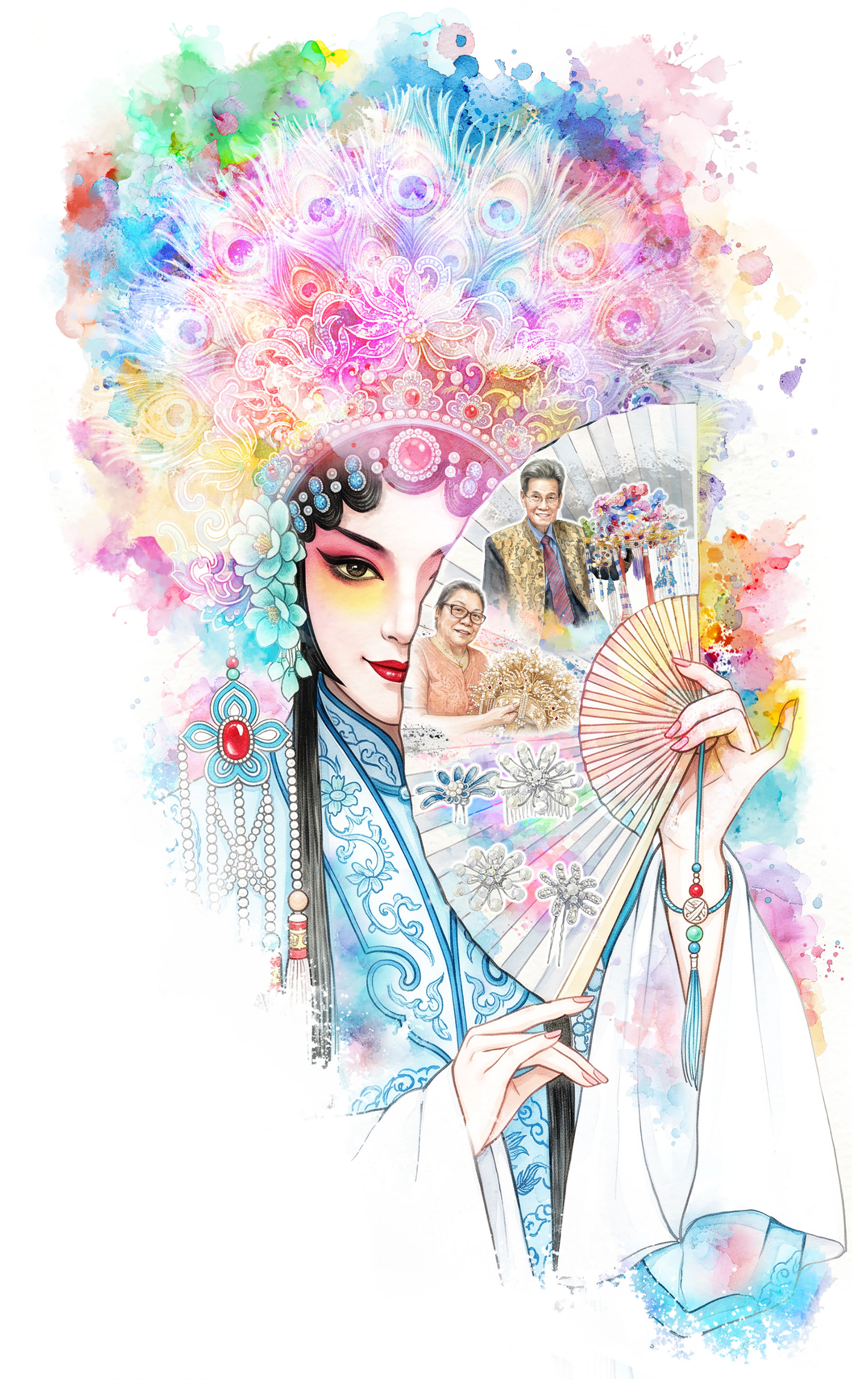
A dozen trainees sat quietly in a Hong Kong workshop, their eyes fixated on their hands churning out hair clips, some of which bear flower-shaped pearls. The clips aren’t the traditional ones sold in stores but are meant for Cantonese Opera headdresses.
The workshop, run by the city’s Leisure and Cultural Services Department (LCSD), is helmed by Chow Yin-wan — a skilled craftswoman who has been in the trade for decades. She is part of a push by the Hong Kong Special Administrative Region to bring back the ancient craftsmanship in Cantonese Opera costumes that has been threatened to slip into oblivion.
READ MORE: Operatic ambition
Traditional Cantonese Opera made it to the Representative List of the Intangible Cultural Heritage of Humanity of the United Nations Educational, Scientific, and Cultural Organization in 2009. But the opera headdress crafting and costume embroidery techniques that were included in Hong Kong’s first Intangible Cultural Heritage List in 2014 failed to click with the public.
By incorporating the style of the traditional opera headdresses into everyday wear accessories, the craftswoman says she hopes they will resonate with today’s younger generation. Chow, who went from being an opera performer to a craft artisan behind the scenes, says she worries about whether the skill can be passed down, adding that most people who try to pick it up are merely driven by hobbies rather than a desire to carry on the craft as a formal vocation or making a living from it.
Facing challenges
Amateurs’ reluctance to enter the profession is compounded by a host of impediments, such as the unstable income of Cantonese Opera performers and the lack of financial support from troupes or organizations for acquiring headdresses and costumes. Thus, they have to purchase these items out of their own pocket, with a single piece costing thousands of Hong Kong dollars, though some performers choose to rent the outfits instead.
Another obstacle is that the raw materials used to make the headdresses — which could be easily obtained in Sham Shui Po district in the past — are now almost nowhere to be found following the COVID-19 pandemic, forcing Chow to source them online. “However, being unable to see the items firsthand, I encounter problems like the materials turning out to be unsuitable, ultimately leading to financial losses,” she laments.
“The headdress is the soul of Cantonese Opera,” says Chan Kwok-yuen, who has been a master of Cantonese Opera costumes for over six decades.
Chan, dubbed the “living dictionary” of Hong Kong’s Cantonese Opera costumes, had been behind the scenes of headdress crafting for more than two years after playing supporting roles in Cantonese Opera troupes and organizations — customarily referred to by Chinese people as the “Pear Garden”. His experience as a performer gave him a profound understanding of the distinct costuming requirements for various roles.
Based on traditional techniques, he has infused his own ingenuity into his work. He has experimented with lighter materials to replace heavy copper and iron, and designed a modular, adjustable headdress that allows performers to detach or assemble components based on the specific needs of a scene, enabling a single set of headdress to adapt to four or five different character looks.
“Insiders can immediately tell it’s my work,” says Chan, beaming with pride. Recalling the trade’s glorious years in the 1950s and 1960s, he says there were dozens of craftsmen as skilled as him at the time. “Now, even the Cantonese Opera audience is shrinking, not to mention the making of headdresses, which are merely an accessory to the opera,” he says. Many people have picked up the skill out of curiosity or as a passing whim. But since it’s hard to make a living in the profession, they eventually give up halfway.
“You put lots of efforts into creating something original, only for others to copy it instantly,” says Chan, adding that in today’s era of advanced internet, traditional craftsmanship is no longer cherished, and few people are willing to pay a premium for a handcrafted headdress.
But despite all the hurdles, artisans led by Chan are doing their bit to revive the industry through nonprofit ways to reintroduce the trade to the mainstream. For years, he has teamed up with cultural organizations and the HKSAR government through exhibitions, lectures and other activities to deepen public engagement with this intangible cultural heritage. These efforts have paid off. Chan has been praised for his deeds over the years, and has kept newsclips about his accomplishments.
In 2019, Chan’s stage costumes and headdresses went on show in Los Angeles. Although he didn’t show up personally, he believes his works have allowed foreigners to appreciate the charm of Cantonese Opera culture, filling him with gratification and pride. “Being able to contribute to promoting Cantonese Opera has brought me great satisfaction.”
Engaging new audiences
In 2024, Hong Kong’s LCSD invited Chan to be a guest speaker on Fun Day of the Hong Kong Heritage Museum. He gave a thematic lecture, guiding the audience through the development history and characteristics of Cantonese Opera costumes in Hong Kong.
Also making a splash is Chow. Apart from government-organized workshops, she has also participated in projects teaching students at Hong Kong’s primary and secondary schools the simple headpiece-making techniques. Before the pandemic, she had cooperated with the LCSD to organize workshops, giving residents a chance to experience this traditional craft and deepen their impression of this intangible cultural heritage. Late last year, Chow went to Macao for an exhibition, where the Macao SAR government invited her to bring along some of her pieces for on-site sale.
Chow has exhibited her works in Beijing, where she organized hands-on workshops on simple headpieces-making, drawing an enthusiastic response.
A new generation of young artisans in the Chinese mainland cities of the Guangdong-Hong Kong-Macao Greater Bay Area is also looking at ways to breathe new life into the craft.
In Guangzhou, He Fengting — a young torchbearer of Cantonese Opera costume craftsmanship — told China Daily the profession faces a serious inheritance crisis, but the public seems to be in the dark.
He Fengting, who was born in 1990, in 2016 took over the Zhuangyuan Fang Costume Workshop in the Guangdong provincial capital from her aunt, Dong Huilan, a provincial-level representative inheritor of the city’s opera costume craftsmanship.
The young inheritor has designed a range of cultural and creative products, including cute Cantonese Opera phone stands, Cantonese Opera keychains, hand-embroidered miniature costume ornaments, and doll clothing. By integrating intangible cultural heritage elements into art toys, she hopes to popularize the craftsmanship of making traditional opera costumes.
It’s difficult to set the prices of Cantonese Opera costumes too high, she says, explaining that for the general public, there are many substitutes, such as those sold online, and that promotion is limited. She has also partnered with an online game company to incorporate the patterns, colors and craftsmanship of classic Cantonese Opera costumes into the character costume designs of the game through digital means.
To entice young people to learn about the craftsmanship, He Fengting has developed Cantonese Opera costume-making techniques into educational do-it-yourself kits to encourage participation among teenagers, while giving lectures at primary schools to offer students immersive hands-on experience. However, her workshop set up on Guangzhou’s Renmin Nan Road in 1996 had to be relocated last year because of the soaring rent.
The new workshop, which opened after this year’s Labor Day holidays, has allowed her to consider rolling out costume-related merchandise and restarting the Cantonese Opera intellectual property cotton dolls. He Fengting says the six master craftsmen at the shop — with decades of experience in making Cantonese Opera costumes, including one aged 92 — don’t intend to call it a day and will carry on their work at the new location to preserve the spirit of the craft.
Ning Jing — an inheritor from Guangdong province’s city of Foshan — has also been at the forefront of the trade. She is leveraging social media momentum to amplify her voice and expand the audience base. She has posted videos and articles about the craftsmanship on social media to broaden the public’s understanding, in addition to joining exhibitions and visiting schools to conduct intangible cultural heritage experience classes on Cantonese Opera headdress making.
“Many people have never even seen what traditional Cantonese Opera headdresses look like, let alone developed an interest in learning more about them,” says Ning.
Like her peers, she adapts Cantonese Opera headpiece designs to everyday items like brooches and hair clips. These products have attracted corporate buyers seeking gifts for their clients.
Over her 33-year career, Ning has noticed a significant rise in public recognition of Foshan’s intangible cultural heritage. While she applauds government efforts to host educational exhibitions, budget constraints have mostly confined these events to the city.
A frequent commuter between Foshan and Hong Kong, where she originally studied the craft, Ning says she hopes both regions can deepen cultural collaboration to expand the heritage’s reach.
The path forward remains uncertain. But for those who stitch, teach and innovate, they refuse to let it break.
ALSO READ: Homing in on the Bard
The relocation of He Fengting’s factory was completed in May, followed by a gradual rollout of intangible cultural heritage activities. Following the closure of the factory at the original site, He persisted in working on preserving Cantonese Opera costumes and exerted greater efforts on projects like restoring artifacts and mapping out their course of development.
He says that in the future, she hopes to continue with more effective activities to create deeper engagement with the public. “We’ve noticed that some young people are interested, but lack access to, or have not found the information channels. Hopefully, we can offer such activities to university students or scholars who work in, or need to understand, related industries,” she says.
For Chan, his lifelong dedication came to life again at Hung Hom’s Ko Shan Theatre in April. As the chief designer for the Cantonese Opera Ten Accusations Against Yan Song, the 94-year-old saw the production draw a triumphant crowd, selling more than 80 percent of the tickets. The true highlight, however, was the stage debut of his treasured, hand-beaded garments, which shimmered under the theater’s lights as a dazzling testament to his artistry.
Despite every difficulty, the master remains steadfast in his aspirations, bound by a simple, enduring truth. “I hope to promote Cantonese Opera. I’m a child of the ‘Pear Garden’.”
Contact the writer at atlasshao@chinadailyhk.com
