

Industry at threshold where 5G giving way to 6G, IoT ascending to next stage
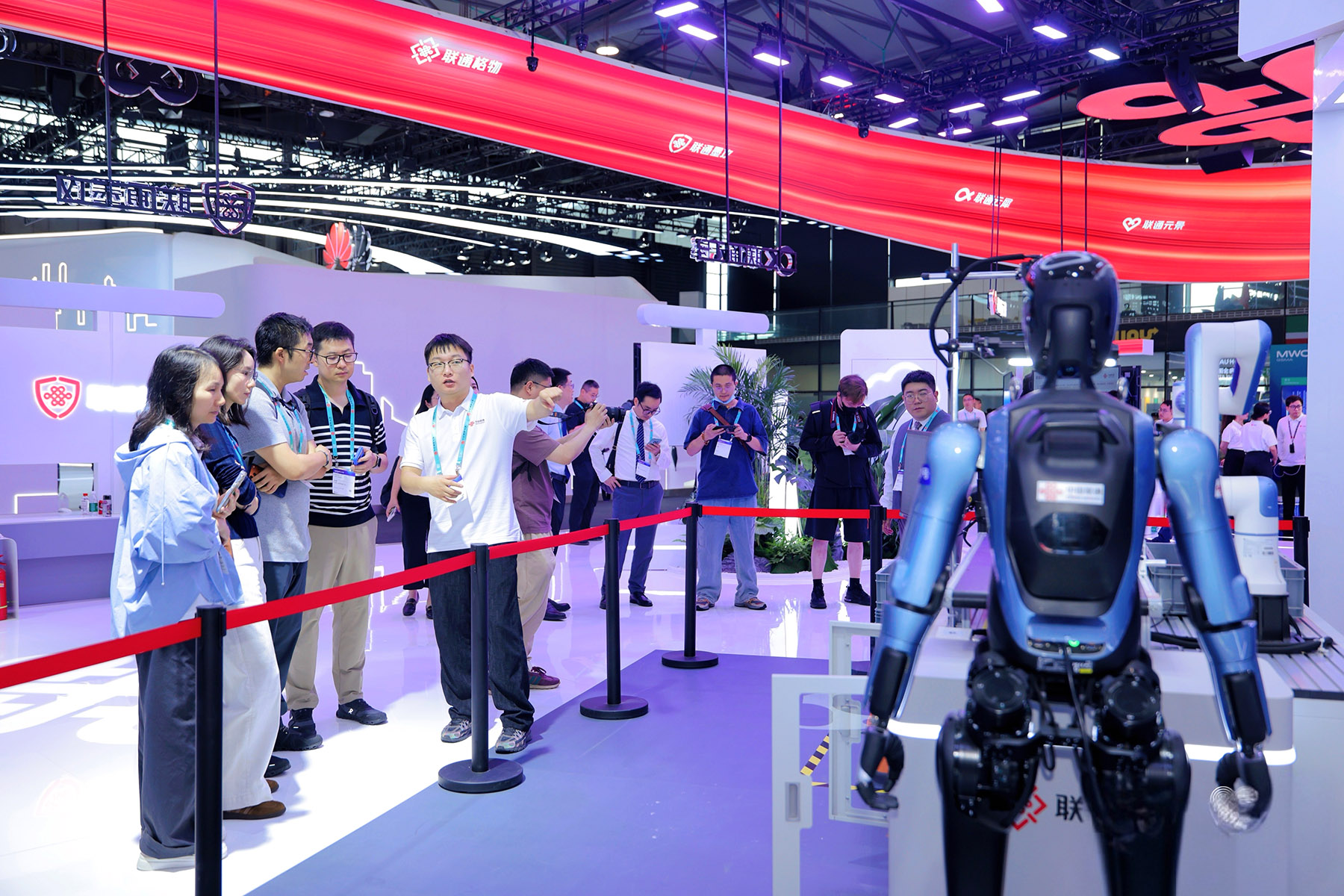
As the world's gaze focused on the FIFA World Cup 2026, an electrifying spectacle of skill unfolded at an exhibition hall in Shanghai: humanoid robots stepping up to the penalty spot, striking balls with precision and celebrating goals in front of roaring crowds.
The humanoid robot football penalties challenge, a centerpiece of the newly launched mobile artificial intelligence innovation pioneer zone at the 2026 Mobile World Congress Shanghai, also known as MWC26 Shanghai, a three-day event which ran through Friday, featured eight teams including Unitree Robotics, Linkerbot and China Mobile (Hangzhou). No remote controls, no preset scripts — each robot independently completed the entire process, from ball recognition and positioning to angle calculation, force control and shooting, all within milliseconds. It was, in every sense, a hardcore validation of embodied intelligence's perception-decision-motion control loop.
READ MORE: Brand Finance head: Going global, Chinese brands at inflection point
This was just one part of the exhibition that has firmly established itself as the global stage where AI meets the physical world. Vivek Badrinath, director-general of GSMA, an industry group representing the world's largest mobile phone operators, identified humanoid robotics, the low-altitude economy and autonomous driving as the three most exciting frontier tracks in Asia's mobile ecosystem.
Badrinath said not long ago, the core mission revolved around connecting people and devices. That remains important, but it is no longer the whole story. Telecom operators are now strategic digital partners working across industries to drive robotics, drones, connected vehicles and AI solutions deep into every sector of the economy.
Zhong Zhihong, chief engineer of the Ministry of Industry and Information Technology, laid out China's strategic direction for information and communication development: building robust next-generation infrastructure, strengthening technological innovation, deepening digital-industry integration, and pursuing open, win-win global cooperation.
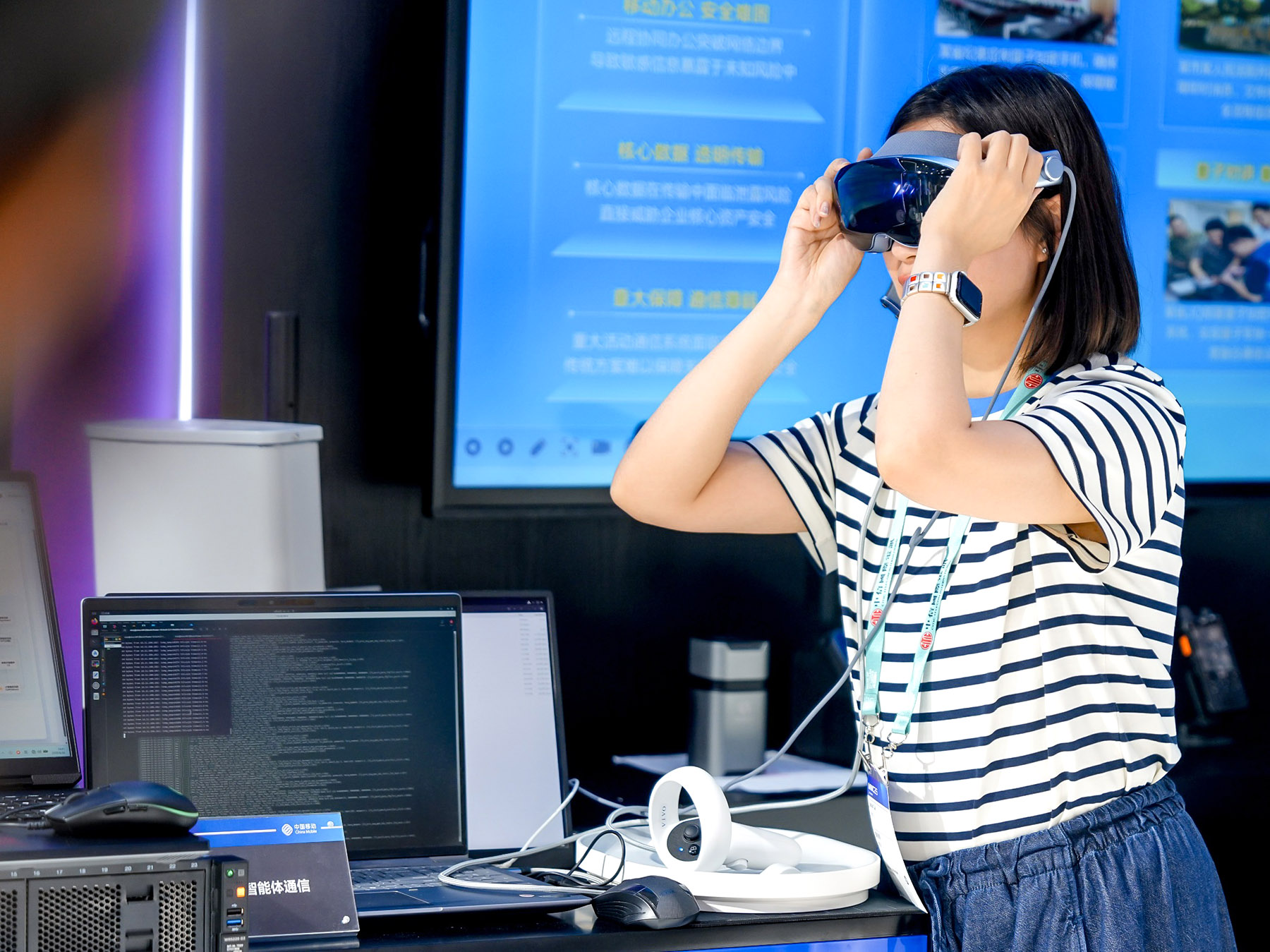
On the technology front, Zhong called for accelerating 6G core research and development and standardization while cultivating application ecosystems across AI, quantum technology and embodied intelligence.
Crucially, she urged the global community to uphold unified 6G standards and build broad consensus on AI governance.
China Mobile Chairman Chen Zhongyue opened his keynote speech with a poignant story: Zhang Xujia, a hearing-impaired individual, received an AI device using China Mobile's "one person, one model" accessibility technology — and for the first time, was able to hear his own voice making phone calls and ordering food like anyone else. "AI should not serve only a select few, nor stop at the general public — it must equally illuminate every life," Chen said.
He argued that the very meaning of "mobile" is evolving — from Mobile Communication (voice and messages) to Mobile Computing (bytes) to Mobile AI (tokens). The core task now is processing "intelligence flows" — knowledge-bearing, problem-solving streams — not just data flows. Telecom operators must break free from the pipeline role and upgrade to AI service platforms capable of millisecond-level semantic parsing, cloud inference and intelligent generation.
China Mobile is building an open intelligent service ecosystem and integrated intelligent infrastructure as twin growth flywheels. "We do not build walled gardens," Chen said. "We aim to be a cooperative, win-win service platform."
On the network side, the company is advancing 5G-A, terabit optical networks and space-air-ground integrated deployment, with 6G R&D anchored to industrial manufacturing and telemedicine scenarios. Self-evolving "autonomous networks" — self-configuring, self-optimizing and self-healing — are also taking shape.
Meanwhile, China Unicom said on the sidelines of MWC26 Shanghai that it has identified international expansion as a new growth engine and is working with global partners to enhance submarine cable systems, cross-border terrestrial fiber routes, and accelerate the buildout of a global data-intelligent network and satellite-based internet of things infrastructure.
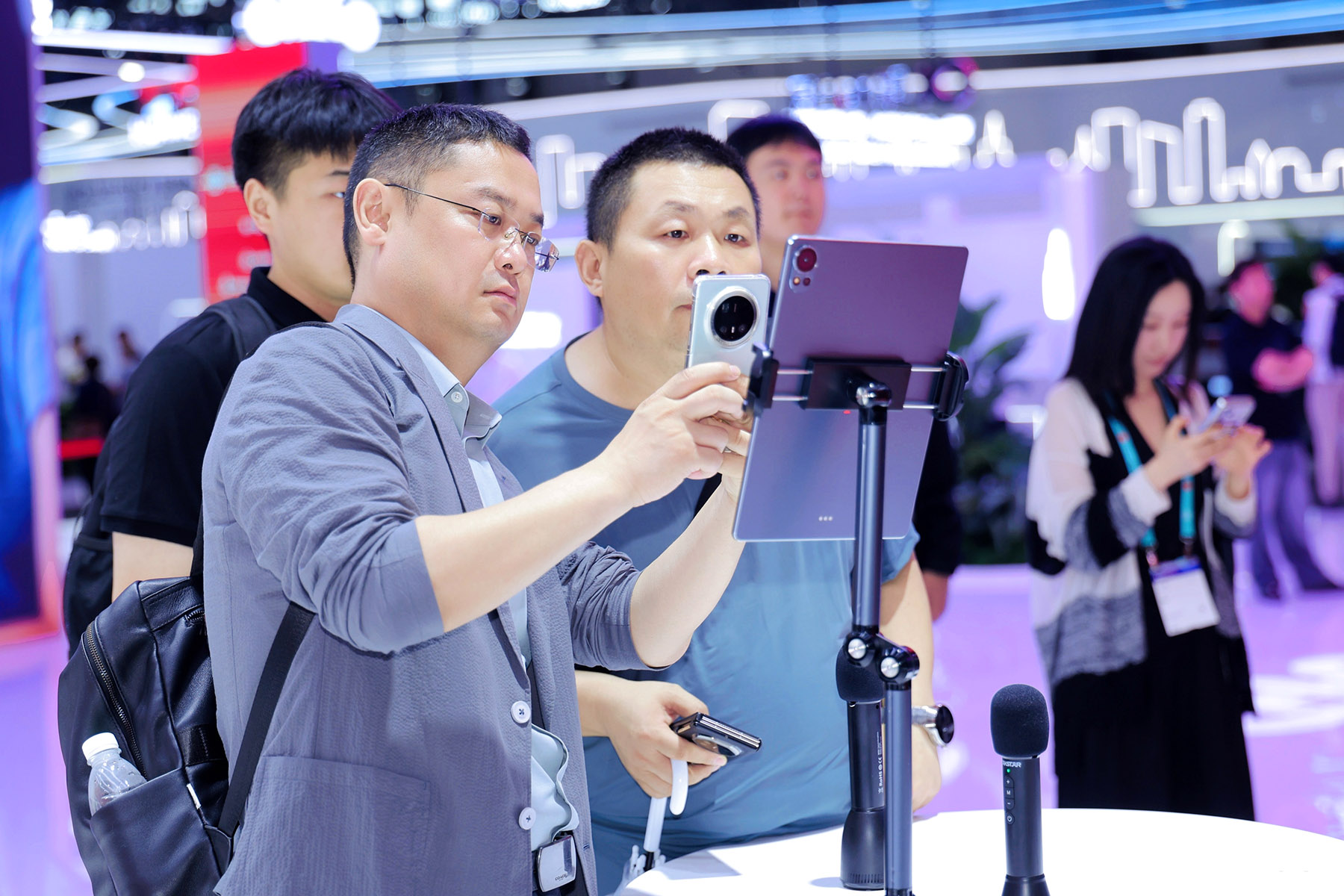
The State-owned telecom giant laid out its vision at the UniCom Global Partners Meeting 2026.
Miao Shouye, deputy general manager of China Unicom, underscored the company's strategic shift from a "basic pipeline provider" to a "comprehensive digital service provider", focusing on the core areas of connectivity, computing power, services and security.
He called for four collaborative actions: co-building intelligent networks via shared submarine and cross-border cables, as well as edge nodes, to create an integrated space-air-ground-ocean network; co-developing a cross-border cloud-computing ecosystem with token-based product suites to tap new business opportunities; co-delivering smart services by embedding AI into industry scenarios to meet diverse client needs; and co-establishing a security framework that ensures safe cross-border data flows and joint anti-fraud efforts.
Huawei Deputy Chairman and Rotating Chairman Wang Tao also declared 2026 a critical inflection point for mobile communications. He outlined key propositions for the next decade.
ALSO READ: Chinese companies shine at MWC
First, mobile networks must expand from connecting people and things to connecting intelligence. In hotspot areas, the density of intelligent agents is expected to exceed 10 million per square kilometer — far surpassing population density in the future. Second, on AI-network integration, Huawei proposed a three-layer intelligent architecture with a two-phase rollout.
On spectrum, Wang stressed that operators need 200 to 400 megahertz of continuous wideband spectrum as the capacity layer to deliver 6G's promised fivefold downlink and tenfold uplink improvements with ultra-low latency and high reliability. For space-terrestrial integration, he outlined two models: telecom operators introducing satellites as supplements, or ground-led collaborative network construction.
As the GSMA's latest report underscores, China now accounts for over 40 percent of global 5G connections. But the story at MWC26 Shanghai was about what comes next. From humanoid robots playing football to AI models giving voice to the hearing-impaired, from drone fleets operating under unified regulatory platforms to connected vehicles evolving into software-defined intelligent platforms, the message was unmistakable: the industry is standing at the threshold where 5G gives way to 6G, and where the internet of things ascends to the internet of intelligence.
MWC26 Shanghai made one thing clear: the future of mobile is not just about faster networks — it is about intelligence that is ubiquitous, inclusive and deeply embedded in the physical world. And China, for better or worse, is leading the charge.
Contact the writers at masi@chinadaily.com.cn
