

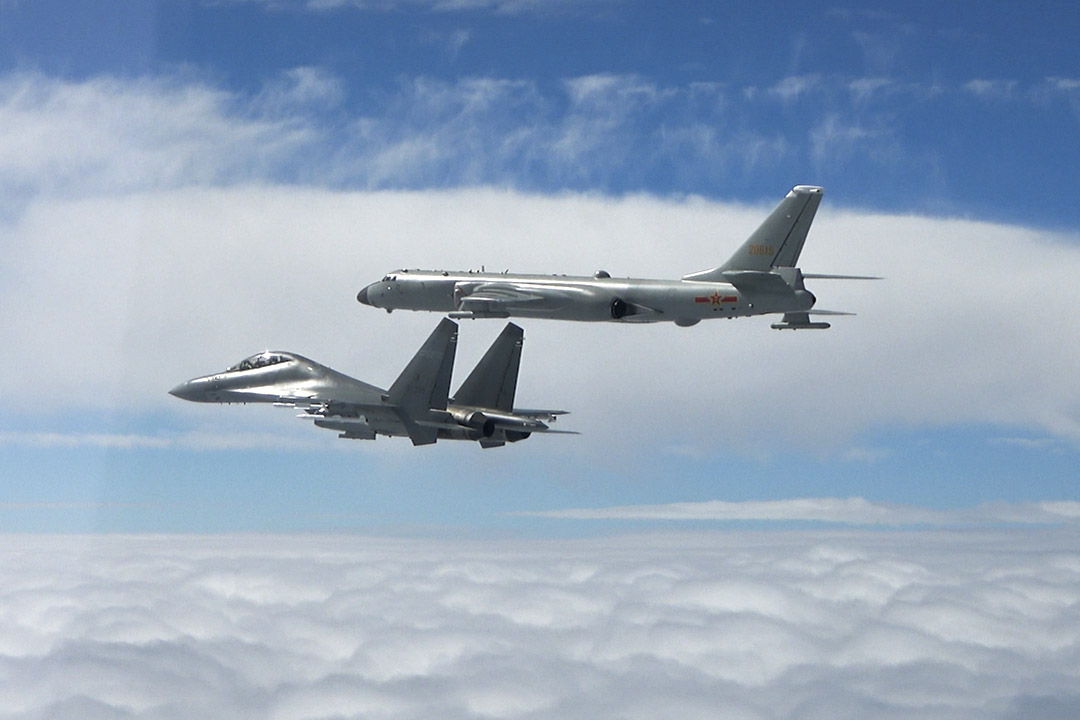
The recent joint patrol by the Chinese and Russian air forces demonstrated the improved capabilities of the People's Liberation Army Air Force in organizing sophisticated long-range operations that incorporate full combat elements, experts said.
Zhang Xuefeng, a military hardware observer and retired PLA Air Force officer, said that in recent years, the range of Chinese aircraft taking part in China-Russia joint strategic patrols has been steadily expanding, bolstered by improved performance and growing systemic operational capabilities.
Zhang said that the joint patrol on Saturday featured two major characteristics. First, it adopted systematic deployment of combat assets. Besides H-6K bombers and various escort fighter jets, the PLA Air Force deployed new large electronic warfare aircraft to deliver intelligence support, he added.
READ MORE: Chinese, Russian air forces carry out joint patrol
"The KJ-500A early-warning and control aircraft also took part in the operation, serving as an aerial command hub, while the YY-20A aerial refueling aircraft extended the flight radius of fighter jets and boosted their capacity to protect bombers," he said.
Second, the observer noted, the operation showed a high level of combat-oriented training.
"For example, escort fighters such as the J-16s carried live ammunition during the patrol. Electronic reconnaissance and jamming gear taken by the escort jets can effectively intercept foreign military radar signals for analysis and positioning, and can launch jamming operations in case of emergencies," Zhang added.
As part of the 11th joint strategic air patrol, aircraft from the two air forces flew over the Sea of Japan, the East China Sea and the western part of the Pacific Ocean.
The operation demonstrated the two sides' determination and capability to jointly safeguard regional peace and stability, the PLA Air Force said in a brief statement.
The PLA Air Force sent several types of aircraft, including the J-10C fighter jet, YY-20A refueling tanker, KJ-500A early-warning and control aircraft, and H-6K bomber, while Russia deployed its Tu-95 strategic bombers, Su-35 fighters and other planes.
ALSO READ: Russia says practical cooperation with China resilient amid external challenges
Wu Peixin, an aviation industry observer, said the advanced tactical and strategic electronic warfare jets participating in the operation are capable of conducting electronic suppression against enemy ground targets, most notably radar systems and air-defense missile installations.
"When required, they can launch anti-radiation missiles to strike high-threat air defense positions, creating a relatively secure environment for strategic bombers to conduct precision strikes against deep enemy targets," he said, noting that the deployment of the KJ-500A also marks a key highlight of the joint patrol.
"Currently the world's best medium-sized early-warning and control aircraft, the KJ-500A is fitted with a state-of-the-art digital array radar whose scanning is fully computer-controlled. Lighter in weight, equipped with more transmit/receive modules and boasting a longer detection range, the radar can effectively counter stealth targets and small low-altitude targets," Wu said.
Contact the writers at zhaolei@chinadaily.com.cn
