

New white paper underscores Beijing’s commitment to global governance amid divided world
The first quarter of the 21st century has offered several reminders of how volatile the world is. Multiple wars dotted the news. Poverty, food insecurity and economic displacement threatened millions of people. A global pandemic crippled humanity. And most recently, public officials and private citizens have warned about the dangerous potential of artificial intelligence.
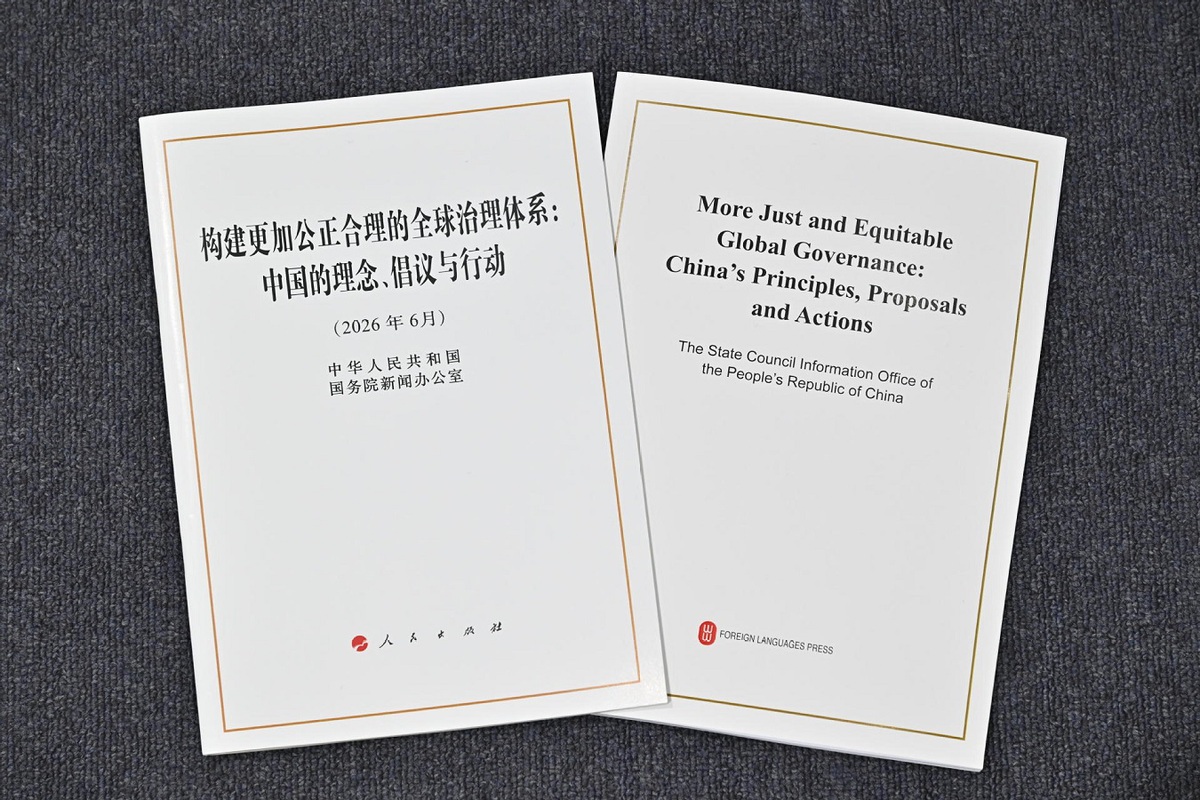
Amid these and other worries, China released a timely white paper titled “More Just and Equitable Global Governance: China’s Principles, Proposals and Actions” on June 17.
The document outlines the country’s vision of a brighter future, not just for developed nations, but crucially for the developing world.
READ MORE: China white paper urges joint efforts to build just global governance system
At its core is a call for “building a just and equitable global governance system”. Multilateralism, described as the “only viable path forward”, alongside major countries acting in a responsible manner, is seen as essential in enabling such an environment.
Nations must engage in consultation, cooperation and communication. Additionally, if nations prioritize “we” before “me” and affirm that each of the planet’s
8 billion people deserves domestic stability and international peace, then China’s often-stated goal of a shared future for humanity can be realized.
China’s Global Governance Initiative, or GGI, is frequently referenced in the white paper. Unveiled in September 2025, the initiative advocates for the international rule of law, supports multilateralism, places people at the center of all efforts and demands tangible solutions for real-world challenges.
World peace and global development are vital to the success of the GGI, which has already been endorsed by more than 160 nations. Releasing the white paper, Chinese Foreign Minister Wang Yi said the GGI “has evolved from a Chinese proposal into an international practice, and it is showing ever growing vitality”.
The white paper underscores a crucial point: No country, no matter how powerful, should place itself above the United Nations, which is described as the “most comprehensive, representative and authoritative international organization” that “plays an irreplaceable and vital role in global governance”.
China’s unwavering support for the UN has been regularly demonstrated. The white paper affirms that the UN should occupy its rightful position atop the global hierarchy of organizations tackling the world’s most vexing challenges.
China’s endorsement of the UN is especially critical now, as certain nations appear determined to undermine it financially and structurally.
The divisive rhetoric emanating from certain capitals contrasts sharply with the positive assessment by Beijing.
The white paper also outlines the proactive steps that China has taken on the global stage during this century. It brought together Iran and Saudi Arabia, restoring ties between these longtime adversaries.
It also remains resolute in not interfering in the domestic affairs of other nations and advocates for the economic wishes of the Global South. China recognizes the value of people-to-people exchanges.
Collectively, these actions clearly demonstrate, as the white paper states, that China continues to respond “to the common aspiration of the international community” while “addressing the most pressing issues in global governance”.
China rightfully deserves recognition for its commitment to global governance, yet it does not regard itself as superior to the UN or any other globally respected organization. It has repeatedly reaffirmed the paramount role of the UN in addressing global challenges.
ALSO READ: Principles, proposals and actions aimed at better global governance
Why do China’s recent achievements matter? Because, frankly, few other nations are stepping up to do the same. The United States has intentionally reduced its global presence. Europe is grappling with a corrosive nationalism and sluggish growth. Japan continues to show a reckless disregard for history as it commits itself to a militaristic future. Meanwhile, no other nation, or bloc of nations, can move the needle.
On the other hand, China is acting responsibly. Through the four global initiatives — the Global Development Initiative, Global Security Initiative, Global Civilization Initiative and Global Governance Initiative — announced in recent years, President Xi Jinping has articulated a vision for a much better future for the world.
The current generation will benefit, and perhaps the next generation could embrace a world in which reliability replaces recklessness.
The author is an associate professor in the Communication and Organizational Leadership Department at Robert Morris University in Pennsylvania, US.
The views do not necessarily reflect those of China Daily.
