

Despite obstacles imposed by DPP, event still enables further exchanges
Editor's note: The Taiwan question is a key focus for China and the international community. China Daily is publishing a series of reports to track hot Taiwan-related topics and address disinformation from the Democratic Progressive Party administration.
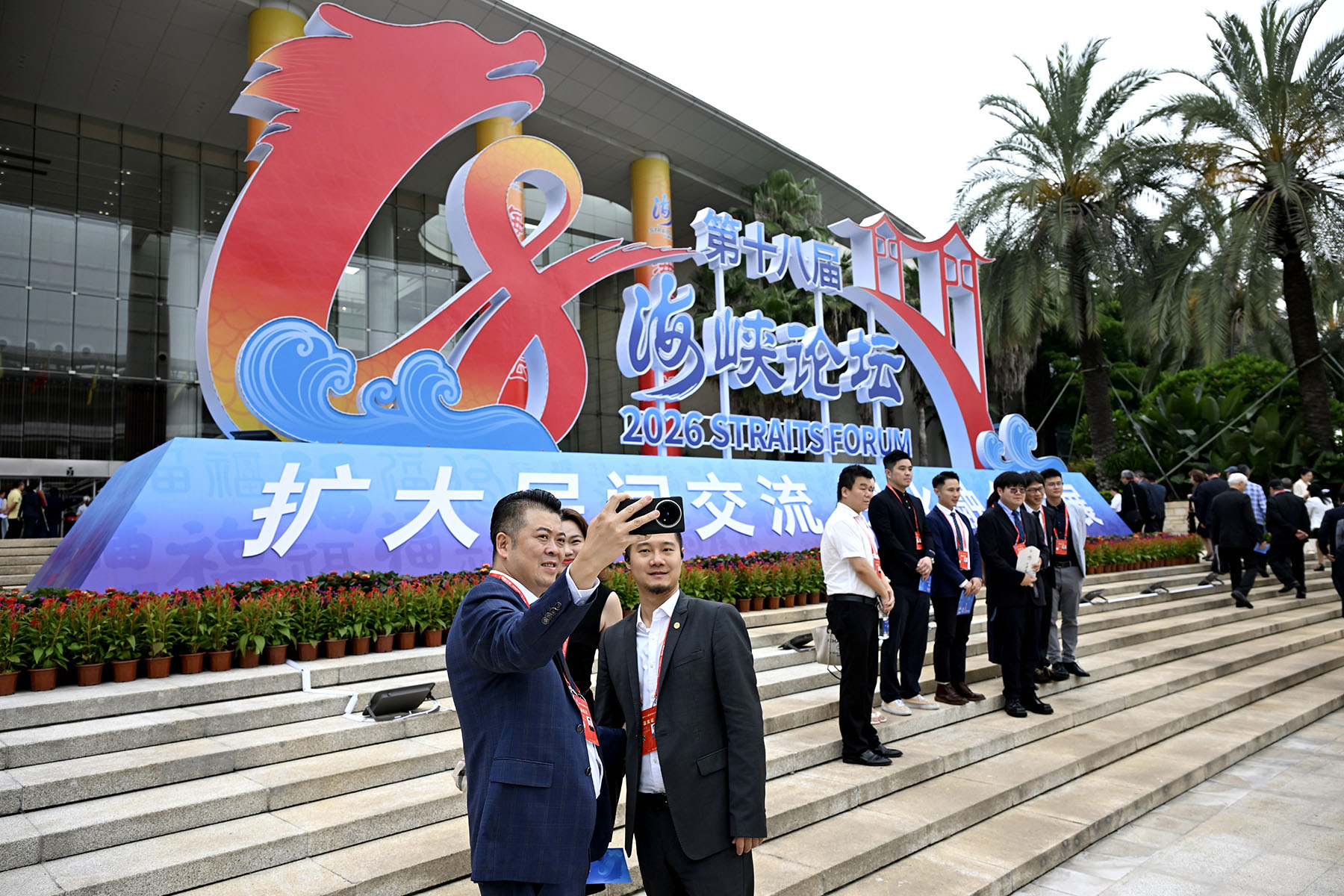
The deep-seated momentum of cross-Strait economic and cultural integration remains resilient — actively driven by the Chinese mainland's fusion efforts — despite political barriers imposed by Taiwan authorities, according to attendees of the 18th Straits Forum held in June in Xiamen, Fujian province.
As the largest mainland-hosted platform for grassroots exchanges between the two sides of the Strait, the annual event gathered compatriots across industries to advance diverse cooperative achievements.
The event with over 30 activities attracted over 6,000 compatriots from Taiwan, including a large number of young people and first-time visitors, despite the strictest restrictions and obstructions imposed by Taiwan's ruling Democratic Progressive Party authorities.
READ MORE: Straits Forum highlights peace, exchange, rejects separatism
In a milestone development, mainland enterprises signed purchasing agreements with businesses and trade associations from Taiwan's agricultural counties, including Taitung, Yunlin and Nantou, to import specialties such as pomelos, tea and aquatic products.
This cross-Strait procurement initiative delivers tangible dividends directly to grassroots farmers and fishermen on the island.
Around 120 industry professionals witnessed the signing. Yang Chichun, vice-chairman of the Taiwan Agricultural United Marketing Cooperative, celebrated an atemoya fruit contract with Hunan province, saying that it is a joy to bring the hardworking farmers' fruits into the vast mainland market.
In April, a 10-point policy package was released by the Chinese mainland's Taiwan Affairs Office of the State Council, which focused on increasing cross-Strait flights, tourism, agricultural trade and other aspects vital to the welfare of the ordinary people of Taiwan.
The DPP authorities, however, have attempted to suppress exchanges, with their mainland affairs authority labeling the forum a tool for "penetration and division".
Due to blocks imposed by the DPP, Yao Ching-ling, the magistrate of Taitung county, was barred from attending in person and had to deliver her speech via a pre-recorded video during the signing ceremony.
Chang Jung-kung, vice-chairman of the Chinese Kuomintang, called the ban on local magistrates attending the forum a great regret, noting that agricultural cooperation is the most pragmatic way to enhance the livelihoods of Taiwan residents.
"Taiwan farmers and fishermen market their products to the mainland simply to make a living. To smear and suppress them for this is absolutely against justice," Chang said.
Recent reports from Taiwan media revealed that peanut harvest prices in Yunlin county — the island's largest peanut-producing region — have plummeted, possibly due to widespread panic among local growers over potential zero-tariff peanut imports from the United States under recent trade frameworks.
Chen Binhua, spokesman for the State Council Taiwan Affairs Office, said: "The DPP authorities disregarded the farmers' anxieties, made nothing more than a perfunctory effort, showing that the DPP is completely helpless. This fully exposes their governance incompetence and proves that blindly kneeling to the US will only harm the interests of Taiwan's various sectors."
Chen added that the new agreements with the mainland would allow agricultural products from relevant Taiwan counties to enter the mainland market more conveniently, boosting incomes for farmers in central and southern Taiwan.
"The DPP authorities act out of political self-interest, jumping out to smear and attack the forum every year, and this year they went even further to restrict and obstruct participants," Chen said. "But the more they disrupt, the more they fail."
Song Tao, director of the Taiwan Affairs Office, reiterated at the forum that peace, stability and the welfare of Taiwan compatriots can only be guaranteed by adhering to the 1992 Consensus and opposing "Taiwan independence" separatism.
Business and industrial leaders attending the forum urged Taiwan enterprises to actively leverage existing preferential policies and look toward more cooperation.
Lee Cheng-hung, president of the Association of Taiwan Investment Enterprises on the Mainland, said:"The DPP authorities are highly contradictory; they claim to value public livelihood but impose highly irrational and self-contradictory restrictions."
Lee said that growing cross-Strait trade shows the two sides are "stronger together", urging entrepreneurs to expand into emerging industries on the mainland, including semiconductors, the low-altitude economy and artificial intelligence.
Chou Hsi-wei, vice-chairman of the Want Want Group from Taiwan, also said that the desire of compatriots on both sides for peace and integration cannot be stopped.
"Obstructing freedom of assembly and trade violates basic rights and is completely wrong, and 'Taiwan independence' is a dead end," Chou said.

Fostering integration
Beyond economic pacts, physical and institutional links topped the agenda as participants explored new integration pathways. Cross-Strait infrastructure projects were highlighted at the forum this year, as a rising number of Taiwan visitors called for closer economic integration despite political barriers.
Taiwan attendees toured major developments in Xiamen, including the ongoing Xiamen Xiang'an International Airport and Xiamen-Jinmen Bridge projects.
Wang Chao, head of the Xiamen section project of the bridge, said:"Once completed, the bridge will end the history of Jinmen residents waiting for ferries and favorable weather. It will drastically boost traffic efficiency and transport capacity for people and goods."
Wang added that the bridge structure will also carry pipelines to supply water, electricity and gas to ease energy shortages on Jinmen.
The new Xiamen airport, scheduled to open by the end of this year, sits just across the water from Taiwan-administered Jinmen.
Li Sheng-feng, vice-chairman of Taiwan's pro-reunification New Party, said: "Tens of millions of passengers will land right on the opposite shore every year. If artificial barriers block us from linking up, Jinmen will miss an immense development opportunity."
Li blamed Taiwan's ruling DPP for restricting opportunities for young people by distorting the mainland's image. "The DPP has no right to make choices for young people. Enabling them to see the real mainland is being responsible for their future," Li said.
Chai Hsuan, a Taiwan vlogger who has documented the Xiamen-Jinmen bridge construction site multiple times, said younger generations in Taiwan increasingly view "Taiwan independence" as a false proposition.
"They prefer to join the mainland's progress," Chai said, noting recent milestones such as Hong Kong astronauts joining the mainland's space program. "Taiwan talents need platforms to seize these opportunities."

Young bonds
Political barriers have failed to dampen the enthusiasm for travel, as official data points to an accelerating recovery in personnel exchanges. Fujian entry ports recorded 518,000 arrivals from Taiwan from January to May, marking a 29.7 percent surge year-on-year.
To facilitate closer integration, 19 pairs of cross-Strait youth organizations signed partnership agreements alongside the release of 23 cooperative projects during the forum in Xiamen.
In the financial sector, the event saw the release of the mainland's first-ever group standard for banking services tailored for Taiwan enterprises to help them more easily enter the mainland market.
For maritime and cultural cooperation, authorities announced five new measures to boost cross-Strait shipping, while Fujian province introduced Taiwan television dramas into prime-time satellite broadcasting slots.
Young Taiwan visitors at the forum welcomed these policies and noted the stark contrast between their experiences on the mainland and the political rhetoric in Taiwan.
An Chen-chu, a Taiwan youth, recalled her surprise at discovering mainland digital payment systems and said: "The DPP authorities are blocking our channels to see the world. I told people back home how convenient it is to go out with just a phone instead of a heavy wallet."
Chen Yi-xuan, another young attendee from Taiwan, expressed her excitement at seeing mainland actor Zhang Linghe, whose recent historical drama has become a major hit on the island.
ALSO READ: Importance of exchanges highlighted
Mentioning several mainland period dramas also popular in Taiwan, she said, "Traditional aesthetics and Chinese cultural heritage share a profound resonance across the Strait because our culture stems from the same roots.
"Culture serves as an excellent bridge. Since Taiwan's roots are in the mainland, I hope more young people will return to explore their heritage, allowing both sides to interact and integrate like family," Chen said.
Su Heng, a Taiwan political commentator, said the DPP tried to obstruct the Straits Forum out of fear that island residents will witness the mainland's rapid development and see through the falsehoods fabricated by the party.
Su cited two recent Taiwan polls showing that public support for "independence" has dropped to a record low of 21 percent, while nearly 60 percent back proactive peace consultation with the mainland.
The public narrative in Taiwan is changing as people witness the mainland's growing global strength, Su said, adding that shifting US policies have triggered widespread skepticism toward the US.
