

Editor’s note: A new wave of entrepreneurship is sweeping across the Chinese mainland, driven by the rapid rise of AI-powered one-person companies. The first article in this series explores whether this represents an opportunity for solo entrepreneurs in the AI era, or is a policy-fueled bubble.
One-person companies are mushrooming across the Chinese mainland, fueled by artificial intelligence and supportive government policies. But industry experts have warned of a market shakeout amid stiff competition, while a mature entrepreneurial system for the sector has yet to emerge. Zhou Mo reports from Shenzhen.

In a cramped 25-square-meter office at SegMaker — an entrepreneurial incubator nestled in Shenzhen’s bustling Huaqiangbei electronics hub — Li Xinyu sits, surrounded by a dozen secondhand MacBook laptops. He logs inventory on a business management system while his artificial intelligence assistant crunches sales data and generates product visuals for e-commerce storefronts.
The young entrepreneur sources used Apple notebooks from digital recycling platforms, runs quality inspections on every device, and resells them to consumers through e-commerce giant JD.com’s secondhand marketplace. He handles every link in the chain himself — from sourcing, testing, product listing and packaging to after-sales services.
“I’ve never imagined I could run a company all by myself. But, with the help of AI, what once seemed impossible has become reality,” says Li.
With some experience in quality inspection, procurement and operation, Li quit his job as a corporate employee and set up Shenzhen Wanwu Xinghe Technology Co in March this year. His venture is part of a fast-growing wave of one-person companies (OPC) sweeping across the Chinese mainland’s entrepreneurial landscape.
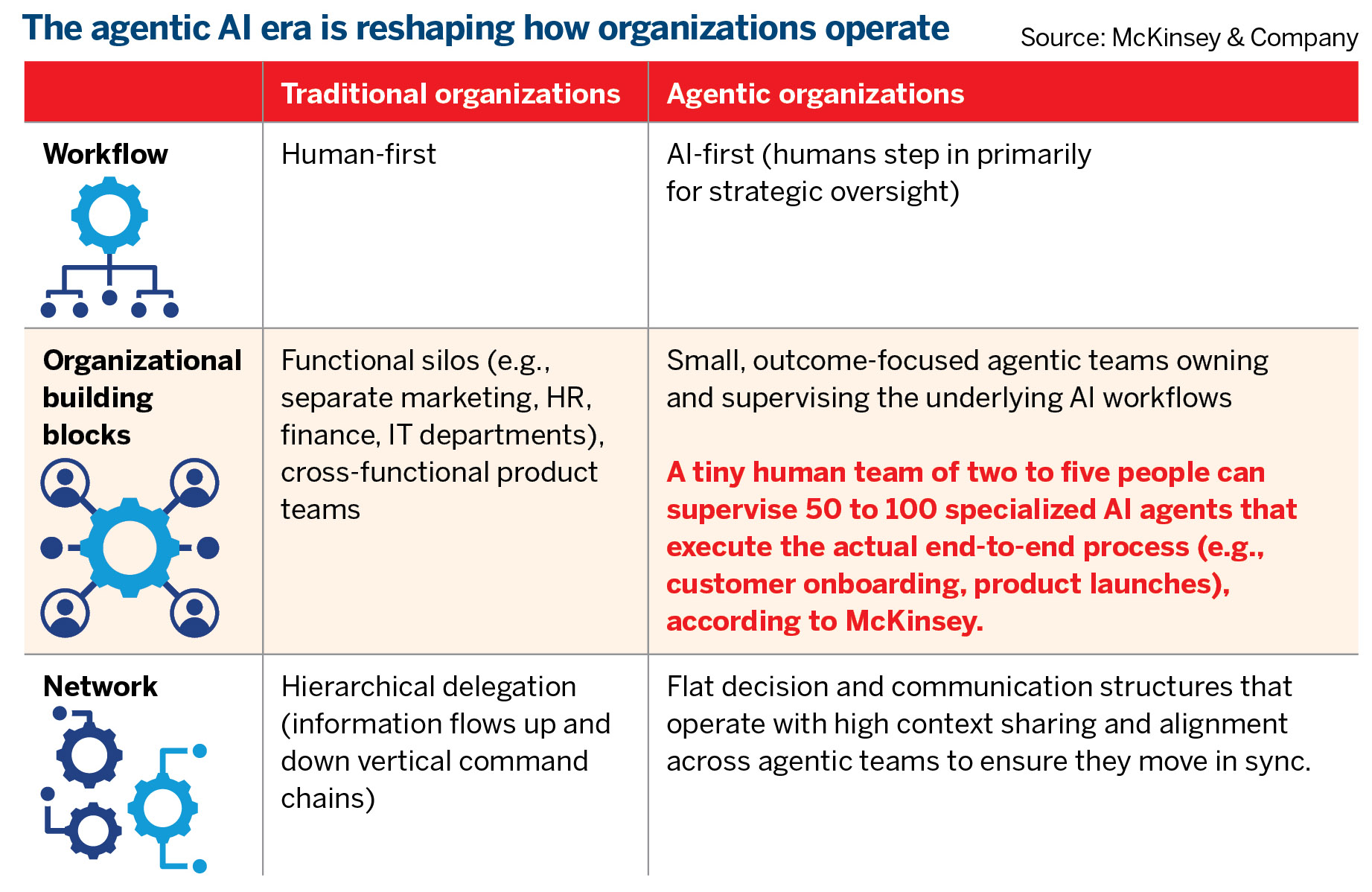
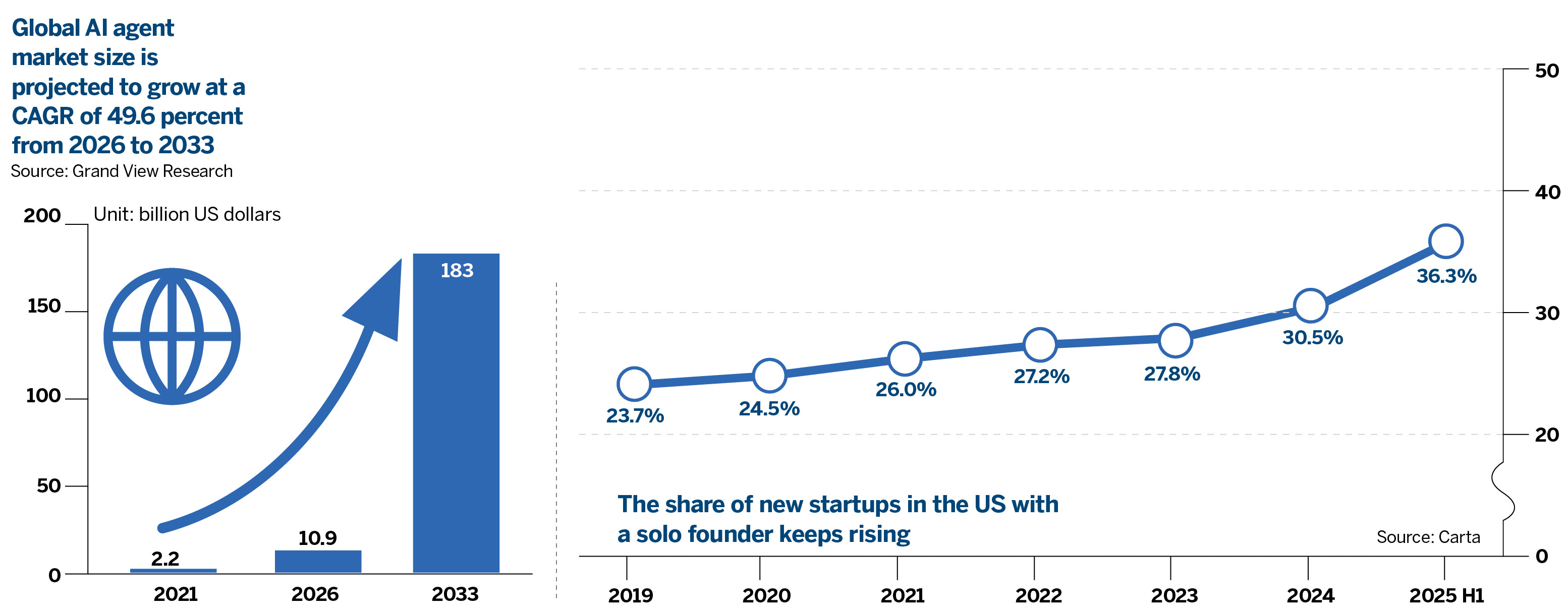
Harnessing AI for growth
An OPC is a lightweight, limited-liability legal entity run by the founder, widely enabled by AI to automate product design, content creation, customer services, and operational management. Distinct from traditional self-employment, an OPC holds a formal corporate status, shields its founder with limited liability, and is subject to standard corporate income tax rules.
AI’s rapid advancement has laid solid ground for this new form of entrepreneurship and sparked a fresh wave of momentum nationwide. According to a report by the Zhongguancun Talent Association in Beijing, the number of OPCs in China hit 16 million as of June last year, taking up 27.4 percent of the total number of companies in the country. The number of newly registered OPCs surged 47 percent year-on-year to 2.86 million in the first half of 2025, accounting for 23.8 percent of the country’s total number of new company registrations.
Local governments on the mainland are betting on OPCs as a new engine for boosting employment and driving innovation, with cities rushing to introduce supportive policies since the start of the year.
The southern tech hub of Shenzhen launched an action plan in January aimed at setting up over 10 nationally leading OPC communities by the end of 2027, with each spreading over at least 10,000 square meters, and fostering more than 1,000 high-growth AI startups.
Hangzhou — capital city of East China’s Zhejiang province — unveiled a guideline in April, pledging to support the development of OPCs “in their whole life cycle”, with policies covering company registration, administrative guidance, intellectual property protection, and credit-based financing. Wuhan in Central China’s Hubei province has also introduced 10 measures to help OPCs grow with data, talent, community and financial support.
ALSO READ: One-person companies rise in popularity, gain policy support
Yet, for all the widespread fanfare, a critical question lingers. Is the OPC boom a transformative economic trend ushering in an era of AI-powered solo entrepreneurship, or a policy-fueled bubble set to end in a wave of high failures?
Stretching over 10,000 square meters and split into eight satellite venues scattered across Huaqiangbei, SegMaker stands as a quiet cradle for Shenzhen’s newest wave of solo entrepreneurs. Nearly 100 OPCs fill its corridors, with an occupancy rate of over 80 percent.
Inside one sprawling venue, high-ceilinged floors are sliced into a grid of tiny, partitioned work cells. The smallest measures just five square meters — just enough to accommodate a desk and a chair. Outside every unit, a simple printed company name is affixed to the door, with a newly hatched enterprise staking its claim.
This is where Huaqiangbei’s OPCs are born. They take their first tentative steps within these micro offices, leveraging the area’s unrivaled electronics supply chain to gain traction, and expanding until they outgrow their cramped quarters, upgrading to larger workspaces as their businesses pick up beyond the confines of a tiny startup nook.
Li’s firm is among them. For the 25-year-old entrepreneur, the decision to quit his full-time job and start his own business wasn’t a spontaneous gamble, but a deliberate, calculated choice grounded in policy and industrial strengths.
“The biggest incentive for me to start an OPC is the government’s tailored policy support for entrepreneurs, plus Huaqiangbei’s complete electronics-industry chain,” he says.
Previously costing 3,000 yuan ($443) in monthly rent, Li’s workspace is eligible for a three-year tiered rent subsidy under government policy. He only needs to pay 1,560 yuan per month in the first year, 1,200 yuan monthly in the second and 900 yuan per month in the third.
Backed by policy perks and Huaqiangbei’s industrial advantages, his startup gained traction in the initial stages, raking in 300,000 yuan in sales for April — the second month of its operations.
For others, the entrepreneurial journey is far less forgiving. Wang Jiayi founded an e-commerce OPC in May last year, selling Apple smartwatch straps, but has been struggling to make ends meet.
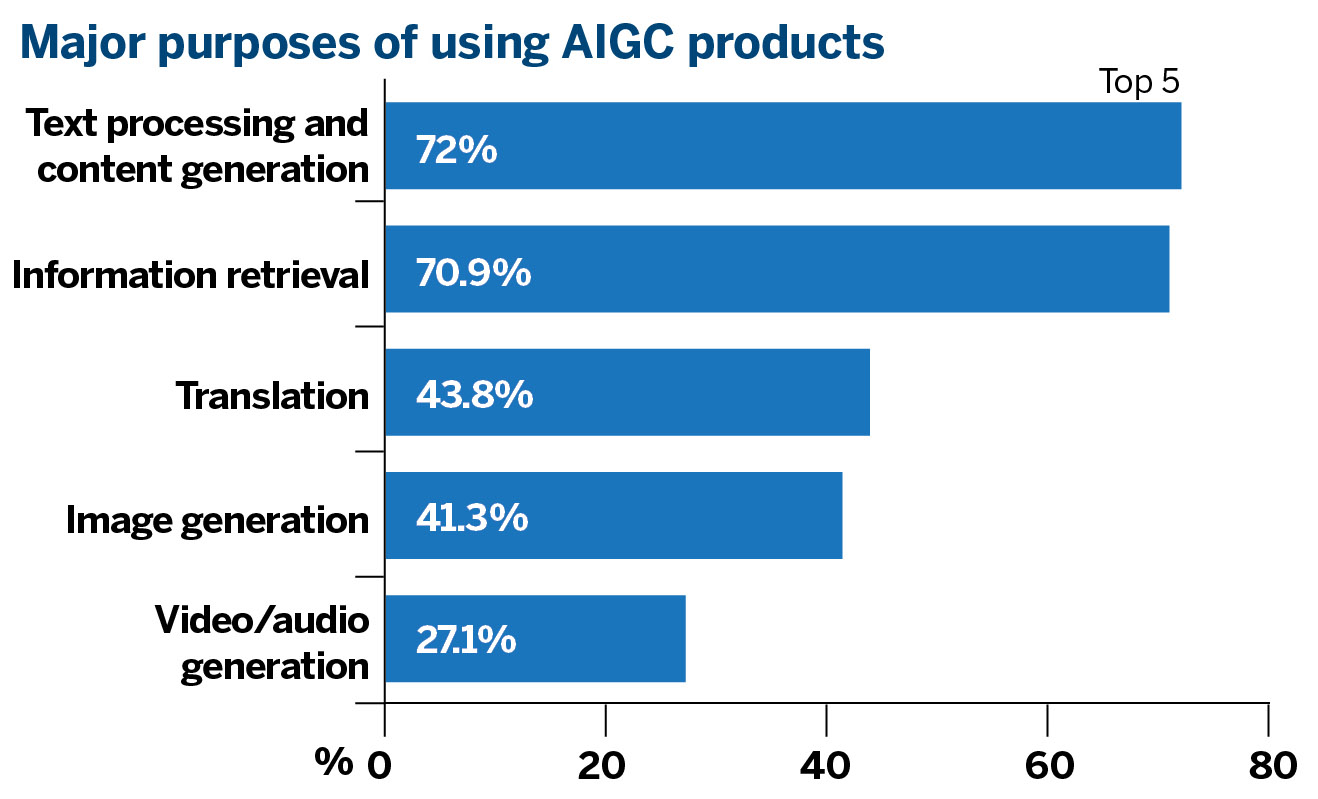
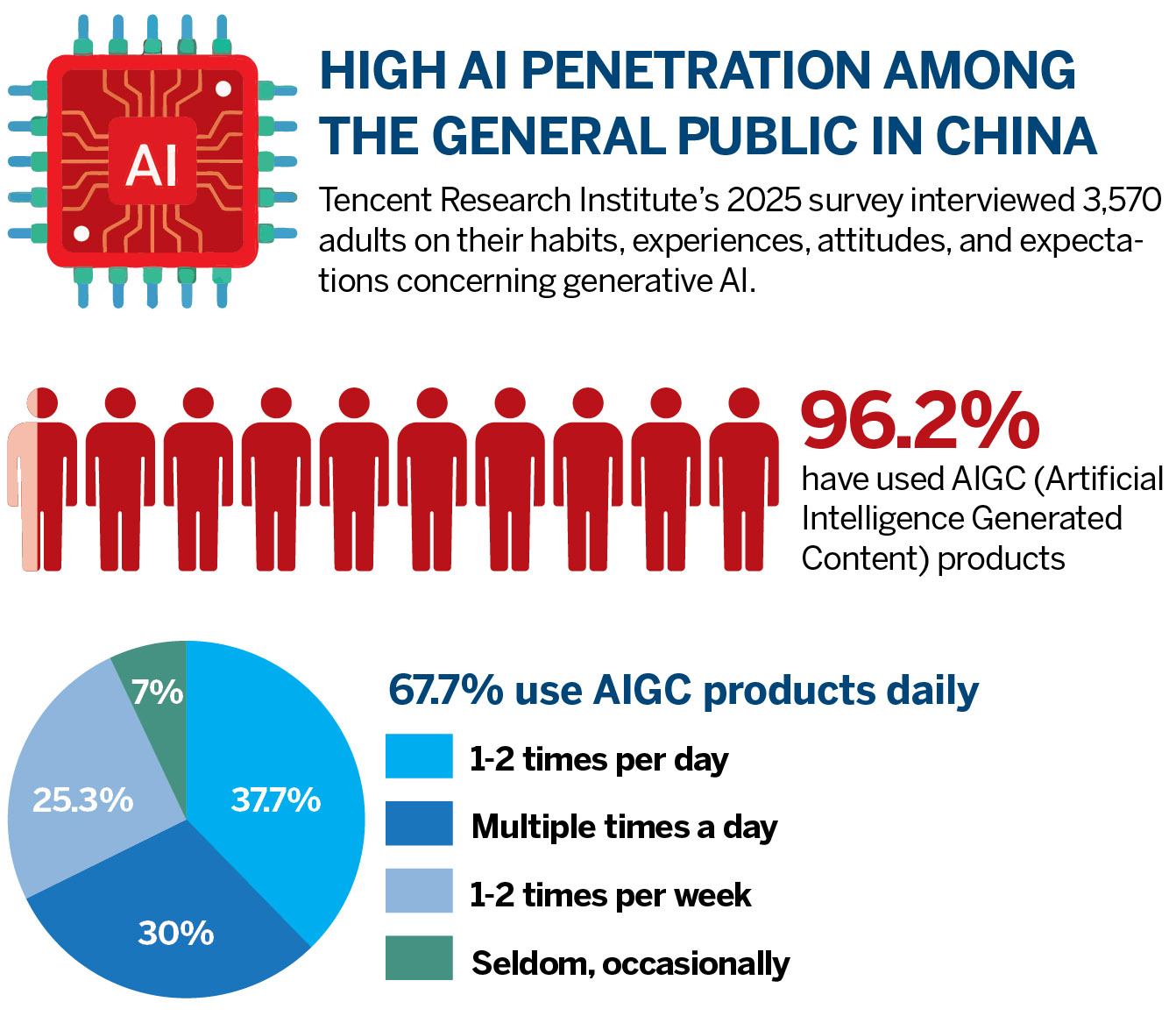
“I only got five orders on the day my online store started. Now, an average daily volume of roughly 100 orders still translates into meager earnings,” she sighs. “Everyone uses the same AI tools to generate product introduction, edit images, and manage store operations, so there’s almost no particular advantage. We can only compete in pricing which keeps profit margins squeezed razor-thin.”
Challenges amidst opportunity
According to Wang, several of her friends who have launched OPCs are also struggling to sustain their businesses and keep their heads above water.
“The public hype around AI-powered OPCs makes it look easy, but the real survival pressure is overwhelming. It’s never as simple as letting AI run the business and waiting for profits,” she laments. “For OPCs without stable supply chain resources and brand exposure, sustaining long-term profitability is incredibly tough amid fierce market competition.”
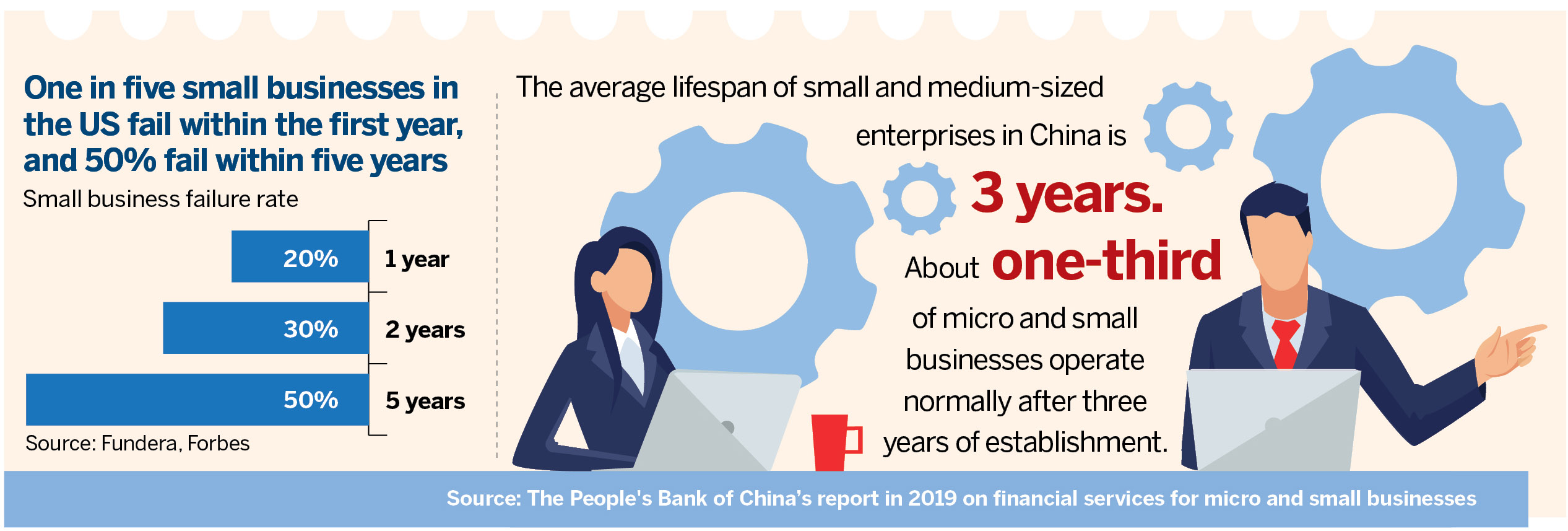
According to a report by tech news platform Huxiu, citing research data from financial news outlet Caixin, four in 10 OPCs fail due to the challenge from customer acquisition. Without a steady client base, even cutting-edge AI tools and premium services can’t generate real revenue.
ALSO READ: AI drives boom in one-person companies nationwide
Another 40 percent of OPC founders keep up a busy front, but lack core operations and a viable business model, masking poor earnings by pretending to run a business, the report said.
“Entrepreneurs face fierce peer competition in every dimension of their products, including pricing, quality, and after-sales services. Sourcing problems, hurdles in securing reliable suppliers, along with financing constraints, remain major pain points for OPCs in their day-to-day operations,” says Yan Zhenqiang, director of operations at SegMaker.
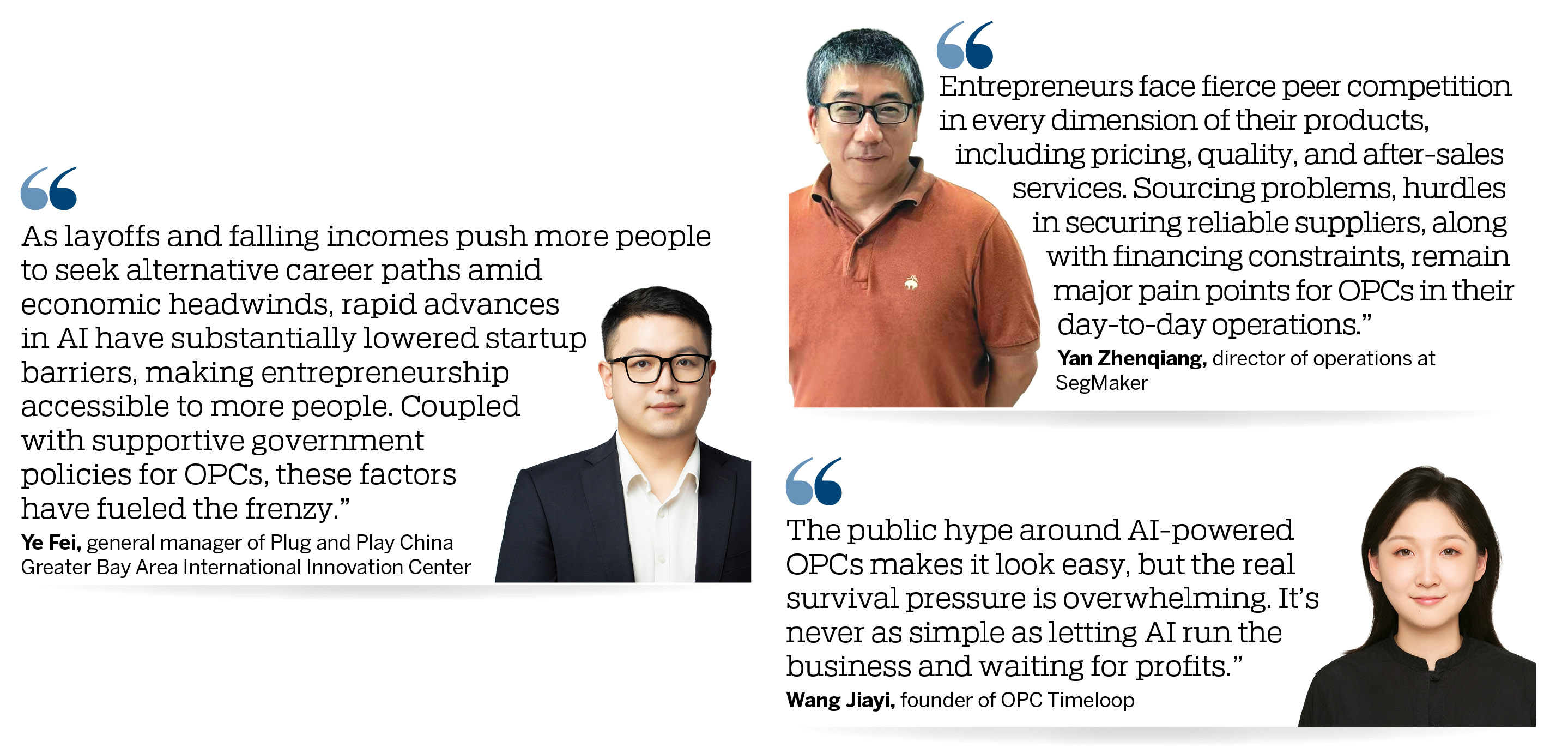
Ye Fei, general manager of Plug and Play China GBA International Innovation Center, attributes the OPC boom to three key driving forces.
“As layoffs and falling incomes push more people to seek alternative career paths amid economic headwinds, rapid advances in AI have substantially lowered startup barriers, making entrepreneurship accessible to more people. Coupled with supportive government policies for OPCs, these factors have fueled the frenzy.”
He notes that China is still in the early stages of nurturing a mature OPC entrepreneurial ecosystem.
“The country’s long-term vision is to cultivate a few industry leaders from the OPC ecosystem. But, before the towering trees can take root, the ground must first be nourished. The priority is to ‘grow the grass’ by creating a vibrant base of grassroots one-person ventures to enrich the overall entrepreneurial landscape,” he says.
While OPC development has yet to enter a phase of brutal saturation, Ye believes a market shakeout is inevitable in the long run.
“When the industry matures and consolidates, only OPCs with solid core capabilities, sustainable business models and a clear market direction can stand the test of time and emerge as the ultimate survivors.”
Contact the writer at sally@chinadailyhk.com
