

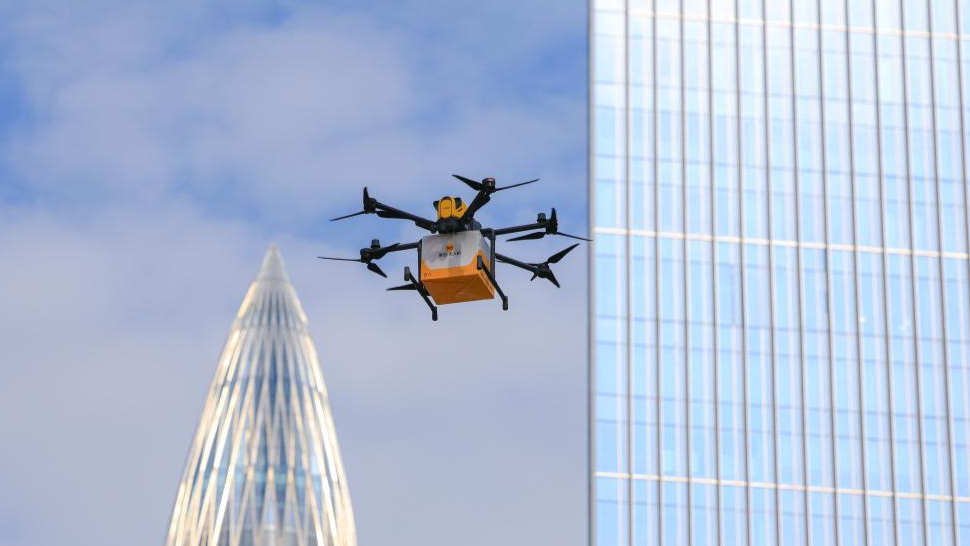
Commercialization of the cross-boundary low-altitude economy in the Guangdong-Hong Kong-Macao Greater Bay Area has moved a step forward with the recent launch of China’s first cross-boundary insurance policy for ultralight electric vertical takeoff and landing (eVTOL) aircraft.
A tech company based in Shenzhen’s Qianhai special economic zone has secured over HK$20 million ($2.55 million) in coverage for its S-Zero eVTOL model.
The product, jointly delivered by People’s Insurance Co (Group) of China Ltd (PICC) Shenzhen branch and PICC (Hong Kong) Co Ltd, adopts an innovative model of underwriting in Shenzhen and policy issuance in Hong Kong. The policy covers equipment damage and third-party liability insurance.
Under Hong Kong’s regulations, compliant aviation insurance is a mandatory prerequisite for all flight operations. However, regulatory and operational differences between Shenzhen and Hong Kong have made traditional aviation insurance incompatible with ultralight eVTOL operations, creating a barrier that barred mainland firms from conducting flights in Hong Kong.
The breakthrough, by addressing the difficulty, will help promote the commercialization of the cross-boundary low-altitude economy in the Greater Bay Area.
The low-altitude economy, which is an integral part of China’s new quality productive forces, is playing an increasingly important role in driving the country’s economic growth. According to the estimate from the Civil Aviation Administration of China, the market size of China’s low-altitude economy hit 1.5 trillion yuan ($221 billion) in 2025 and is expected to be 3.5 trillion yuan by 2035.
The Hong Kong Special Administrative Region is also doubling down on the low-altitude field as part of its push to integrate itself into the nation’s overall development.
According to a joint announcement by Hong Kong’s Logistics and Supply Chain MultiTech Research and Development Centre and a lab under the central government’s Ministry of Industry and Information Technology earlier this year, the Shenzhen-Hong Kong low-altitude logistics regulatory sandbox pilot program is expected to be launched this month. The project will apply for cross-boundary flight permits and carry out routine trial flights upon sandbox approval, with flight openings expected within this year.
The Office of Port of Entry and Exit of Shenzhen Municipal People’s Government revealed plans to prioritize the testing of three cross-boundary drone delivery routes — Shekou to Tuen Mun, Wenjindu to Sheung Shui, and an internal route in the Hetao Shenzhen-Hong Kong Science and Technology Innovation Cooperation Zone. All the routes are expected to be launched this year.
Wen Yajing, executive director of the Department of Hong Kong, Macao, and Regional Development at Shenzhen-based think tank China Development Institute, said cross-boundary pilot programs should be prioritized in fields with clear market demand, mature technical support, and controllable safety risks.
For example, regular transportation services for high-value research samples and emergency medical supplies between Shenzhen and Hong Kong as well as between Zhuhai and Macao could be explored, she said.
Joint efforts could also be made to develop cross-boundary sightseeing tourism routes so as to create cultural and tourism brands featuring Greater Bay Area characteristics, she added.
Hendrick Sin, a deputy to the National People’s Congress from Hong Kong, said that difficulties in cross-boundary flights between Hong Kong and Shenzhen lie in airspace management and coordination as the two cities operate under different management systems, and so cross-boundary flights need approvals from both mainland and Hong Kong authorities.
He suggests that institutions and mechanisms covering airspace management, flight-route declaration, and customs clearance supervision between the two cities be established to carry out trial drone flights.
Then, a whitelist system for enterprises and cargo should be rolled out in phases, with certified enterprises and low-risk goods subject to registration-based management to streamline approval procedures, thereby promoting regular cross-boundary logistics services, he added.
