

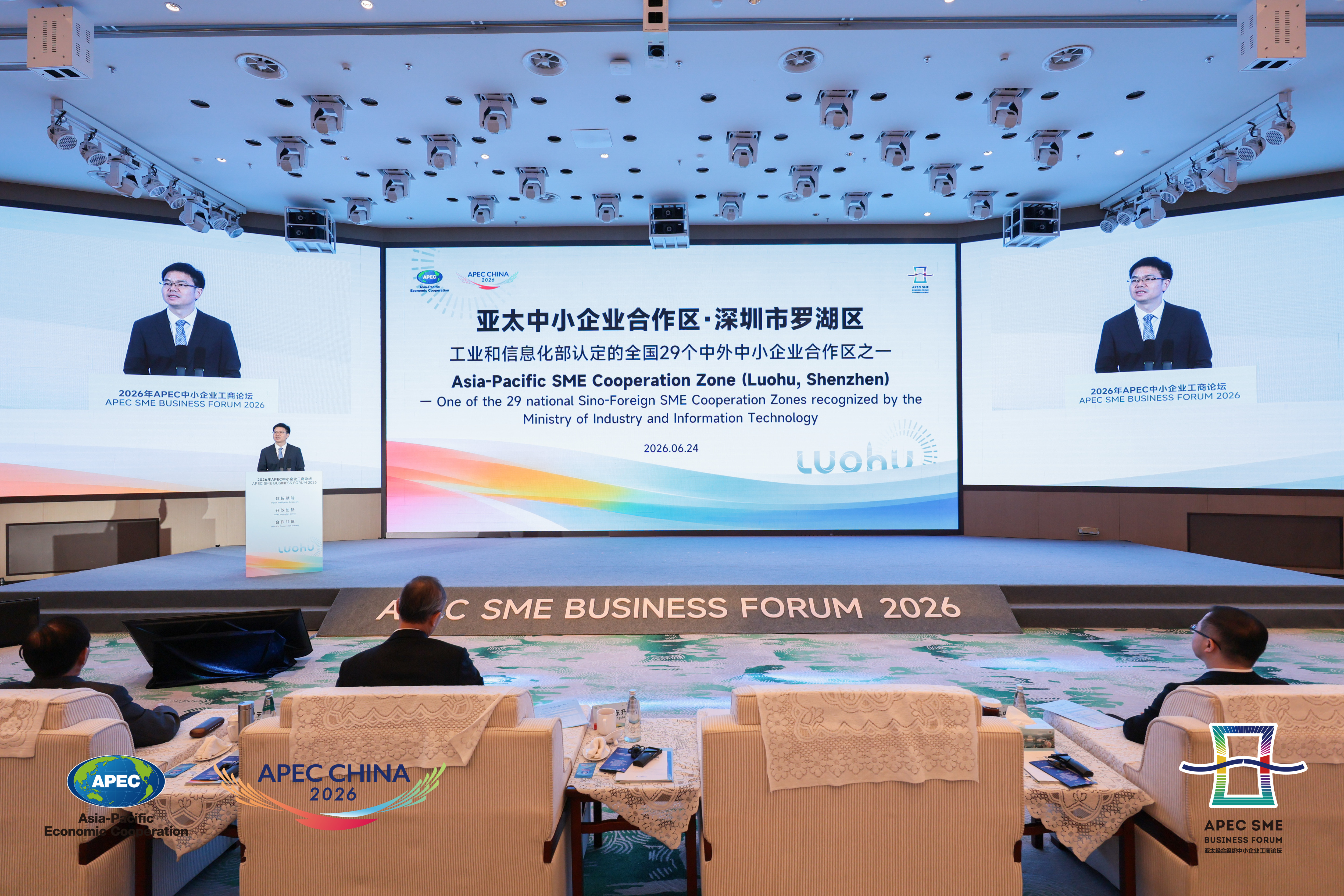
Highlighting the importance of small and medium-sized enterprises (SMEs) to the local economy, business leaders in the Asia-Pacific region called for strengthening digital transformation, resources integration, and commercialization support to accelerate their high-quality growth.
They made the remarks on Wednesday during the APEC SME Business Forum 2026, a three-day event for APEC economies to boost cooperation and tap opportunities in Shenzhen. As China’s innovation hub, the city will host this year’s APEC Economic Leaders' meeting in November.
Li Ying, chairman and general manager of Shenzhen Enrigin Technology, a semiconductor manufacturer that focuses on strengthening the independence of China's artificial-intelligence chip supply chain, stressed the significance of lowering the barrier to AI adoption for SMEs.
She said that micro, small, and medium enterprises account for 97 percent of the total number of enterprises in the Asia-Pacific region, and 86 percent of business managers believe that AI will transform entrepreneurial operations.
However, unlike large enterprises, SMEs are more concerned about the cost, security, and reliability of AI products. She proposed jointly developing low-cost service packages that integrate computing power, industry models, software tools, and training services for use by SMEs.
She also said she hopes that APEC economies will build a shared AI application ecosystem focused on high-frequency application scenarios such as manufacturing and trade, as well as establish trustworthy rules to strengthen the regulation of AI tools.
Adi Tegar Surya, vice president of the Indonesian Industrial Park Association, highlighted the role of industrial parks in helping SMEs integrate into the regional industrial ecosystem for inclusive and balanced development.
He said that as key platforms that connect large, medium, and small enterprises and bring together capital, technology, and talent, industrial parks hold irreplaceable strategic value in boosting the economy.
Indonesia has over 175 industrial estates, and their manufacturing accounts for 19 percent of the country’s GDP, he added. Currently, these estates are prioritizing investments in the food and beverage, pharmaceutical, cosmetics, electronics, textile and fashion, and halal logistics sectors.
He called on Asia-Pacific economies to increase investment in industrial parks and work together to promote industrial synergy in the region.
ALSO READ: Guangdong and Indonesia deepen ties under APEC
Kong Seong-hyun, secretary-general of Korea Initial Investment Accelerator, said that South Korea’s public-private partnership has played a crucial role in linking startups with venture capital, easing the companies’ pressure in securing funding and resources.
He believes that such an innovative initiative, enabled through the coordinated efforts of policymaking and market mechanisms, has strong potential for replication. It could serve as a reference and provide policy insights for Asia-Pacific economies to further improve their startup support frameworks and unlock SMEs’ innovation potential.
The APEC SME Business Forum has been held in China six consecutive times. This year’s event is attended by 75 international guests from 13 APEC economies. As the host venue for this year’s forum, Shenzhen’s Luohu district established the Asia-Pacific SME Cooperation Zone last year, which is designated one of China’s 29 Sino-foreign SME cooperation zones.
During the forum, numerous business and research institutions from China, South Korea, Indonesia, and other countries signed strategic cooperation agreements in areas such as the commercialization of scientific and technological innovations, the operation of cross-border industrial parks, and internationalization services for enterprises.
Representatives from the APEC economies will continue their Shenzhen visit on Thursday, exploring local strength in sectors such as AI and robotics.
