

Province's recent innovations in manufacturing, mobility going global, showing further growth possibilities
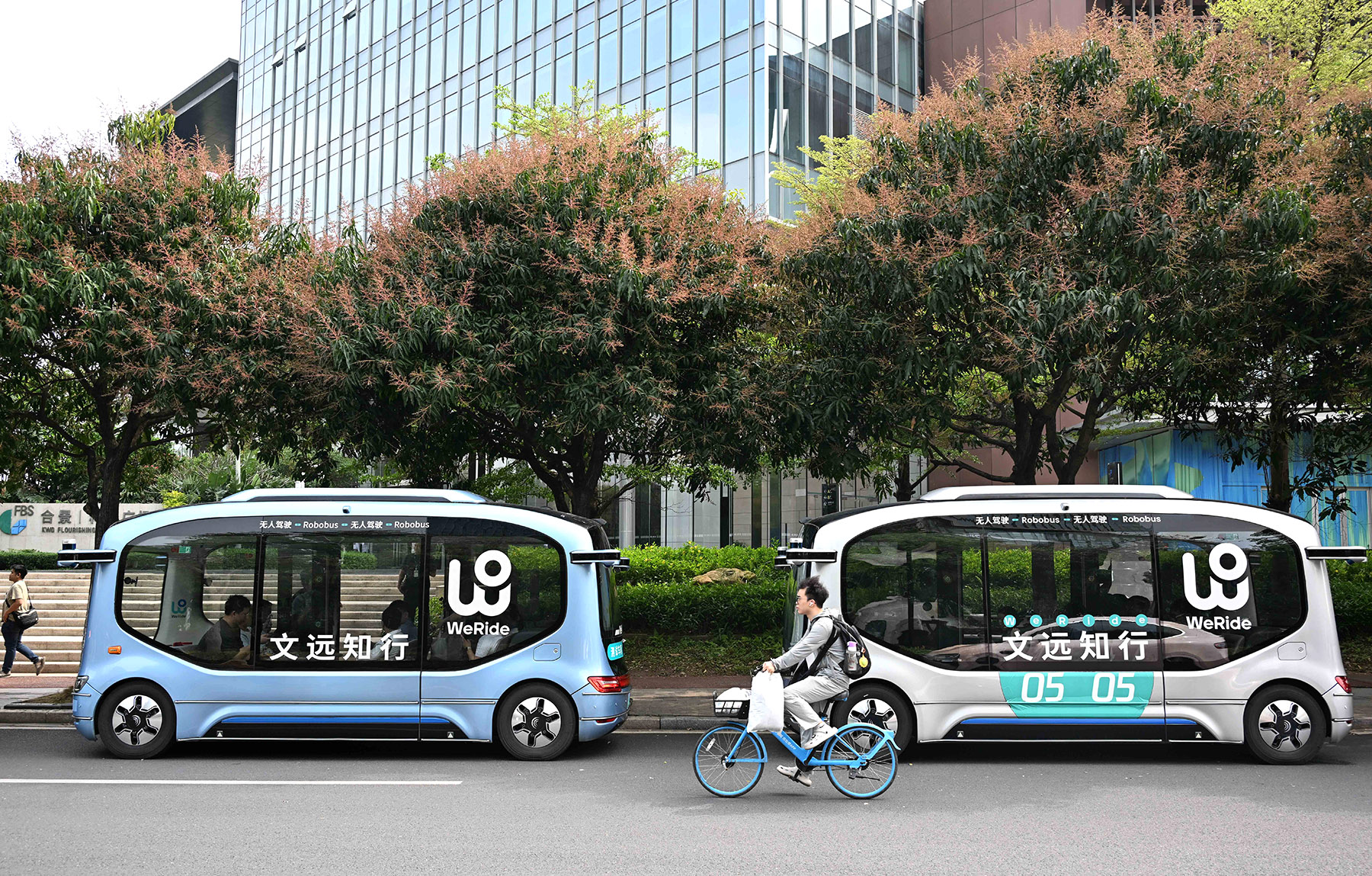
A driverless robotaxi glides through the streets of Guangzhou, Guangdong province, slowing to pick up a passenger before merging back into traffic. Roughly 70 kilometers away in Dongguan, robotic arms work in harmony on an assembly line, while in Shenzhen, an engineer uploads a circuit design to an online platform, and within hours the first prototype is already entering production.
Though these technologies appear to belong to different industries, they share one thing in common: many are being developed by private enterprises from Guangdong, China's largest provincial economy and one of the country's most vibrant innovation hubs.
One year after the implementation of the Private Economy Promotion Law — the country's first comprehensive legislation dedicated to promoting private sector development — Guangdong is increasingly emerging as a testing ground where policy support, manufacturing capabilities and entrepreneurial vitality are combining to nurture a new generation of globally competitive industries.
READ MORE: Guangdong to boost sci-tech innovation
According to the Guangdong Federation of Industry and Commerce, private businesses accounted for more than 95 percent of all market entities in the province by the end of 2025, contributing over 60 percent of its GDP and foreign trade.
More importantly, private businesses have become the backbone of Guangdong's innovation ecosystem, making up more than 80 percent of both the province's national-level "little giant" enterprises and nationally recognized high-tech companies.
Labs to real roads
Few sectors better illustrate Guangdong's push toward innovation-driven growth than autonomous driving.
Founded less than a decade ago in Guangzhou, WeRide has grown into one of the world's leading autonomous driving companies whose automobility services have been deployed in more than 40 cities across 12 countries.
Eyeing an expanded global footprint, in April, WeRide launched robotaxi operations in Singapore through a partnership with Grab, while also rolling out commercial driverless services in Dubai together with Uber, further extending the reach of Chinese autonomous driving technology overseas.
For a private company founded less than 10 years ago to compete on the global stage, "everything starts with technology", said Maeve Zhang, assistant to the president and head of marketing at the company.
Zhang said at the heart of the company's strategy is its self-developed WeRide One universal autonomous driving platform, which allows robotaxis, minibuses, autonomous sanitation vehicles and freight vehicles to share nearly 90 percent of their underlying software architecture and algorithms.
"The unified platform not only reduces development costs, but also gives the company the flexibility to adapt quickly to vastly different operating environments — from tropical downpours in Southeast Asia and extreme heat in the Middle East to Europe's stringent data privacy regulations," Zhang said.
The company's robotaxi fleet has grown from 100 vehicles in 2023 to around 1,300 today, and aims to increase that number to 10,000 by 2029 and 100,000 by 2032, she said.
"There is no finish line for a technology company," Zhang said. "Its technologies must continue to evolve, and the services must also continue to improve."
Behind WeRide's global ambitions lies the strength of Guangzhou's broader automotive ecosystem. As one of the city's three pillar industries, automobile manufacturing grew 5.5 percent year-on-year in the first quarter, while new energy vehicle output surged 36.1 percent.
Production of lithium-ion power batteries for vehicles and intelligent in-car equipment also jumped 41.7 percent and 35.3 percent, respectively, providing fertile ground for the development of next-generation mobility technologies.
Showcases to factories
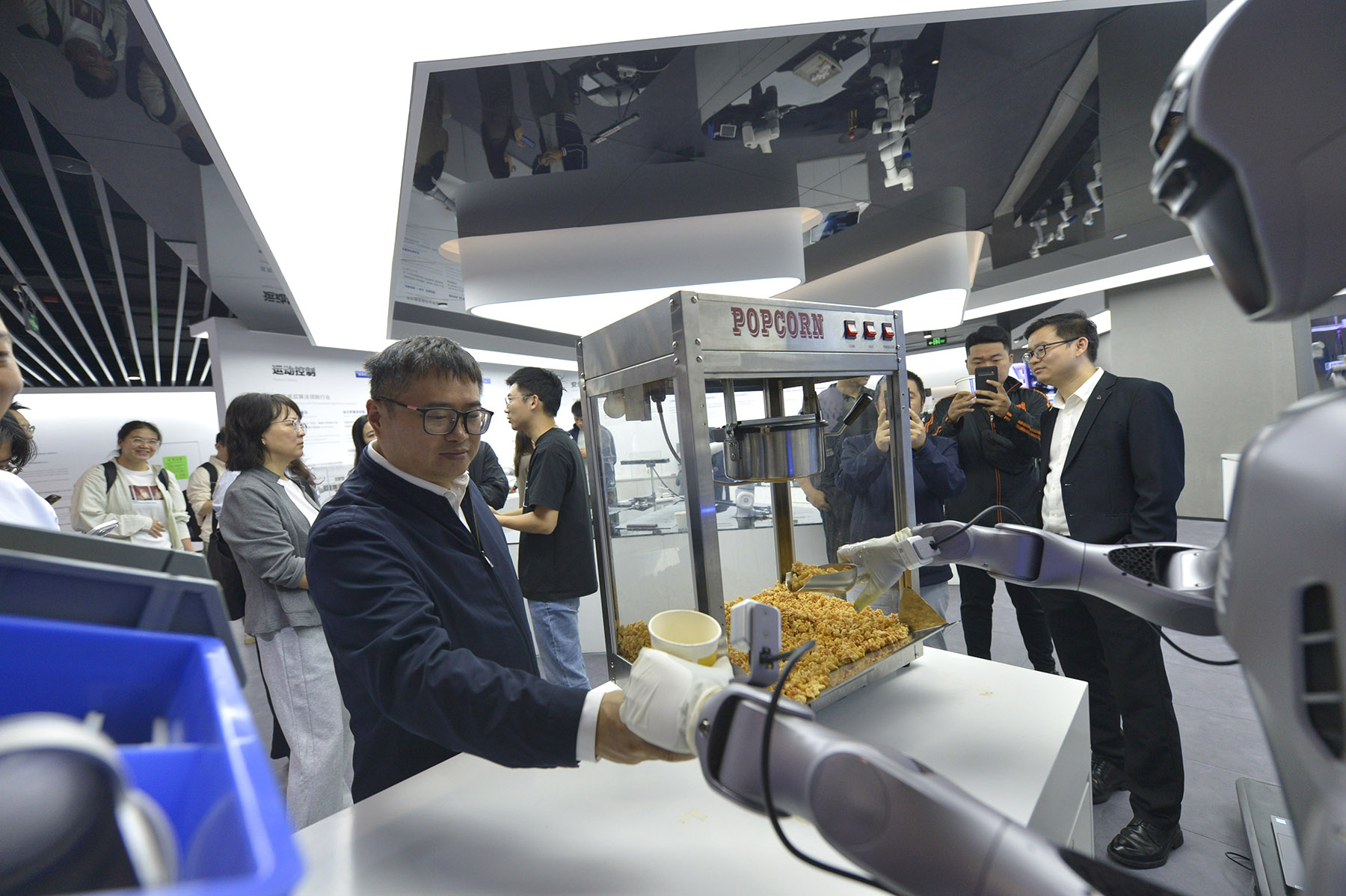
If Guangzhou's private innovators are redefining how people move, manufacturers in Dongguan and Shenzhen are transforming how things are made.
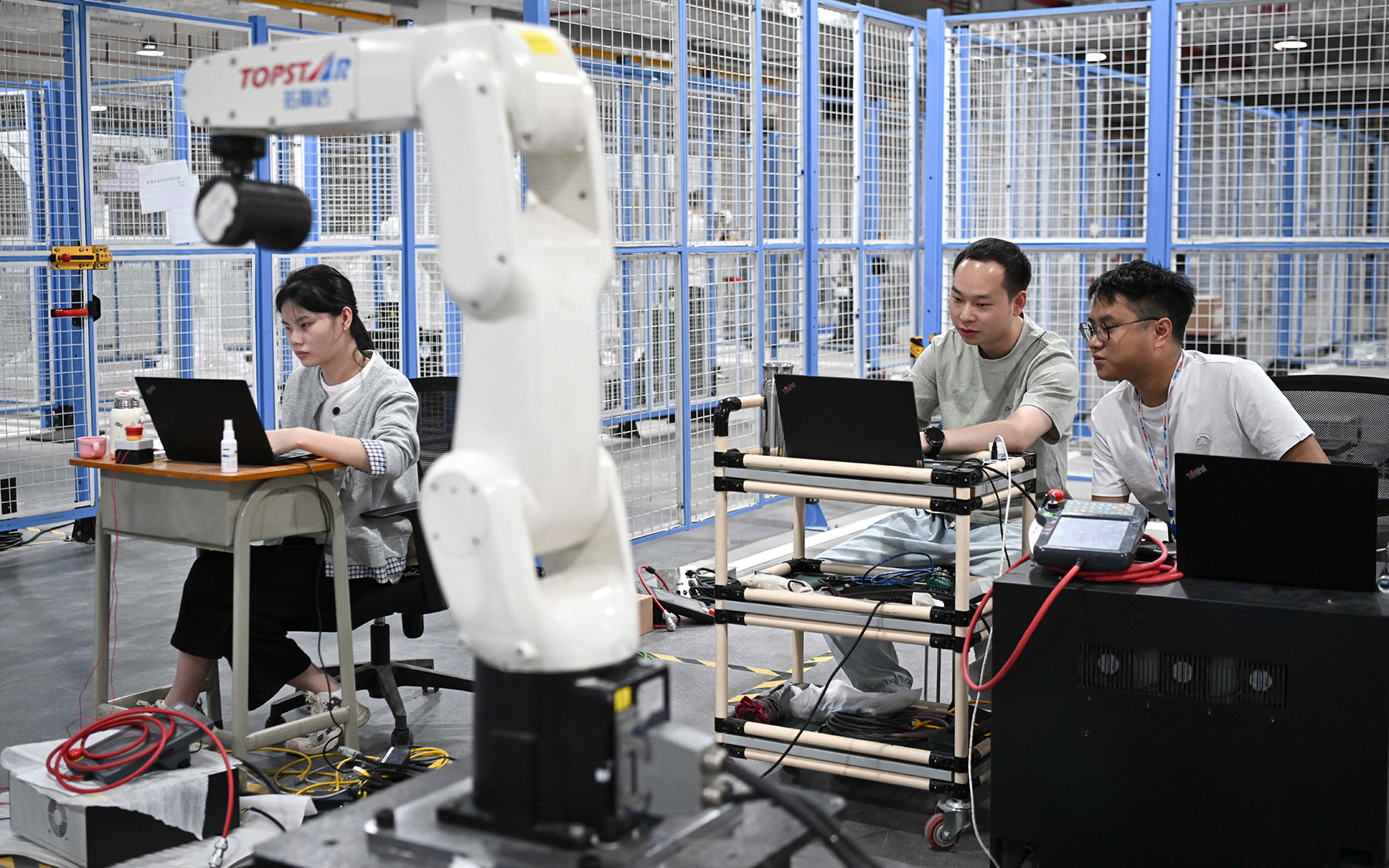
Guangdong Topstar Technology Co, a Dongguan-based industrial robotics manufacturer, has spent nearly two decades evolving alongside the province's vast factory economy. Starting with automation solutions for injection molding workshops, the company later expanded into multi-joint industrial robots and intelligent manufacturing systems.
In 2025, it unveiled Xiaotuo, a humanoid robot designed specifically for injection molding applications, followed by the launch of its quadruped robot Xingzai, capable of traversing rough terrain and carrying heavy loads in firefighting, security inspection and industrial maintenance scenarios.
Yet for Topstar, the biggest challenge is not building robots, but making them reliable enough for real-world applications.
"Completing a single pick-and-place task in a laboratory is relatively easy," said Zhang Jian, a senior executive at the company. "What customers want on a production line is continuous operation without failure."
Zhang said that delivering industrial-grade reliability requires advances not only in artificial intelligence algorithms, but also in the robot's mechanical body and the precision manufacturing equipment behind it.
"Many of the high-end machine tools used to produce complex robot components once depended on imports," he said. "Today, we have achieved independent control over core technologies, giving us a much stronger foundation for large-scale deployment."
The company's recent growth is a vivid reflection of the rising demand for intelligent manufacturing upgrades across China's industrial sector. Topstar's industrial robot and automation business revenue surged more than 80 percent year-on-year in the first quarter, while revenue from the computer numerical control machine tool business expanded over 60 percent.
A similar story is unfolding about 80 kilometers south in Shenzhen, where collaborative robot maker Shenzhen Dobot Corp is helping bring Chinese intelligent manufacturing solutions to factories around the world.
As the world's largest collaborative robot supplier by shipment volume in 2025, the manufacturer now gets more than half of its revenue from overseas.
Xie Kaixuan, Dobot's marketing director, said foreign customers are no longer choosing Chinese robots simply because they are cost-effective.
"Overseas clients are no longer asking us only, 'How much does your robot cost?' They are increasingly asking, 'How long can it work, and how reliably can it operate?'" Xie said.
That trust has been earned thanks to the strong industrial foundation that Chinese manufacturers have built over years of serving the world's most complicated and comprehensive production environments, he added.
"What overseas customers value most is that we can offer a trusted solution that has been repeatedly validated in China's extensive and real industrial environments and proven capable of long-term, stable operation," Xie said.
In many ways he believes the globalization of Chinese manufacturing is entering a new phase.
"China is no longer exporting simply cost-effective machines," Xie said. "We are exporting integrated intelligent solutions that customers can truly rely on."
Ideas to businesses
What enables so many of Guangdong's private technology companies to move from an idea to a commercial product so quickly?
Part of the answer lies not only in the province's manufacturing strength, but also in a growing ecosystem that lowers the barriers to innovation itself.
For many hardware entrepreneurs in Shenzhen, innovation now begins with a simple click.
An engineer uploads a circuit design to an online platform, and within hours the first printed circuit board enters production. A few days later, a physical prototype is ready for testing and refinement.
"Whether it's a student experimenting with a personal idea or an early-stage startup producing a small batch of prototypes, our platform makes it possible to bring those ideas to life — something traditional manufacturing often cannot support," said an executive of operations at Shenzhen JLC Technology Group Co, an integrated platform covering PCB prototyping, component sourcing, assembly and precision manufacturing.
ALSO READ: Guangdong puts Greater Bay Area at heart of 15th Five-Year Plan
By digitalizing the entire process, it has reduced the cost of a single PCB prototype from several thousand yuan to just tens of yuan, while shortening delivery time from several weeks to as little as 12 hours.
"Our goal is to become an accelerator for global hardware innovation and technology commercialization," he said, adding that a humanoid robot can now move from design drawings to a fully assembled prototype in as little as one to two weeks.
By the end of 2025, JLC's online platform had attracted more than 9.59 million registered users, up 34.73 percent year-on-year. The company had also served customers in over 180 countries and regions and processed more than 21.08 million orders during the year.
"Foreign users increasingly value our end-to-end service model, spanning everything from electronic design automation to prototype manufacturing," he said. "What underpins that capability is China's complete industrial ecosystem. The ability to seamlessly connect design, components sourcing and manufacturing at such speed and scale is something that is still hard to find elsewhere in the world."
Contact the writers at lijiaying@chinadaily.com.cn
