

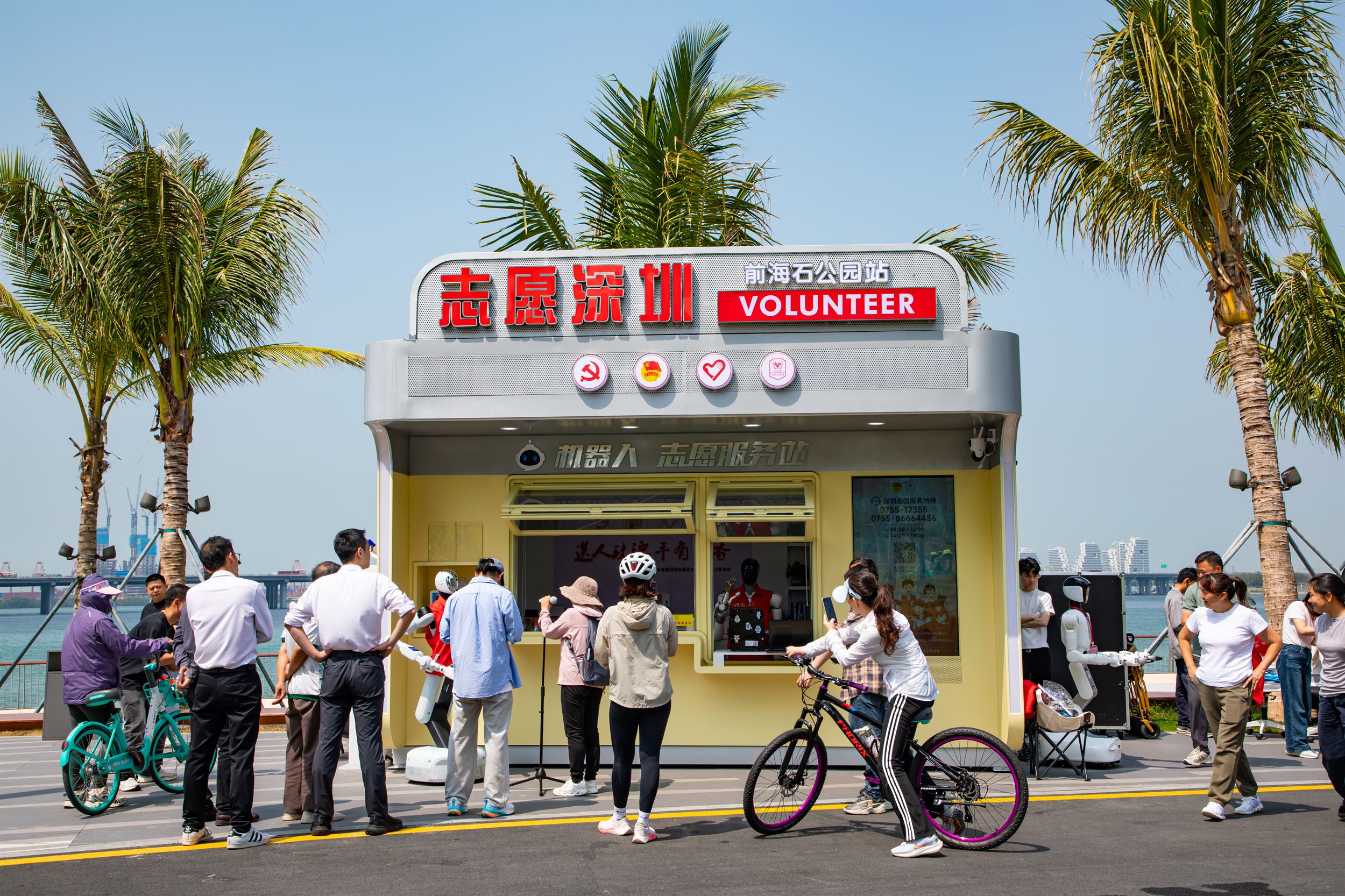
Service robots are evolving from novelty assistants to a reliable option to support the hotel industry in reducing costs, increasing efficiency, and standardizing services, hotel industry practitioners and observers said.
They said more robot and automation techniques will be adopted in future, bringing new energy to hospitality services, however the human touch remains vital.
Their comments followed the announcement that a hotel run entirely by robots on the western artificial island of the Shenzhen-Zhongshan Link is expected to welcome its first guests in early 2027.
The venture marks a bold step in Shenzhen’s drive to fuse its booming robotics industry with tourism and transform the western artificial island of the Shenzhen-Zhongshan Link — until now just a roadside photo stop with stunning views — into a destination in its own right.
“The entry of robots into the hotel industry is no longer a novelty,” said Lily Li, research manager of IDC China. According to IDC’s data, the hotel industry accounted for nearly a quarter of global service robot shipments in 2025.
After years of development, service robots are gradually becoming a mature solution for the hotel industry, by standardizing services and relieving employees’ workload. In the short term, hotels should increase their investment in robotic equipment and systems for repetitive tasks such as delivery and cleaning, while keeping employees for interacting roles, such as reception, dealing with complaints and other complex roles, Li said.
In the long term, she added, as technology develops, it will be cheaper for hotels to use robots, with improved manufacturing supply chain and reduced hardware costs. Additionally, the reliance on environmental modifications will diminish and the total cost of ownership for robot deployment will continue to fall.
“Robo-servants will become more widespread in the industry,” Li forecast.
Giovanni Angelini, professor of practice of The School of Hotel and Tourism Management of The Hong Kong Polytechnic University, said hotels can truly benefit from using tireless machines and algorithms to deal with administrative, accounting, and repetitive work.
However, he said he also believes that providing attentive service should be fundamental to the hotel industry. “We know that there are no shortcuts to delivering a satisfying guest experience, as this requires the human touch at the heart of hospitality,” said Angelini, who is also the former CEO of the Shangri-La Hotels and Resorts.
Angelini added that another challenge for the industry is weighing which positions to retain and which to eliminate. He said technical expertise and specialists may join hospitality, top managers will stay, while clerical positions will be partially replaced.
Huang Lijun, a current student who loves traveling, shared her first experience of receiving service from a robot . “It is quite convenient,” she said. “Honestly, I was bit shocked when I saw a robot deliver my food to my room’s door.”
Huang said she believes robots are a win-win for both hotel owners and customers, for lowering costs and experiencing faster services. Yet, she insists that humanity is the key factor when she chooses which hotel to book.
“Interpersonal connections are essential for me. Communication skills and empathy become even more crucial when problems arise,” she said.
Davis Xu contributed to this story.
