

Humanoids, smart glasses, AI demand catapult nation's innovation globally
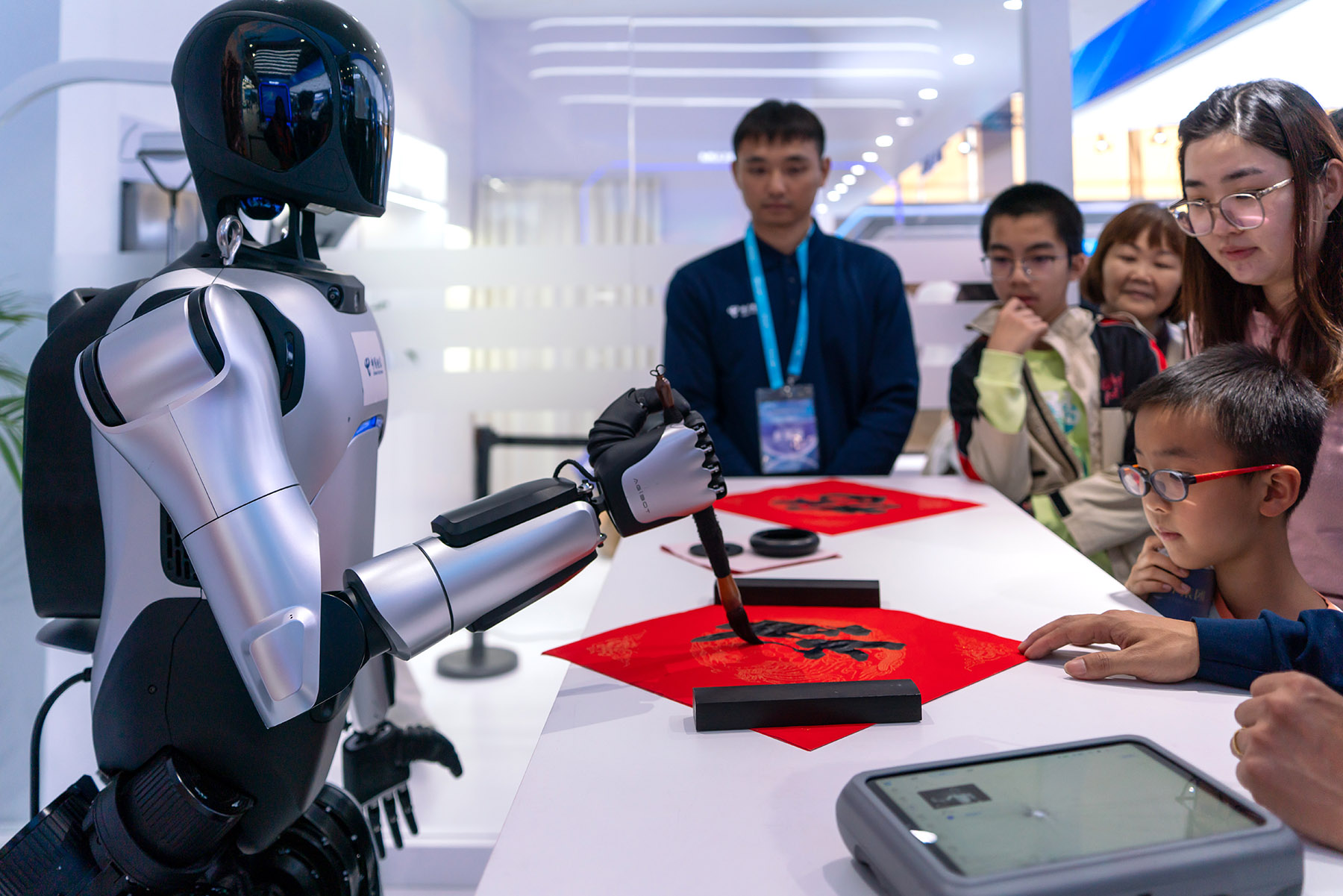
Out of every 10 humanoid robots shipped worldwide, eight come from China. That single statistic from a market research company captures a remarkable shift in the country's export story.
Gone is the reliance on sheer scale and rock-bottom prices. The new wave of Chinese tech exports — embodied in robots, artificial intelligence systems and smart hardware — is defined by sophistication, speed and a distinctly high-tech appeal, experts said.
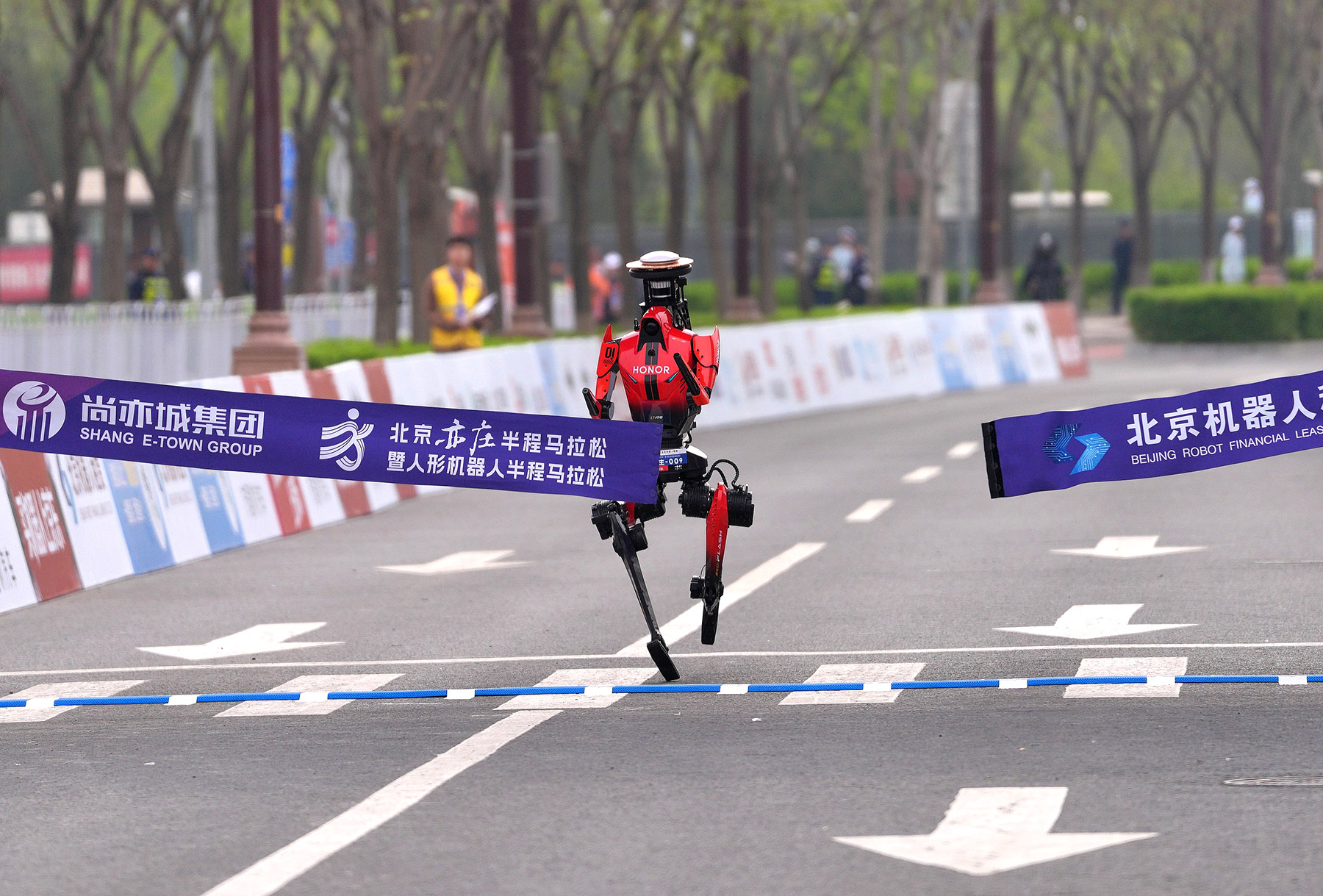
The transformation is perhaps best illustrated by an unusual race held on a crisp April morning in Beijing's southern suburbs. More than 12,000 human runners lined up for a half-marathon. Alongside them, jostling for position at the start line, stood over 100 humanoid robots.
READ MORE: Robots outrun humans at Beijing half marathon
One of them, a nimble machine named "Lightning" from the Honor Qitian Dasheng team, crossed the finish line in 50 minutes and 26 seconds. To put that in perspective, the men's half-marathon world record, set by Uganda's Jacob Kiplimo in March, stands at 57 minutes and 20 seconds. Lightning, built in China, beat it by nearly seven minutes.
Yet the real headline was not the winning time — it was how the robots ran. Nearly 40 percent of the teams used fully autonomous navigation, a dramatic leap from the previous year's remote-controlled field. Technologies borrowed from self-driving cars, including LiDAR and vision-only navigation, have been successfully grafted onto two-legged machines.
Zhao Mingguo, a researcher at Tsinghua University's Department of Automation, watched the race closely. "This proves that once Chinese industry sets a goal, it has the ability to get it done," he said.
Behind the marvel on the racecourse lies the relentless pursuit of technological breakthroughs and advanced manufacturing in China. The confidence that powers these robots at full speed comes from a strong industrial and supply chain system.
Today, China is home to more than 140 humanoid robot manufacturers, with annual shipments reaching 14,400 units — accounting for 84.7 percent of the global total. Out of every 10 humanoid robots shipped worldwide, eight come from China, according to a report jointly released by CCID Media and China Electronics News in March.
More importantly, Chinese technology is arriving on the global stage with a sleek, high-tech confidence. Leading the charge is AgiBot, a Shanghai-based company that has become the world's top humanoid robot shipper, according to a report by market research firm Omdia.
The company began delivering to overseas customers in 2025 and opened its first international experience center in Malaysia in January.
Then, in late February 2026, AgiBot made a decisive move into Europe. At a launch event in Munich, Germany, the company officially announced its entry into the German market, unveiling a full portfolio of general-purpose embodied robots and industry-specific system solutions tailored for Europe.
But the announcement that drew the most attention was a strategic partnership with Minth Group, a global leader in automotive exterior and structural parts.
Under the agreement, Minth's network of modern factories around the world will serve as dedicated training grounds for AgiBot's robots — real-world environments where machines can learn, collect data and refine their algorithms.
Esther Wei, Minth Group's chairwoman and CEO, said: "This partnership not only drives Minth's own smart manufacturing upgrade, but also injects precious real-scenario data into the robotics industry, accelerating algorithm iteration and technological evolution".
Customs data show that in the first quarter of this year, China's total exports of various types of robots reached 11.32 billion yuan ($1.67 billion), with shipments to 148 countries and regions. Among them, cleaning robots accounted for nearly 70 percent, becoming the main driver of exports.
For instance, walk into a tech park in Shenzhen's Nanshan district, and you will see the commercial reality behind the spectacle. Pudu Robotics has been quietly shipping service robots to more than 80 countries and regions — not only floor-cleaning machines, but also food-delivery robots that navigate crowded restaurants and customer-engagement bots that greet shoppers in malls across Europe and Southeast Asia. By the end of 2025, Pudu had shipped a total of 120,000 robots, the company said.
A few blocks away, engineers are putting a four-legged robot through its paces. At 62 kilograms, it is no toy. In one three-minute test, it performed continuous back-flips, side flips and a spinning jump that launched it 87 centimeters off the ground.
The secret? A local supply chain so efficient that the company can source all 30,000 components within half a day. That speed has allowed eight product iterations in just six months — a pace that leaves many overseas competitors struggling to keep up.
Shenzhen Dobot Corp Ltd, specializing in industrial robot arms, has also shipped its precision manipulators to more than 100 countries and regions. Walk into a factory in Germany or a warehouse in Brazil, and you are increasingly likely to see a Chinese-made robotic arm handling delicate assembly or heavy lifting.
Xie Kaixuan, marketing director of Dobot, said: "The key to embodied intelligence is moving from 'lab demonstration' to 'real-world commercial use'. At a cinema in Shenzhen, Dobot's humanoid robot has already achieved fully automated popcorn sales. It works 14 hours a day, and its daily revenue has exceeded 20,000 yuan."
Zhang Yin, vice-chairman and secretary-general of the Guangdong Artificial Intelligence and Robotics Industry Alliance, said: "The Greater Bay Area is the only region in the world that has both AI technology and mechatronics technology — and the ability to deeply integrate the two. This advantage is reflected in the collaboration and layout of Guangdong, Hong Kong Special Administrative Region and Macao Special Administrative Region."
The export boom is not limited to walking or rolling machines. Smart glasses have become another unexpected hit. Equipped with real-time translation, visual assistance and noise-cancelling communication, they are flying off shelves from Tokyo to London. Chinese manufacturers have turned the glasses into a practical tool for business travellers and tourists alike.
ALSO READ: Robot housekeepers set to enter homes in trial
In 2025, smart glass shipments in China reached 2.46 million units, a year-on-year increase of 87.1 percent. Overseas shipments grew by 64.9 percent, covering 32 countries and regions, according to data from market research company International Data Corp.
Local governments are also moving fast. The Hainan provincial government said it will focus on cultivating future industries and building new engines for development in 2026. In the field of embodied intelligence, Hainan will proactively plan for "brain-like models" tailored to unique application scenarios such as deep-sea exploration and tourism, and develop a variety of embodied intelligent robots, including underwater robots and cultural tourism consumer robots.
Seeing the potential, Beijing Galbot recently established a unit in Hainan, with a business scope covering the manufacturing of service and consumer robots and the research and development of intelligent robots.
What ties all these stories together is a fundamental shift in strategy. Chinese tech companies are no longer competing on price alone. They are offering a complete business loop: hardware to attract customers, software to keep them, and value-added services to generate long-term revenue. It is a model that has already proved successful in smartphones and electric vehicles — and now it is being applied to robotics and AI, experts added.
Contact the writers at masi@chinadaily.com.cn
