

Culture exchange, people-to-people engagement championed by Hong Kong educators, African diplomats
“I was wondering, even asking them, are you sure a Chinese did them? Because the artwork, the artistic expression, came so close to what would have come from a South African.”
Speaking to China Daily recently, Mojalefa Mogono, South Africa’s consul general in the Hong Kong Special Administrative Region, found himself, time and again, savoring prize-winning pieces he’d seen from a local “Zulu Love Letter” creation contest in April: delicate beaded panels — customarily a secret vernacular of love, stitched by women of South Africa’s Zulu clan — now reinterpreted by Hong Kong youngsters, from secondary school to college students.
The contest was part of a year-round African cultural showcase and exchange program put on by Hong Kong Metropolitan University’s Li Ka Shing School of Professional and Continuing Education (HKMU LiPACE) — the school’s latest move to deepen its internationalization, studiously timed to align with the central government’s designation of 2026 as the “China-Africa Year of People-to-People Exchanges”.
The Year of Exchange initiative was hammered out by Chinese and African leaders at the 2024 Beijing Summit of the Forum on China-Africa Cooperation.
ALSO READ: HKMU turns to Northern Metropolis and AI to drive growth
Set in 2026 to mark the 70th anniversary of the start of diplomatic relations between China and African countries, the Year of Exchange aims to breathe new life into an already time-honored friendship through people-to-people engagement. The hope is that mutual understanding can be carried across generations, the event’s official concept paper reads.
The paper offers programmatic headings like “young leaders”, “cultural kaleidoscope”, and “symphony of ideas”, which LiPACE’s Dean Benjamin Chan Tak-yuen described as the foundation of the school’s cultural calendar for this year.
“Our range of activities has heightened the level of interaction by placing students, young people, at the center and using culture as a medium to promote cross-dialogue among civilizations,” Chan said. “It’s important to create the conditions for humanity to build bonds with one another, especially during these unsettling times.”
Alongside the “Zulu Love Letter” contest, a variety of Africa-themed activities are slated for LiPACE students and beyond: workshops on ancient Egyptian artifacts and hieroglyphic writing, fashion displays from Nigeria’s major ethnic groups, and more.
The school has also installed long-term culturally themed classrooms, among them an “African floor” — a walking tour in miniature where an Egyptian reading room sits alongside a Zimbabwe corner, a South African arts-and-crafts room, Nigerian fashion displays, and walls offering pictorial depictions of the African continent.
Since 2019, LiPACE has operated a strategy it calls the “Three-I” initiative — “internationalization-in-place”, “intercultural awareness”, and “inclusion” — aiming to reach out to a wide array of Hong Kong’s foreign communities, including diplomatic missions, with a purpose to “impart real experience for students learning about other cultures” and “bring the world to the classroom”, Chan said.
And in the vision’s actualization, “Africa has always occupied an important place,” Chan added.
“By 2050, one out of four people on this planet will come from the African continent. If not starting to introduce Africa to students now, then when?” he said, citing the United Nations’ World Population Prospects 2022.
The school has collaborated with four African consulates-general across Hong Kong — for South Africa, Egypt, Nigeria, and Zimbabwe — on varied cultural activities. It has also signed memorandums of understanding with three top-tier African higher education institutions: South Africa’s University of Cape Town, a long-reigning African leader in global rankings; the American University in Cairo, Egypt; and Bulawayo Polytechnic in Zimbabwe.
Youngsters at center of connection
Mogono came to HKMU’s main campus in Kowloon City district on April 22, after presenting prizes for the “Zulu Love Letter” contest. He was accompanied by Egypt’s Consul General Baher Sheweikhi, Nigeria’s Oludare Folowosele, and Zimbabwe’s Mutamba.
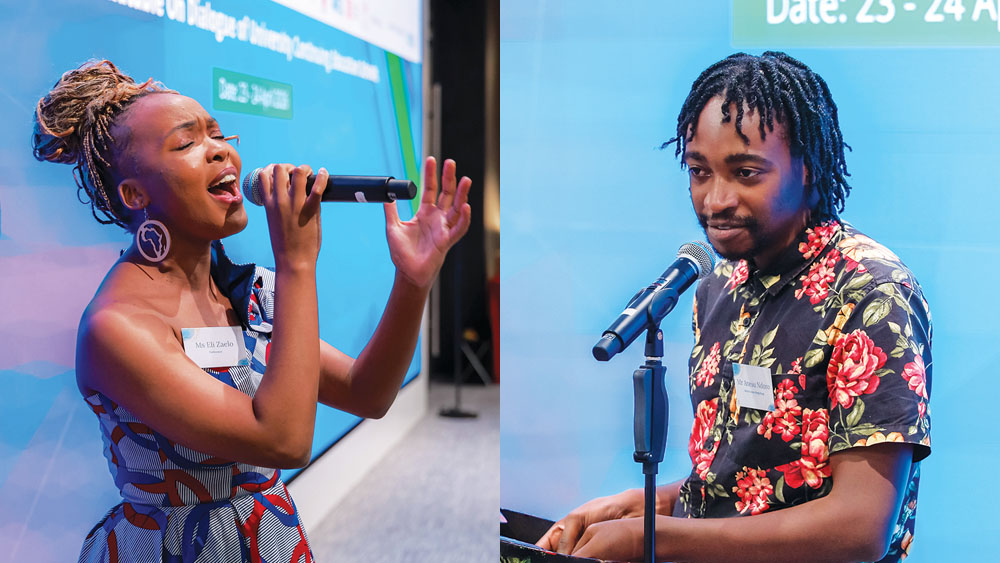
The diplomats were there for an “African Culture Night” — which marked the official launch of LiPACE’s bids under the banner “2026 China-Africa Year of People-to-People Exchanges” — flanked by government officials, overseas university representatives, and clusters of students.
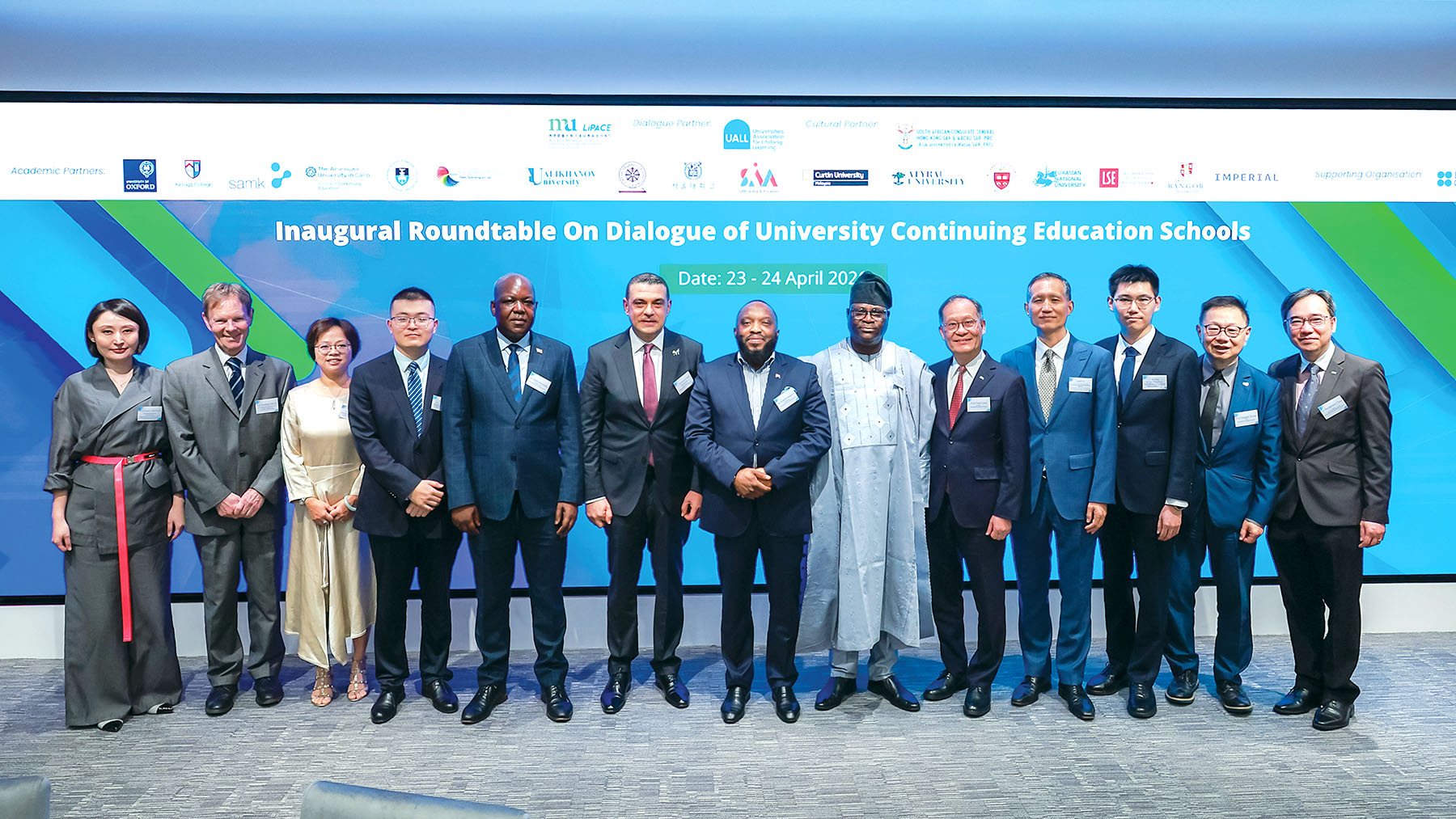
The evening also served as a prelude to the inaugural “Roundtable on Dialogue of University Continuing Education Schools”, hosted by LiPACE from April 23 to 24.
The roundtable attracted education professionals and senior administrators from 15 universities in 10 countries — including LiPACE’s three African partner institutions — with an extensive agenda covering future-oriented training, workforce upskilling, lifelong learning, as well as local culture and sustainability.
“These are very important events,” Paul Lam Kwan-sing, HKMU’s president, told the gathering. “It’s about building bridges, connecting people at a time when many bridges are being destroyed amid conflicts.
“We need to build bridges, come together, talk to one another, and understand one another’s culture, ways of thinking, and improve our understanding,” he added.
“Connect”, “people-to-people engagement”, and a focus on young people were frequently mentioned themes of the evening.
Mogono showed photographs of LiPACE students on a study trip in Cape Town in May 2025. Those students had come to his office before that trip.
“For many of them, it was their first time going there,” Mogono said. “I was telling them where to go. There was excitement.”
He added that when the students returned, “They said they would love to go back again.”
The Year of Exchange, Mogono suggested, should not be a one-time fair. “It should be every year; people should know that every year is a people-to-people year, and that it’s important to get to know each other.”
Nigeria’s consul general, Folowosele, also nodded to LiPACE’s work with African consulates-general, calling the collaboration “tremendous”. His consulate-general came on board after LiPACE reached out for assistance in organizing a Nigerian fashion event for students.
“We see this as an opportunity to tell students and the university community more about our country,” he said.
Folowosele said that he sees such a partnership as “a starting point”. From it, he noted, further collaborations will grow, envisioning greater reciprocal exchanges among students, Hong Kong’s Nigerian community, and among institutions that have begun to take notice of the trend, particularly following the official elevation of China-Nigeria relations in September 2024 to a comprehensive strategic partnership.
“Nigerians like to explore … and Hong Kong students, among Chinese students, should also catch up on the ‘go-global’ initiative, and explore other places, including Africa,” he said.
Mutamba said the Zimbabwean consulate-general signed a memorandum of understanding on international cooperation with LiPACE last year. Now, plans are underway to forge cultural, student exchange linkages with more Hong Kong universities as a key part of their cultural diplomacy efforts.
“Studying in Hong Kong would enable students to join a vibrant community,” Mutamba said. Many Zimbabwean students have already arrived, he added, supported by scholarships from both the Hong Kong SAR government and its universities, pursuing degrees in fields key to Zimbabwe’s growth, like engineering.
Mahmoud Allam, dean of the American University in Cairo’s School of Continuing Education, said some LiPACE students were scheduled to visit his school in May for a study visit focused on Egyptian antiquity, tourism, and hospitality.
“I’m really happy that Hong Kong universities are generally active in engaging in cultural exchanges, open to collaboration,” Allam said. “Young students especially need to understand different cultures — the world is growing closer.
“Younger generations worldwide share more similarities, more of a global perspective. They are, in a sense, better suited for exchanges,” he added.
Beyond words
At the African Culture Night, one of the winning authors of the “Zulu Love Letter”, Qian Yinuo — a first-year LiPACE student majoring in creative culture and arts practice — took the stage to share her experience in the competition.
“It means so much,” Qian spoke of the praise she received from the South African consul general. Through the creation process, she said she gained a “larger understanding” — that the beaded panels are “not only a beautiful art form, but a vessel for emotional exchange, a bearer of South African culture”.
Qian, a dedicated enthusiast of Chinese calligraphy and traditional Chinese painting, said that these African cultural activities led her to “exactly the frontier I’ve always wanted to explore” of how to welcome distant cultures in, waft Chinese culture out, and blend them into a new idea and trend shared by all.
Her feelings were echoed by other participants. “This activity made me realize that art can transcend distance, culture, and race, touching people’s hearts more powerfully than words can,” said Jaitrongdee Aishwariya, the senior-secondary category champion from Yan Chai Hospital Lim Por Yen Secondary School.
Yeung Hiu-wai, a teacher from the same school, described this process of creating the artwork entirely using visual elements as a profound and meaningful exercise in patience, communication, and focus for the students, bringing a cross-cultural resonance.
Similarly, Hon Hin-shan, a teacher from Yan Chai Hospital No 2 Secondary School, thought the event was of great educational meaning.
“By comparing African and Chinese cultures, students experienced how visual arts can transcend language barriers and foster mutual respect and understanding,” Hon said. “Such experiences are important for nurturing a global outlook and cultural inclusivity.”
Ng Sze-long, the first runner-up from that school, said he learned that symbols are used to show feelings in African art. “This activity shows that young people can connect through art and creativity. It inspires me to learn about new cultures and be more respectful. I think sharing our traditions helps us build a more peaceful and friendlier world. It makes me want to explore more cultures in the future,” said Ng.
ALSO READ: ‘One program, two diplomas’: HKMU LiPACE-SZIIT cross-boundary education sees its first graduates
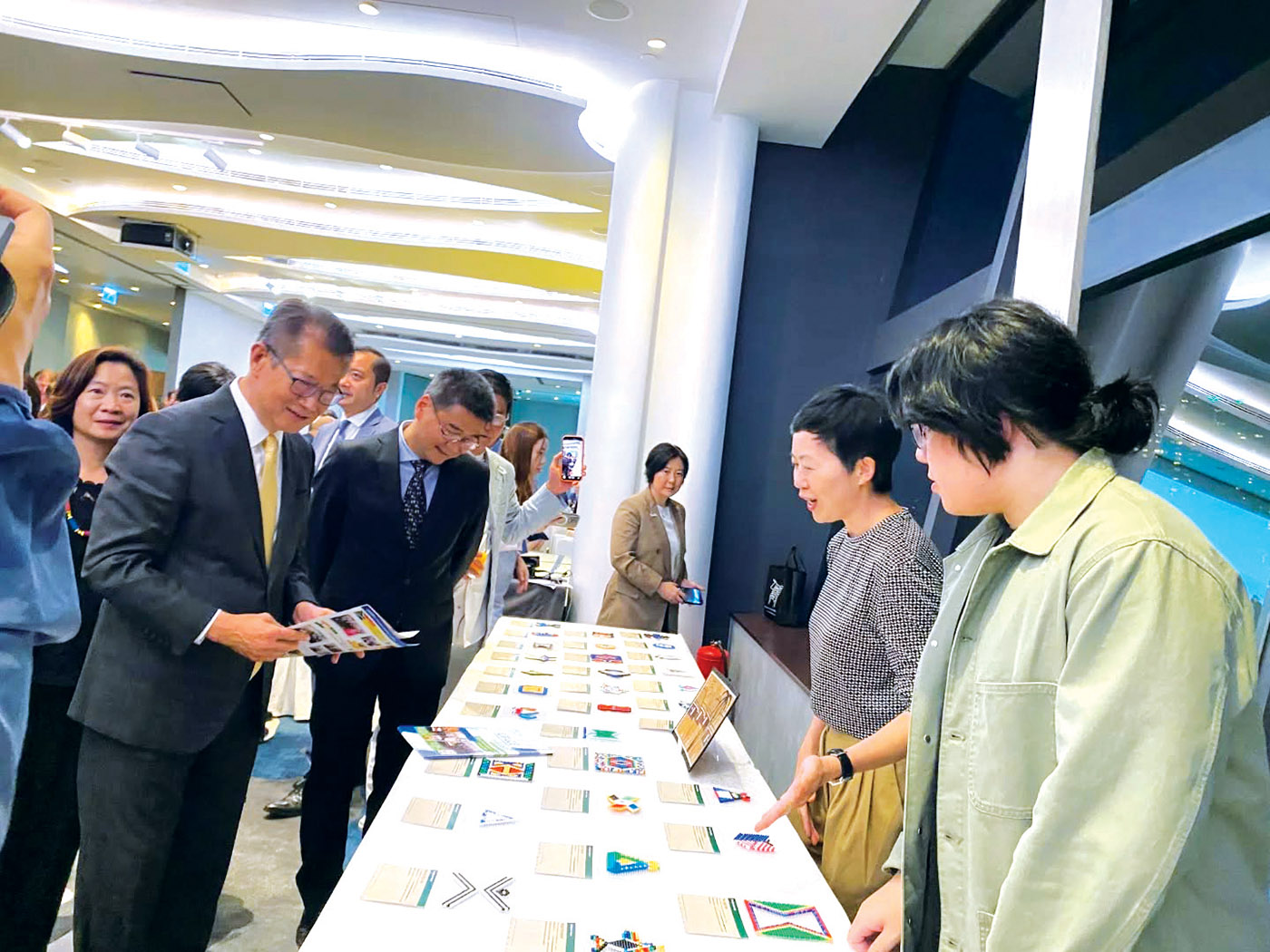
Award winners from the “Zulu Love Letter” competition were later showcased at the South African National Day Reception on April 23 and were admired by senior attendees, including Hong Kong Financial Secretary Paul Chan Mo-po and Hua You, deputy commissioner of the Ministry of Foreign Affairs in the Hong Kong SAR.
Paul Chan was briefed by students on how they used geometric patterns and colors to create “secret languages” that transcend cultures, and he expressed high appreciation for their work.
In his address at the event, Paul Chan said, “We would be delighted to welcome more young people from South Africa to study in Hong Kong, build their future here, and bring home new ideas, new experiences, and new connections.”
Contact the writers at wanqing@chinadailyhk.com
