

On remote Qushan in Zhejiang province, a team of female delivery drivers is reshaping traditional roles, balancing motherhood and work while forging independence and solidarity, Chen Nan reports.
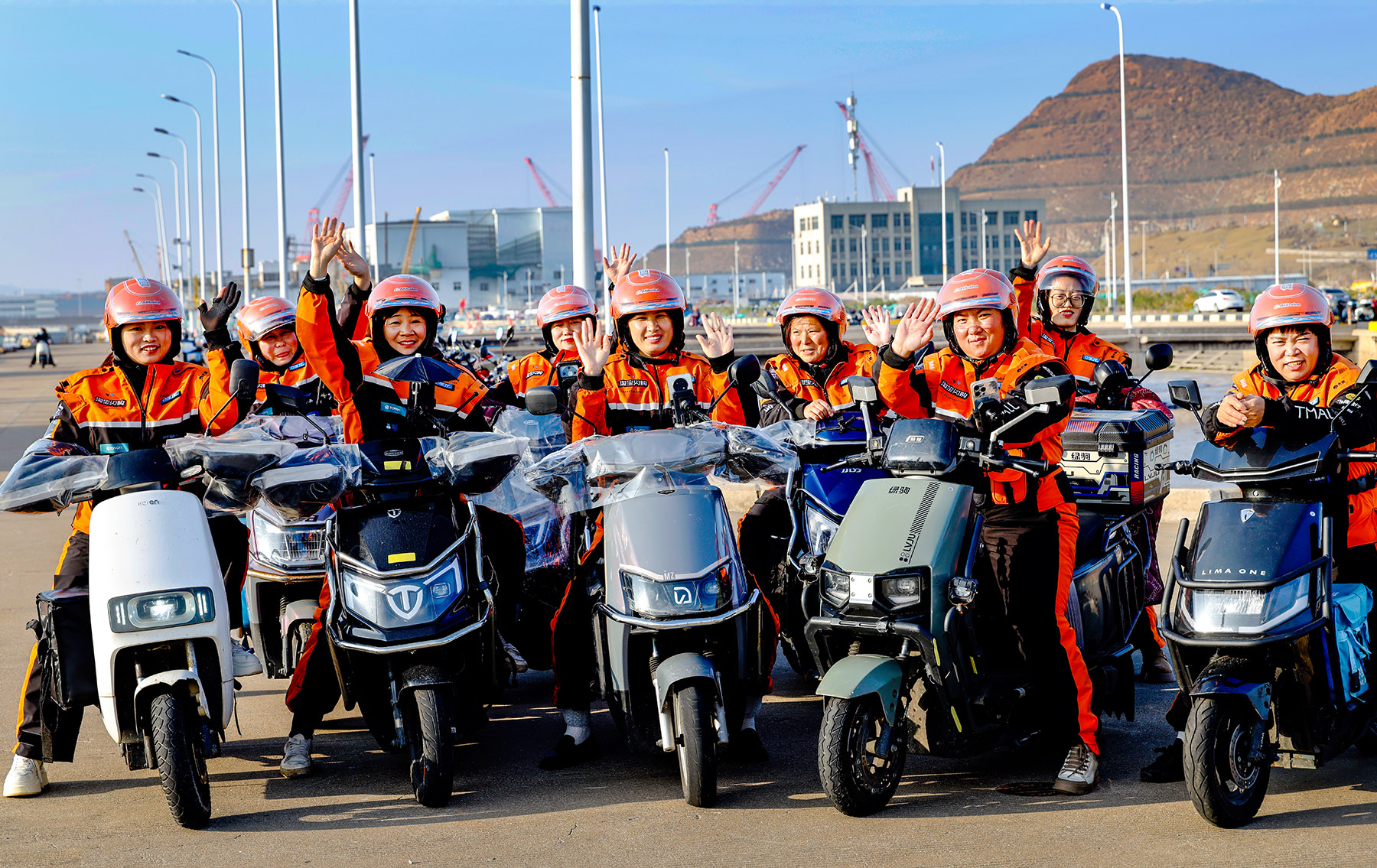
Part of the Zhoushan Islands in China's Zhejiang province, hundreds of kilometers from the mainland, lies Qushan Island, home to fewer than 100,000 residents.
Life here revolves around a main road, which is a narrow stretch lined with schools, a clinic, a handful of shops, four bubble-tea cafes, and a lone coffeehouse. This modest cluster forms the island's "central business district". Yet, in the past year, it has become the stage for an extraordinary cast of women.
They are mothers averaging 40 years of age who have traded the predictable rhythms of domestic life for the hum of electric scooters and the uniform of the island's delivery service. Day after day, clad in orange and black, they navigate winding lanes and stair-stepped alleyways, threading the island together one takeout order at a time.
Once tied to roles defined by family and circumstance, such as wives awaiting fishermen at sea, and mothers trapped in part-time work, they now claim a new agency in these small, daily movements, quietly "rebuilding themselves" with every delivery.
From February to March this year, renowned Chinese photographer Xie Hailong, whose work has chronicled ordinary lives for 35 years, visited Qushan, drawn by curiosity.
"On an island surrounded by wind and sea, I wanted to see how these women could seize their own lives," he says. More than 10 of his photographs are being displayed in an exhibition titled Seeing: Cities and Riders, running from April 17 to the coming Sunday at public locations across 12 cities nationwide, capturing these women, who root themselves in a life defined not by circumstance, but by choice, against the rhythm of waves and wind.
Xie, 75, is known for a photo that he took in 1991, telling the story of Su Mingjuan, then 8 years old, with great sparkling eyes and a pencil in hand, in rural Jinzhai county, Anhui province. The photo became a household image after it was used as a poster for Project Hope, which was launched by the China Youth Development Foundation in 1989 and is dedicated to helping underprivileged children get an education.
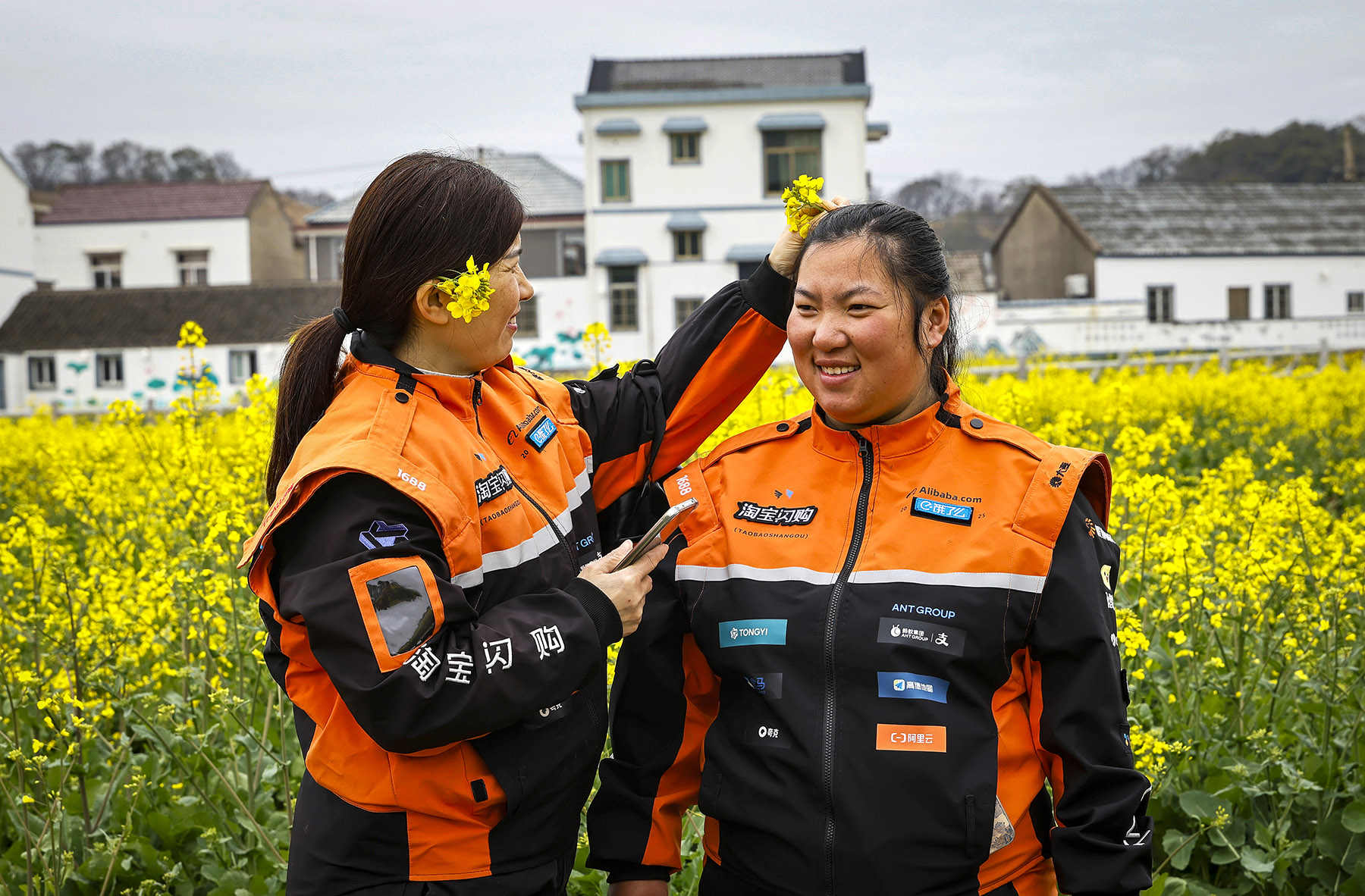
Xie was inspired by a video online that he watched in 2025, featuring this group of women whose optimism, smiles and authenticity shone through every frame.
"I was captivated by their energy and found myself curious about this unique team — how, in such an isolated place, surrounded only by wind and sea, could they courageously choose their path, work tirelessly, and hold tightly to the life they wanted to live," the photographer says.
The first time he saw them in person, their vibe instantly drew him in. They were a diverse group of women, aged between 30 and 50, all dressed in bright orange uniforms. They gathered at the "CBD" of the island and chatted and laughed together.
"Their electric bikes were parked nearby, and they were like a burst of color against the backdrop of the island. When an order came in, one of them would zip off to deliver it, only to return afterward and join the group once again," says Xie.
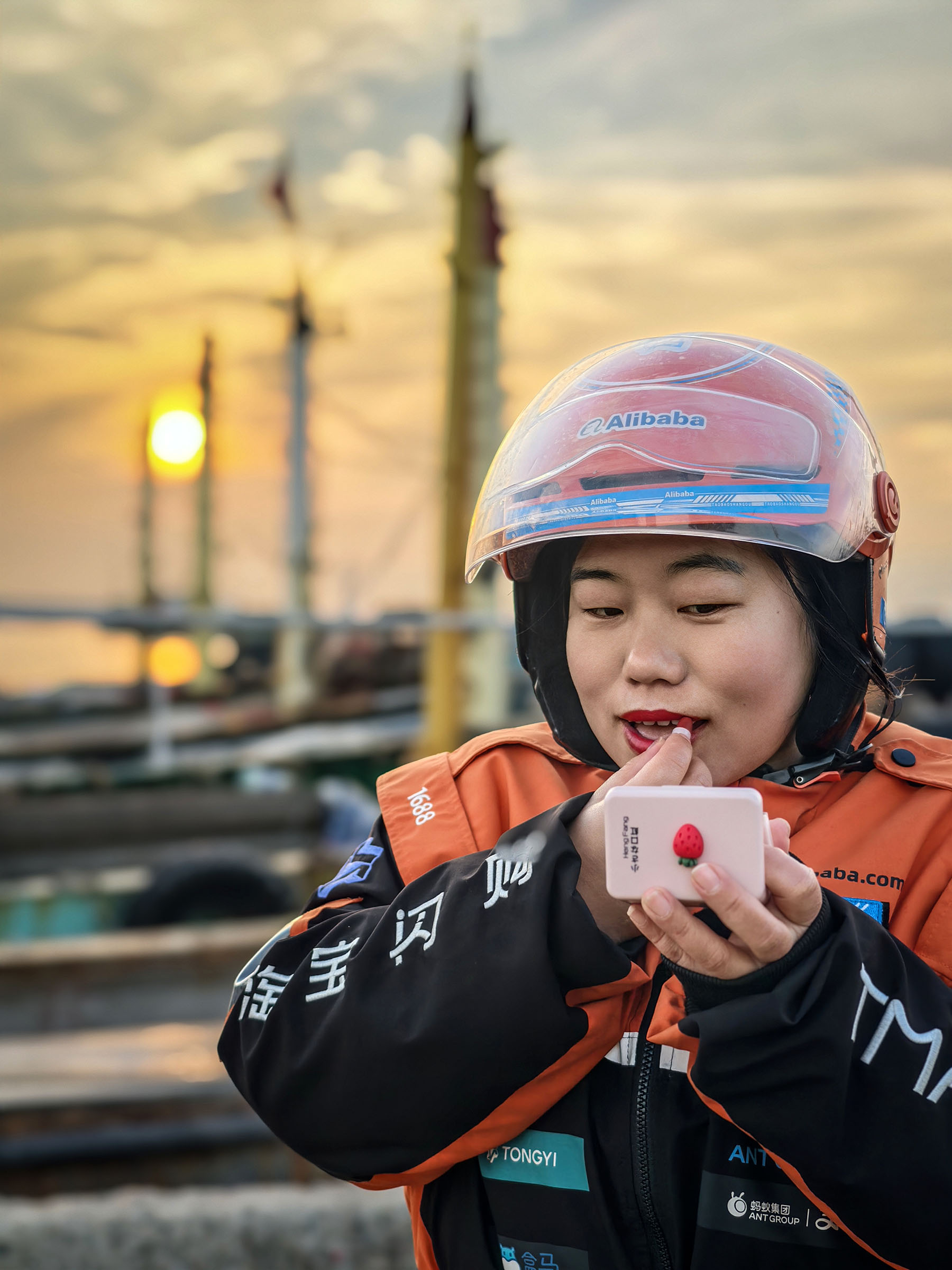
During the days when their husbands were out at sea, these women became each other's family, supporting one another through thick and thin. When one of them had fewer orders, the others would step in and share theirs. If a newcomer was unfamiliar with the island's streets, the experienced riders would patiently guide her. Between orders, they would pull out little mirrors and lipsticks to touch up their makeup, reminding each other that, even in their uniforms, they never forgot the importance of feeling beautiful.
"It is a life that is both modest and deeply connected, where community comes first, and every little act of kindness carries weight. These women aren't just making deliveries; they are building lives for themselves and each other, grounded in determination, sisterhood and joy," the photographer says.
Among these women is Chen Lirong, born in 1997 and the youngest and fastest of Qushan's female riders. She is also the navigator, the one steering the small team through the chaos of rising orders. Each day begins at 7 am with the routine of family: delivering her two daughters to school. By 8:30 am, her delivery box is already brimming with orders. She rides until mid-afternoon, pauses to pick up her children, and then continues the cycle — juggling work and motherhood with the precision of someone who has spent years learning to adapt.
For Chen, deliveries are more than a job; it is the first work she has ever held that allows her to earn a living while tending to her children. Even at the busiest moments, she can glance at her phone, or quickly dash out an order and return home to care for her daughters.
In April 2025, when Taobao Shangou, or Taobao Instant Commerce, an online daily life services platform, officially launched operations on Qushan Island, Chen's reliability earned her the trust of Hu Gaoyang, the logistics manager. She became the leader of the all-female riders, guiding new mothers into the unfamiliar, physically demanding world of delivery work.
Initially, both Chen and Hu worried that the women, many long accustomed to full-time childcare or household work, might not adapt to the harsh rhythms of outdoor delivery. But as the first surge of orders hit, those doubts quickly vanished.
During the summer of 2025, order volumes skyrocketed by more than 1,000 percent. Some riders, brand-new to the job, handled 189 deliveries in a single day, and over the course of a month, completed more than 2,000.
Chen herself was no stranger to struggle. Born in Anhui, she had drifted from factory work in Guangdong province to follow her husband to Jiangsu province. By 2016, marriage and childbirth brought her to Qushan, where her husband became a fisherman and she a homemaker, bound to domestic responsibilities while he went out to sea. Early one March morning, photographer Xie captured a photograph of her sending her husband off at 4 am, the harbor dark and silent.
"There was no dramatic embrace," Xie recalls. "Just a quiet farewell. The silent care between them hit me harder than any posed shot. I found myself tearing up behind the camera."
Raising two daughters while managing household repairs, medical trips and family errands, Chen's desire to work and earn never waned. A previous job in a local factory ended when it shut down, leaving her life once again in a transitional state. But as a delivery rider, she found not only an income, but also her calling. She schedules her team around childcare needs: mothers with younger children ride the mid-shift, those with older children the early shift, while those without children cover the late hours. In high season, she stays late to help manage orders herself, ensuring no one is overburdened.
At 46, Hu Yingrong became the first female delivery rider to join Chen's team. Having lived on the island for nearly 20 years, she's seen her life unfold in ways she never expected. Her eldest daughter is now in college, while her youngest son is still in middle school.
For nearly a decade, Hu Yingrong searched for work on the island that would allow her to balance earning an income with taking care of her children. Before she became a delivery rider, she tried various jobs but found herself doing the laborious task of mending fishing nets.
For a decade, she was bound to those nets. While the men of the island used fishing nets to bring in the harvest, Hu believed that women on the island had their own "mission" — the work of repairing and maintaining them. When the boats returned from fishing, they were filled with nets that needed mending: some torn and some covered in small fish and shrimp that had to be removed.
When her children were on vacation or at school, she would work in a fishnet factory surrounded by piles of discarded nets alongside other women just like her. They worked from sunrise to sunset, often losing track of time.
Then, in 2025, a new opportunity appeared. She became the second female delivery rider on the island, marking the beginning of a new chapter in her life. Finally, she had a job with a base salary, and the harder she worked, the more she earned.
However, the transition wasn't easy. Unlike younger riders like Chen, Hu Yingrong struggled at first. When she joined the team, she was faced with the busy periods of July and August — times when the number of orders was overwhelming. She couldn't even read the delivery routes on her phone's navigation system because they looked like a tangle of branches and twigs, constantly splitting and extending. But with persistence and a willingness to learn, she quickly adapted.
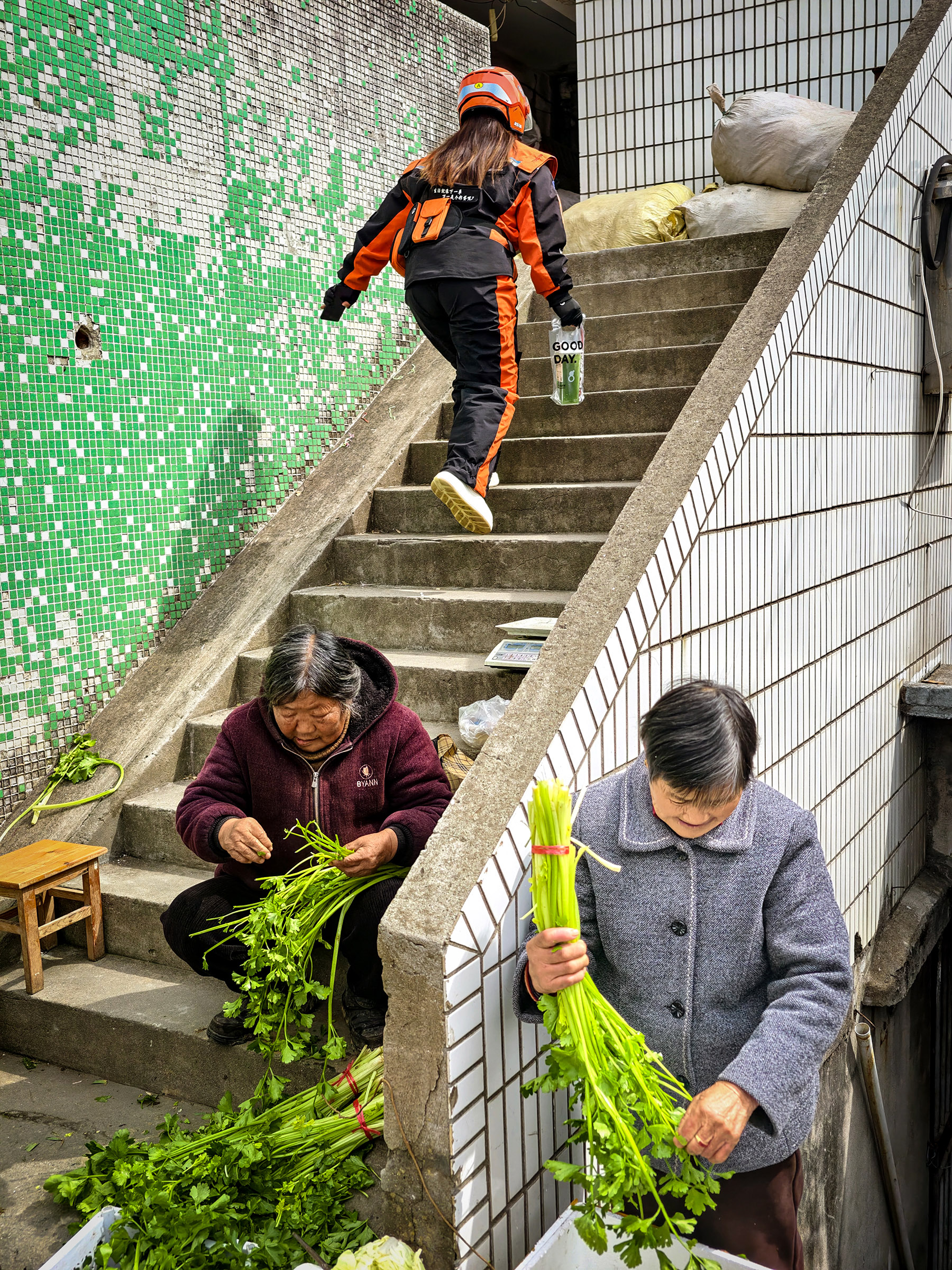
The island is full of buildings without elevators, and she often found herself climbing staircases, sometimes multiple flights in a row.
"My legs would hurt so much," she says, recalling the physical toll. Yet, she pushed through and excelled during the peak seasons, earning over 10,000 yuan ($1,472) a month — figures she had never dreamed of while working in the factory. During the off-season, she could still make 7,000 to 8,000 yuan — an amount that once seemed impossible.
Now, she has carved out some time for herself. After sending her son to school in the morning, and finishing her deliveries, she returns home to do housework or tend to her small vegetable garden.
The exhibition also features photos of other delivery riders taken by other photographers. According to the photo exhibition's curator Yang Han, more than 2,000 works were submitted for the event, with nearly 100,000 riders participating in the voting to select 200 images to be exhibited. The total number of votes surpassed 1 million.
ALSO READ: Women push boundaries to hit new heights
Alongside Xie, more than 50 other photographers are featured, including Zhang Boyuan who has taken pictures of Tang Qi, a rider in Chengdu, Sichuan province, who twice jumped into an icy river to save people.
"Many photographers and ordinary people pick up their cameras and phones to document the riders around them," Yang notes.
"If your pictures aren't good enough, you aren't close enough," Xie says, quoting famous war photographer Robert Capa. "The same applies to portrait photography — this 'closeness' refers to how close you are to the life and heart of the person you're photographing.
"During this shoot, I was moved to tears several times by the passion and optimism of these mothers. Each of them faces various difficulties at home, yet they still wear a smile on their faces. In the past, I've often revisited the children I photographed for Project Hope, checking in on them every few years to see if they're still in school. I hope that in the future, I'll have the chance to return to this small island, to the 'CBD' they've been waiting for, to that little milk tea shop, and see them still wearing smiles on their faces, with their lives getting better and better," Xie says.
Contact the writer at chennan@chinadaily.com.cn
