

High-level forum emphasizes law-based, balanced approach to safeguard stability
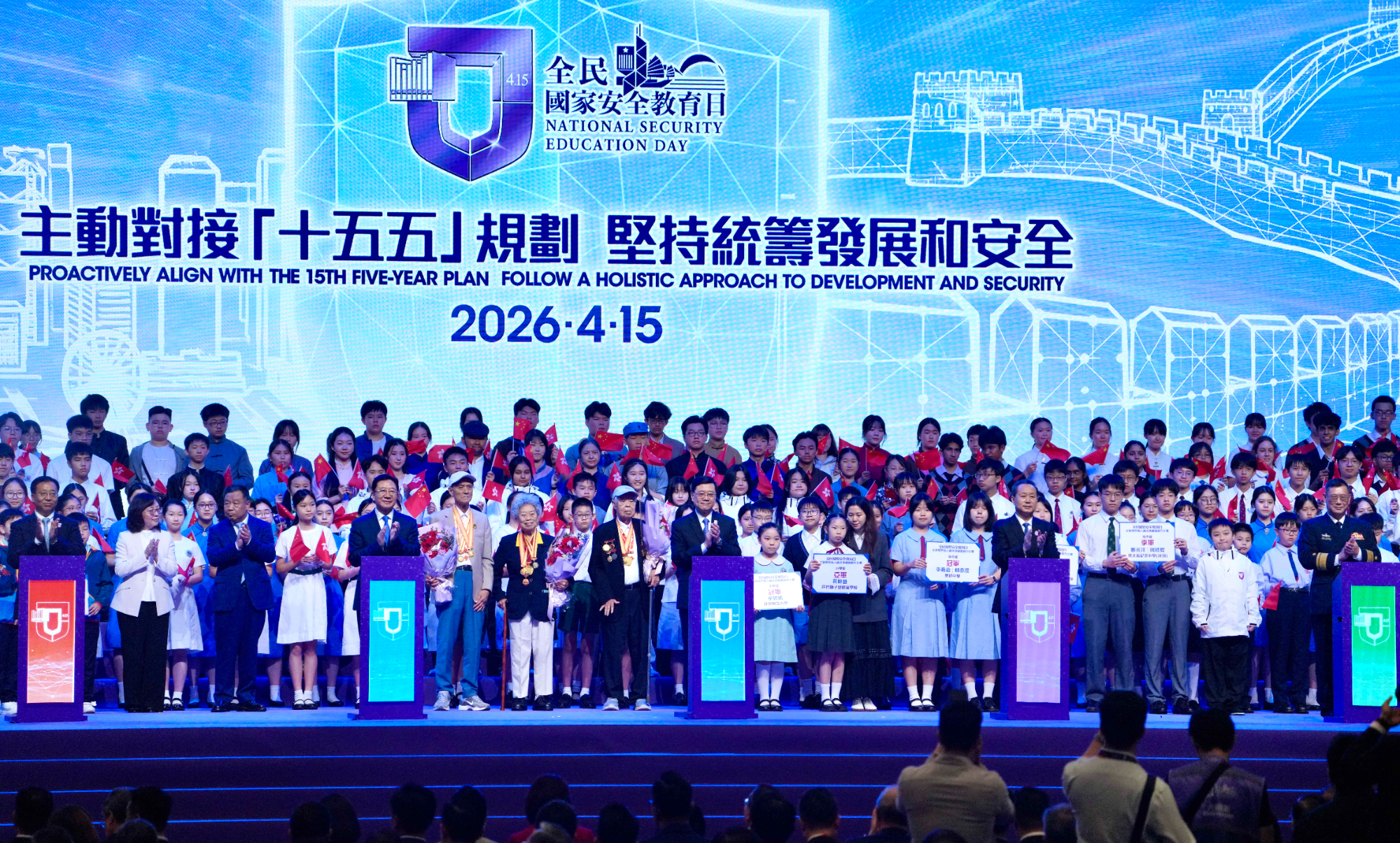
Political leaders and legal experts in the Hong Kong Special Administrative Region on Wednesday called for a clear and accurate understanding of national security, in response to misconceptions fueled by external critics of the central and local governments’ all-out efforts to safeguard stability and drive development.
They made these remarks at the National Security Legal Forum 2026, coinciding with the nation’s 11th National Security Education Day. The event gathered legal officials, scholars and lawmakers to discuss the white paper titled “Hong Kong: Safeguarding China’s National Security Under the Framework of One Country, Two Systems”, the third such document issued by the central government on Hong Kong SAR affairs.
In his opening remarks, Secretary for Justice Paul Lam Ting-kwok stressed the importance of a proper and thorough understanding of the fundamental principles that guide Hong Kong in safeguarding national security. He said that national security is as essential as air and sunshine, but is too often taken for granted.
READ MORE: Xia: High-level security safeguards Hong Kong’s prosperity
Lam addressed a misconception suggesting that Hong Kong is pursuing “absolute” or “generalized” security.
“It is vital to note that (the law) says, ‘relatively free from danger and internal or external threats’, but not ‘absolutely free’”, Lam said, citing provisions in the Hong Kong SAR National Security Law (NSL) and the Safeguarding National Security Ordinance. He added that pursuing “absolute security” might stifle development and violate the fundamental principle of peaceful coexistence under international law.

He urged the public to develop a proper understanding of the fundamental principles that Hong Kong follows in safeguarding national security, so that relevant laws are accepted and followed voluntarily out of genuine conviction.
Lam also referenced the white paper, saying that security is a prerequisite for development, and development, in turn, guarantees security.
“We aim to strike a dynamic balance between development and security so that the two reinforce each other,” he said.
Lam added that Hong Kong will continue to employ judges from other common law jurisdictions, allow foreign lawyers to practice, and protect the lawful rights of investors equally.
Wang Zhenmin, vice-president of the Chinese Association of Hong Kong and Macao Studies, responded to persistent Western criticism of Hong Kong’s national security efforts.
Wang, who is also a professor at the School of Law at Tsinghua University, said that since the NSL took effect on June 30, 2020, some Western politicians and media have deliberately spread falsehoods, accusing the law of violating “one country, two systems” and human rights.

He said that as of January, 98 people had been prosecuted under the NSL, with 78 convicted and a maximum sentence of 20 years handed down. By comparison, he noted that the 2011 London riots resulted in 2,138 convictions with sentences of up to 30 years, and the 2021 United States Capitol riot led to 1,126 convictions with sentences of up to 22 years.
“These figures show Hong Kong’s approach is targeted and laws-based, protecting the vast majority,” Wang said.
He underscored the six fundamental principles outlined in the white paper, including that safeguarding national security is a shared responsibility between the central and SAR governments, and that Hong Kong pursues “open security” to protect global supply chains and the international financial system.
The forum featured two panel sessions where experts and scholars discussed Hong Kong’s practical experience and insights in safeguarding national security.

Legal updates
Hong Kong lawmaker and solicitor Carmen Kan Wai-mun highlighted recent legislative developments, including subsidiary legislation under the Safeguarding National Security Ordinance to implement NSL provisions, amendments to the Prison Rules to strengthen correctional security while protecting prisoners’ rights, and amendments to NSL implementation rules — most notably enabling investigation officers to require device passwords from suspects, subject to judicial authorization.
Kan compared Hong Kong’s safeguards to similar laws in the United Kingdom, Australia, and the US, stressing that the Judiciary continues to function as a gatekeeper.
She added that Hong Kong has been resolutely fulfilling its constitutional responsibility to safeguard national security by continuously forming a comprehensive legal framework.
Anthony Chau Tin-hang, deputy director of public prosecutions of the Department of Justice, shared insights from recent landmark national security cases, affirming that courts strictly adhere to common law principles while safeguarding residents’ rights and freedoms.
ALSO READ: HK legal experts call for proper understanding of national security
A law professor at the University of Hong Kong, Grenville Cross, said that both the NSL and the Safeguarding National Security Ordinance explicitly include provisions protecting human rights, whereas relevant legislation in places such as the UK makes no mention of them whatsoever.
Closing the forum, Deputy Secretary for Justice Horace Cheung Kwok-kwan said that 2026 marks the first year of the 15th Five-Year Plan (2026-30), and the white paper holds significant guiding value.
He called on all sectors of society to jointly uphold a safe and stable environment in Hong Kong. Citing the central government’s latest white paper, he emphasized that stability and peace, the rule of law and civility, as well as unity and vitality, are the core values that Hong Kong must uphold.
Contact the writers at gangwen@chinadailyhk.com
