

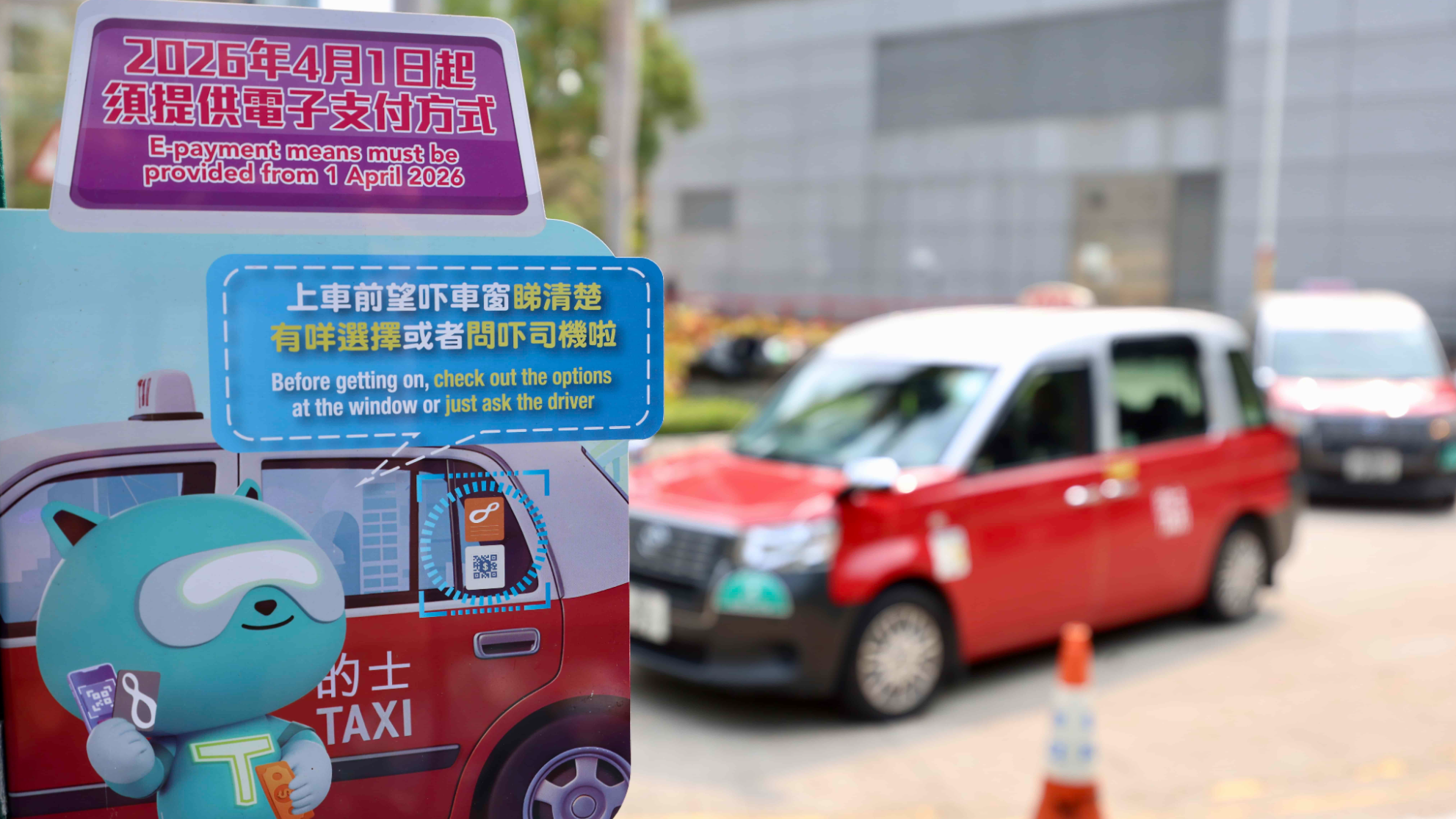
Hong Kong’s taxis entered a new era of fare payments on Wednesday with full implementation of the Transport Department’s requirement that all drivers must offer passengers at least two electronic payment options.
More choices have been offered, including QR code platforms such as AlipayHK and WeChat Pay HK, as well as Octopus, credit card and the Faster Payment System.
Commissioner for Transport Winnie Tse said this move will enhance the industry’s image, improve convenience and encourage more residents and tourists to choose taxis.
On the first day of implementation, Tse visited a taxi stand in Tsuen Wan and observed that most drivers had already installed appropriate e-payment devices and were operating them smoothly.
ALSO READ: Hong Kong taxi drivers reminded to offer e-payment by April 1
Dominic Lee Tsz-king, a Hong Kong Legislative Council member, said he was heartened to see smooth implementation on the first day of the mandatory taxi e-payment requirement.
Lee said he hopes that this momentum will inspire further improvements across the city’s transport network, and reinforce its reputation as being smart, convenient and tourist friendly.
There are about 46,000 active taxi drivers in Hong Kong, and over 47,000 have already set up Octopus accounts capable of receiving multiple e-payment forms, according to department data.
READ MORE: LegCo passes bill to regulate ride-hailing services in HK
To support those who are yet to be connected, the department has set up dedicated service counters in three government car parks – in Sheung Wan, Kwai Fong and Tsuen Wan – where bank and payment platform staff are offering on-site guidance on opening accounts and setting up terminals. The counters will remain open through Saturday, and Tse urged drivers who have not yet registered to do so as soon as possible.
Both drivers and passengers have reported positive changes. Many taxi drivers say that e-payments speed up transactions, reduce the need to carry large amounts of cash and allow them to complete more trips per shift. Some added that passengers are more willing to tip or select their cab when they know multiple digital payment options are available.
ALSO READ: Four more taxi fleet operators granted HK licenses
Leading payment platforms are also embracing the shift. AlipayHK hailed the new rule as a key step in Hong Kong’s evolution into a smart city and said its “driver code” — a dedicated QR code for taxi drivers — has become a core tool in helping the industry transition.
The driver code offers features such as global acceptance, instant settlement, no transaction or withdrawal fees, no need for a terminal and minimal reliance on the driver’s network.
AlipayHK has worked with the Hong Kong Special Administrative Region government for a long time to support digitalization, from electronic consumption vouchers to participating in the public transport fare subsidy program and the Green Living Programme.
Jason Ma Siu-cheong, co-founder and managing partner of local startup Dash, reported a strong uptake. As of 1 pm on Wednesday, Dash, a government-funded, and Transport Department-approved company for digital payment solutions, had more than 10,000 active drivers on the road, on top of over 2,500 taxis equipped with its meter-linked point-of-sale devices.
Contact the writer at tongsijiu@chinadailyhk.com
