

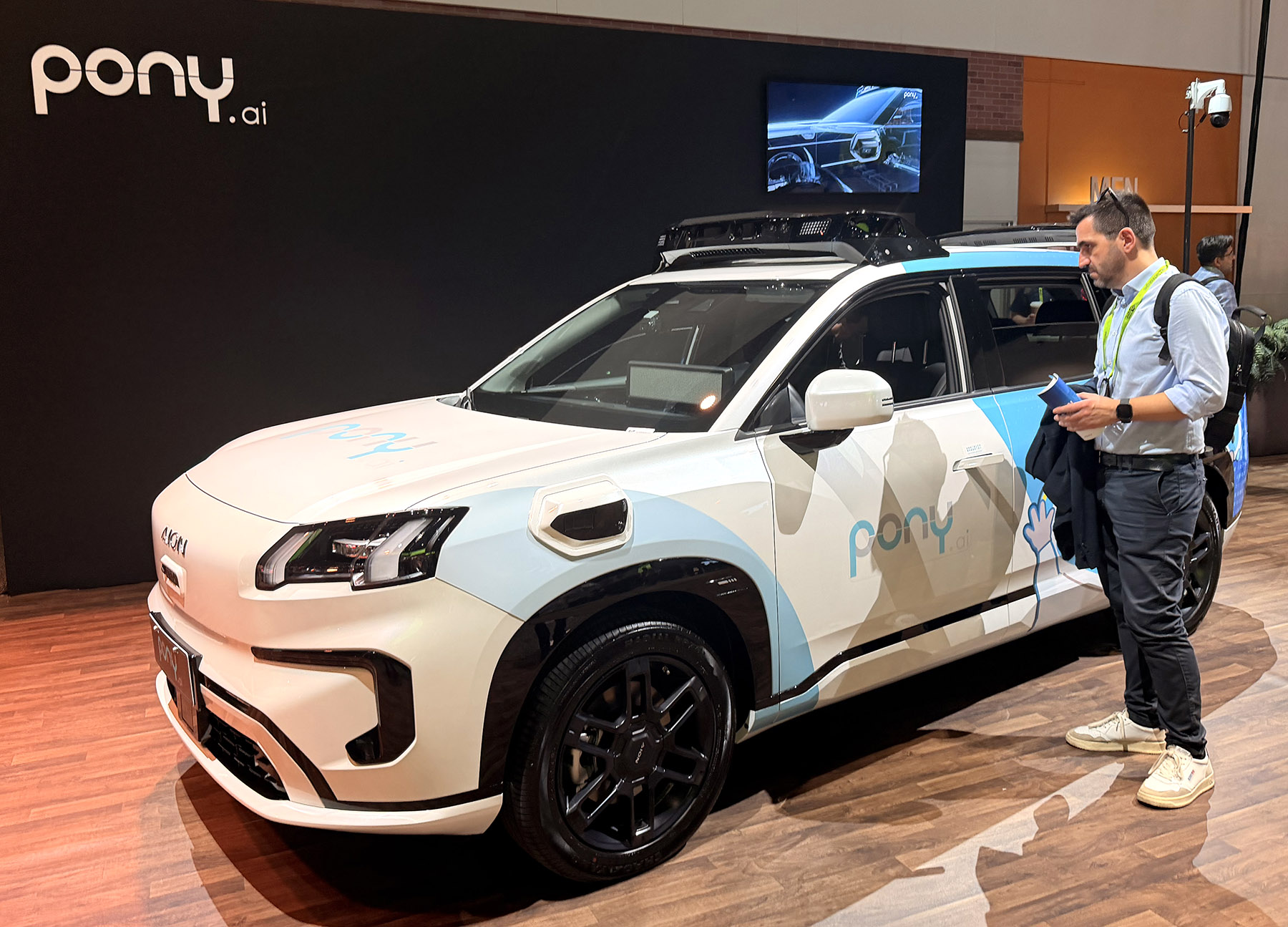
Nvidia is partnering with Chinese carmakers BYD and Geely to tap into the growing autonomous vehicle market, as the United States chipmaker looks beyond artificial intelligence for growth.
Founder and CEO Jensen Huang announced the move on Monday at the company's annual GPU Technology Conference in San Jose, California, declaring that "the ChatGPT moment of self-driving cars has arrived".
The two Chinese automakers will deploy Nvidia's Drive Hyperion platform, an integrated system combining chips, computers, sensors and software engineered for developing Level 4 autonomous vehicles — capable of operating without human intervention in predefined areas or conditions.
READ MORE: AI auto race enters fast lane at CES
Japanese automakers Isuzu and Nissan were also added to Nvidia's robotaxi platform.
The Hyperion platform supports the full autonomous driving pipeline, from cloud-based AI model training to real-time decision-making on the road.
Speaking at a news conference on Tuesday, Huang said the autonomous vehicle business is much larger than commonly perceived, as every major player is working on some kind of autonomous vehicle.
"It's only limited because driving is limited by butts on seats. If we were not limited by butts on seats, the number of miles driven in the world will definitely go up," he said, adding that a largely autonomous road network could become a "multitrillion-dollar business".
Autonomous vehicles designed to transport passengers on demand without a human driver, commonly known as robotaxis, are among the most commercially significant applications of Level 4 technology.
While most consumer vehicles on the market remain at Level 2, requiring constant driver supervision, a growing number of companies are deploying Level 4 robotaxi fleets in select cities.
Chinese company WeRide displayed its Robotaxi GXR at the conference. The vehicle was built with the Hyperion platform, which helps reduce system costs, accelerates safe and reliable Level 4 operations, and enables "easier cross-market validation", it said.
WeRide has outlined ambitious expansion plans, targeting more than 2,600 robotaxis in operation globally this year and tens of thousands by 2030.
'Doing great'
"In China, BYD, Geely, XPeng and Li Auto are all our partners and customers," Huang said at the news conference. "They're doing great, and they're going to continue to do great."
He said Nvidia has "standardized on a platform architecture — sensors and computing with all of them, called Hyperion".
"When their car goes to Europe, maybe some countries who are unable to accept their software stack, the Nvidia software stack can be used," he said.
Monday's announcements add BYD and Geely to a roster of Chinese electric vehicle makers using Nvidia chips for intelligent driving applications, including GAC Aion's sub-brand Hyper, as well as XPeng, Li Auto and Zeekr.
ALSO READ: Nvidia unveils new AI technologies at annual developer conference
China's autonomous vehicle market is expanding at a rapid pace, with cities including Beijing, Shanghai and Shenzhen authorizing driverless operations in designated urban zones. Domestic players such as Baidu and Pony.ai are already running fully driverless commercial services in those cities.
That scale makes China a valuable environment for refining AI-powered driving technology, industry experts said. Autonomous driving is fundamentally a data problem, as the more kilometers driven, and the more cases outside of normal operations that a system encounters, the stronger its underlying AI becomes.
By deploying its platform across millions of vehicles in China, Nvidia can generate the real-world training data needed to outpace competitors and accelerate improvements to its platform, analysts noted.
Contact the writers at liazhu@chinadailyusa.com
