

For one group of young men, the office is a bridge towering 110 meters over the valley, Li Yingxue reports.
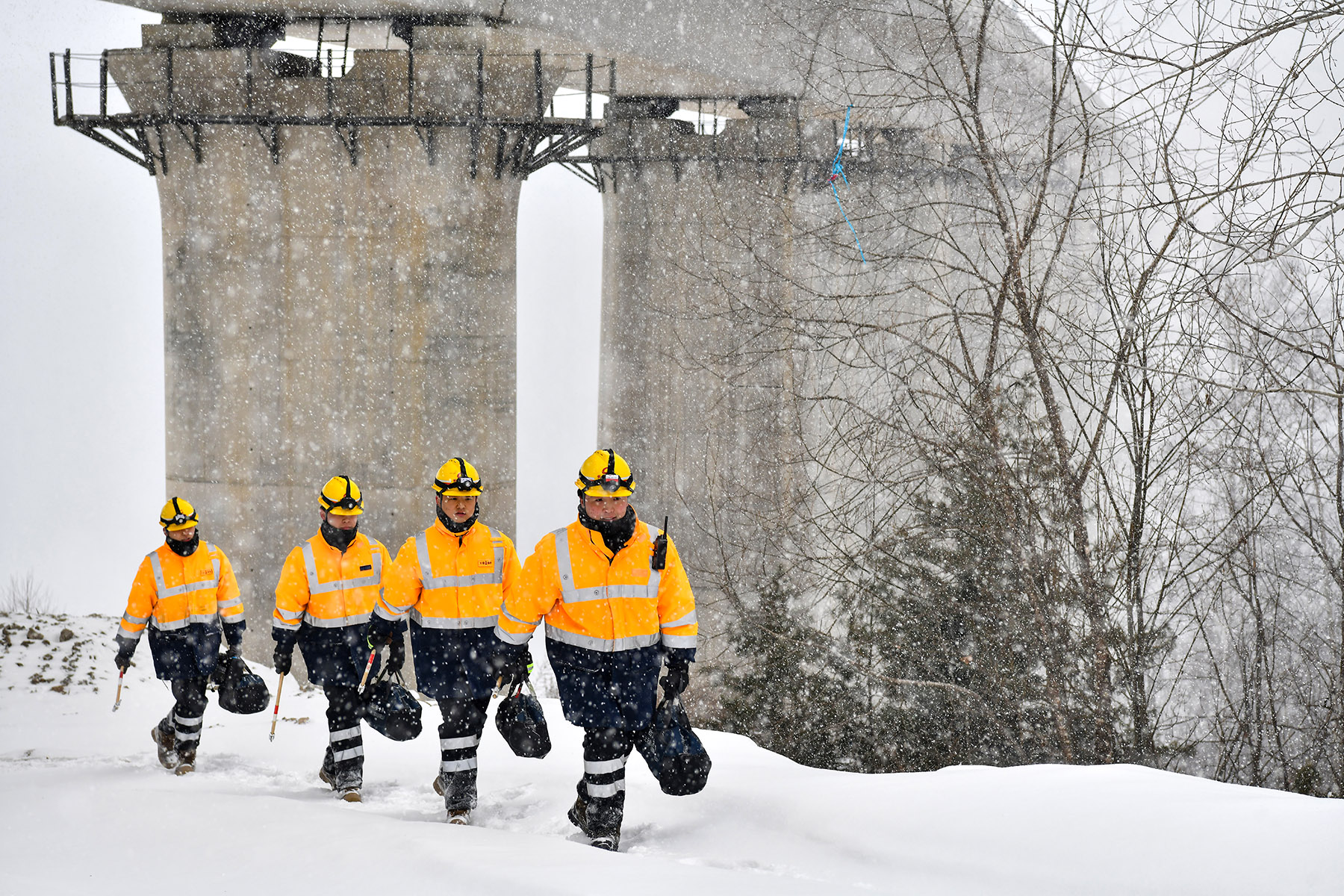
In the Changbai Mountain region in Northeast China, winter can be a test of endurance. The wind cuts like a blade, temperatures plunge to — 30 C, and snow buries boots to the ankle.
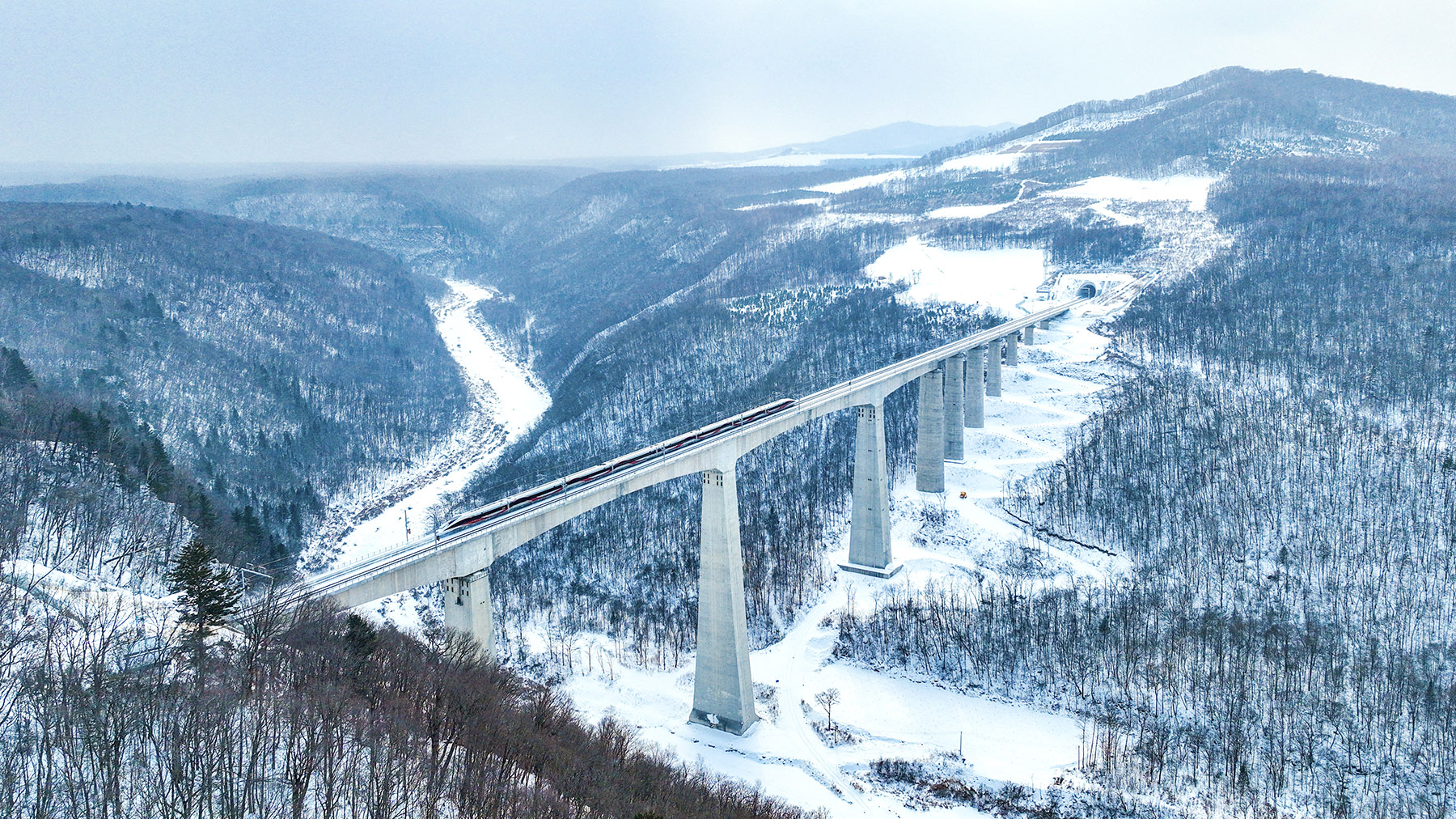
Against this vast white silence stands the Toudao Songhuajiang Railway Bridge, a steel-and-concrete sentinel on the Shenyang-Baihe High-speed Railway. Its No 9 pier soars 110 meters — the height of a 33-story building — the tallest high-speed rail pier in Northeast China.
High above the frozen valley, a group of young men moves methodically through the dark. Their headlamps flicker in the wind. They have been here long before dawn.
They call themselves bridge inspectors. They are also dubbed the youngest "bridge guardians" on the line.
The seven-member team, with an average age of just 27 and composed largely of those born after 2000, works for China Railway's Shenyang Group. They are responsible for inspection, emergency response and routine maintenance along the Shenyang-Baihe section of the Shenyang-Jiamusi High-speed Railway, with a particular focus on the Toudao Songhuajiang Railway Bridge and the Yuanchi Railway Bridge, both grand bridges.
When the Shenyang-Baihe High-speed Railway officially opened on Sept 28, 2025, it ended the era in which Liaoning's Fushun, and Jilin's Tonghua and Baishan had no high-speed rail access. The fastest journey from Beijing Chaoyang Station to Changbaishan Station was shortened to just 4.5 hours, carving out a new route for tourism and the region's growing ice-and-snow economy.
For these young workers, however, the line is not measured in travel time but in responsibility. They were involved as early as the construction phase, and when operations began, they stayed on — shifting from builders to guardians of the route.
During construction, early autumn on Changbai Mountain was damp and bone-chilling. In tunnel shafts where water remains at 4 C all year round, team members had to descend into icy pools to check for pipe debris, misalignment and structural damage. Work uniforms were soaked through within minutes. Each worker carried two sets of clothing, changing whenever one became saturated.
It was not heroism, they say — just the baseline for quality control.
In June 2025, as the project entered a critical phase, Tonghua endured more than two consecutive weeks of temperatures above 30 C. The team walked more than five kilometers a day along the line. A strict rule was set before every shift: drink two bottles of Huoxiang Zhengqi Shui, a traditional Chinese herbal tonic used to prevent heatstroke and maintain energy, before stepping onto the tracks. Heatstroke prevention came first; the work followed immediately after.
From frigid tunnels to scorching ballast, from underground pipe networks to towering piers, they completed their transition from construction participants to frontline custodians.
The Spring Festival travel rush marked the railway's first major operational test. For the inspection team, that meant midnight shifts.
At 24, Jiang Hongyu is already considered a core member. Born in 2002, he graduated in 2023 from Jilin Tiedao University, majoring in railway bridge and tunnel engineering. Less than two years into the job, he has become adept at high-altitude operations.
"When I first started, I was afraid of heights. I didn't dare look down," Jiang says. "But high-speed rail safety doesn't allow for distractions. Once you do it enough, you stop being afraid."
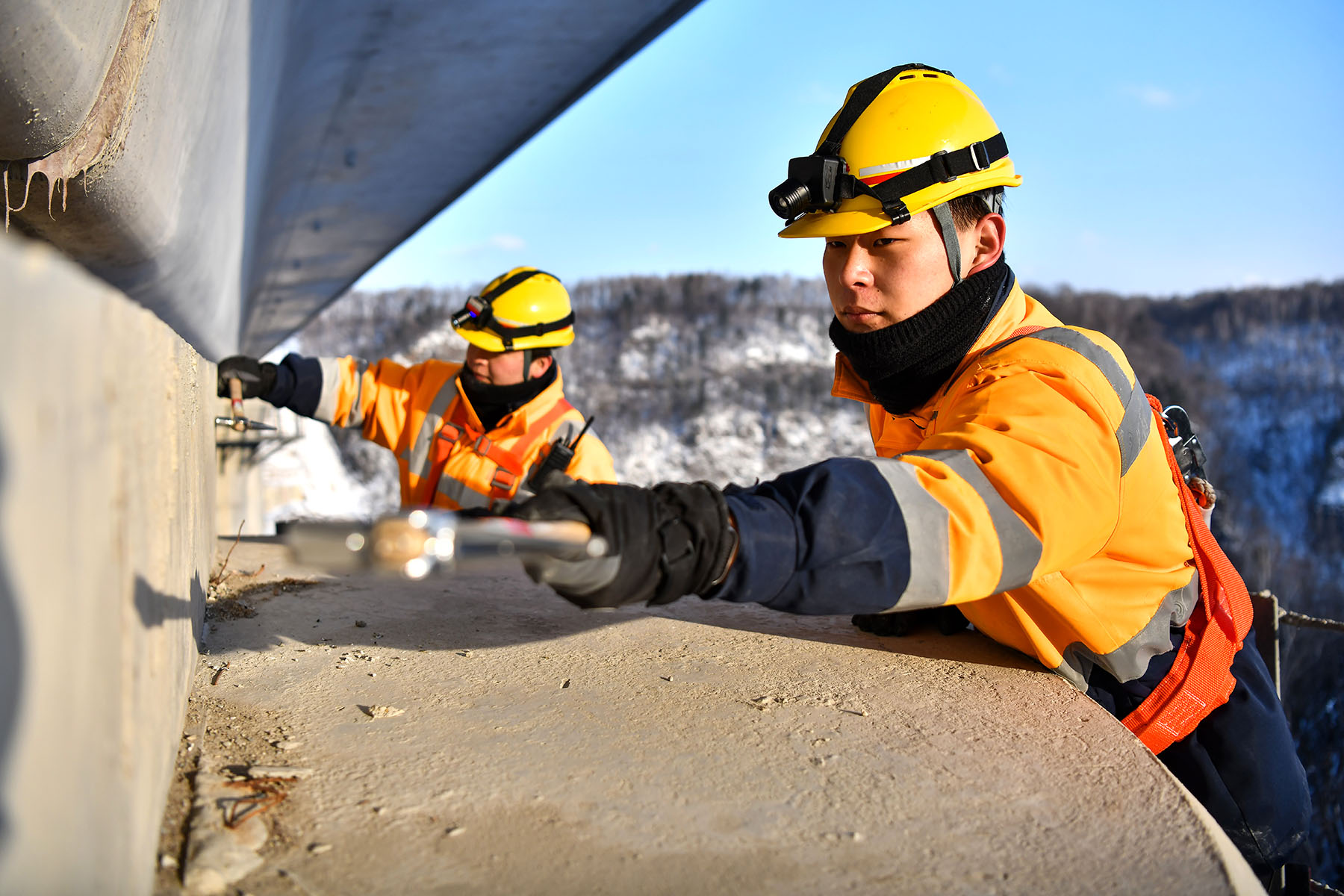
Shortly after midnight, Jiang and his colleagues shoulder safety ropes and inspection hammers and head onto the Toudao Songhuajiang Railway Bridge. They enter the box girder cavity, where the air is still and smells of metal. By the dim light of their headlamps, they tap along the inner walls section by section, listening for hollow echoes that might signal cracks, spalling or hidden defects.
When the girder inspection is complete, Jiang fastens his rope and climbs down a vertical ladder to the pier-top suspended platform. Below him lies a black mountain valley. The wind howls. The vapor from his breath crystallizes along the edge of his helmet. He bends low, checking bearing pads, anti-fall beam blocks and bolt fastenings. Even millimeter-scale irregularities are recorded.
"The bridge piers are the legs of the high-speed railway," Jiang says. "Any tiny hidden risk could affect train safety."
To his colleagues, he is quiet but exacting. "I trust Hongyu completely," says team leader Wang Kai. "He works steadily and pays attention to detail. When I assign him bridge or tunnel tasks, I don't worry. He can shoulder responsibility."
Beyond the region's tallest pier, the team also maintains the Yuanchi Railway Bridge. A 235.8-meter fully enclosed sound barrier — the first of its kind on a high-speed railway in Northeast China — shields the habitat of a rare duck, the nationally protected Chinese merganser, acting like a silent coat for passing trains and minimizing noise impact on the surrounding ecosystem.
On subzero nights, with headlamps cutting through the darkness, the young inspectors move methodically along the bridge.
Chen Boyu, who has been on the job for less than two years, still recalls team leader Wang's advice: "The lighting at night is poor, so you need to inspect even more carefully." Every column, panel unit, and bolt is scrutinized, ice buildup and wind damage carefully noted, as the team balances precision with speed in the freezing wind.
"Most of what we maintain serves passengers," Jiang says. "But this sound barrier protects wildlife and the environment. That feels different."
Their work blends endurance with technology. Drones rise from snowy embankments, scanning towering piers, slopes, and tunnel entrances, while rebar detectors and crack-measurement instruments complement hands-on inspections. Real-time images stream back to handheld controllers, revealing hairline cracks and subtle defects that would be nearly impossible to spot with the eye alone.
"Subtle cracks or hidden defects that are difficult to see with the naked eye can now be quickly detected using drones," Chen explains.
Even before the railway opened, this team of post-2000s workers helped build a "bridge and tunnel gene database", collecting nearly 50,000 structural parameters. That data now serves as a benchmark, sharpening inspection efficiency and accuracy, and ensuring that every train gliding across the valley does so under the vigilant eyes of a generation that guards both infrastructure and the environment with equal care.
By day, they scale piers; by night they patrol sound barriers. Their work remains largely unseen. Even family members struggle to describe exactly where they work — somewhere in the wind and snow of Changbai Mountain, somewhere 100 meters above a frozen river, somewhere inside a dim concrete cavity long after midnight.
Yet every early departure, every careful tap of a hammer, every bolt rechecked is part of a quiet discipline. The trains that glide across the valley at dawn carry tourists, commuters and opportunity. Beneath them, in the cold and darkness, a generation born after 2000 keeps watch — measuring safety in footsteps, and guarding the line with patient precision.
Contact the writer at liyingxue@chinadaily.com.cn
