

A wooden plaque embedded with four characters carries a clan's identity throughout its migration from north to south and beyond, Yang Feiyue reports.
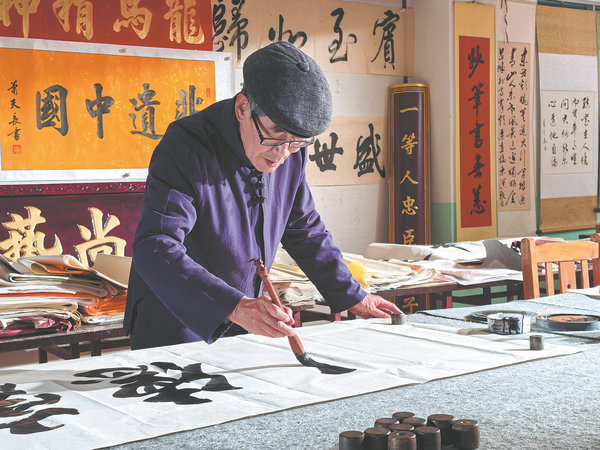
In the Hakka villages of Huichang county, in eastern China's Jiangxi province, a family's identity is declared not with a nameplate, but with an ornate door plaque.
Mounted like a proud brow above the home's entrance, the bian'e is a rectangular wooden board carved with two to four elegant Chinese characters traditionally hung above doorways or in ancestral halls.
It is not only for decoration but also the family creed — a statement of history, and a declaration of values hanging in plain sight.
Driving through the Hakka villages, you'll see them everywhere: centuries-old ancestral halls and modern concrete homes share this silent language.
Originally, the Hakka ethnic group was North Chinese who migrated to South China during the fall of the Song Dynasty (960-1279). They are considered to be a branch of the Han ethnic group.
The tradition of bian'e speaks first, as the characters on the plaque whisper of an ancestral home a thousand miles and a millennium away, declaring a household's creed of diligence and virtue or hopes for future prosperity.
"You can think of Huichang county as an open-air museum, where every doorway is an artifact," explains Huang Zhenlong, director of the Huichang county cultural hall.
"The Hakka bian'e tells our story of migration, scholarly ambition, and moral accountability."
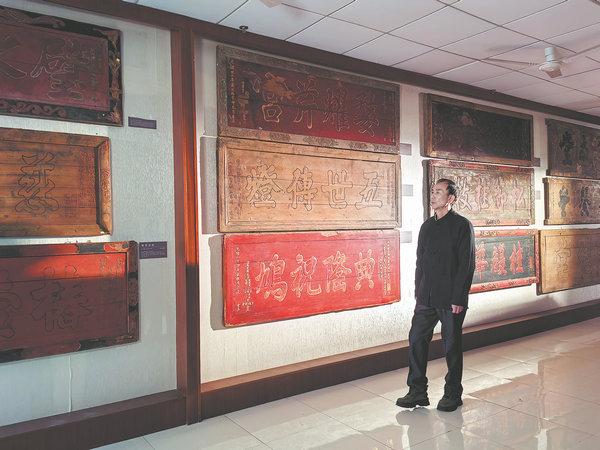
There is no better place to appreciate the profound history behind those wooden boards than the Hundred Plaques Hall, a quiet sanctuary that preserves over 130 bian'e from the Ming Dynasty (1368-1644) onward.
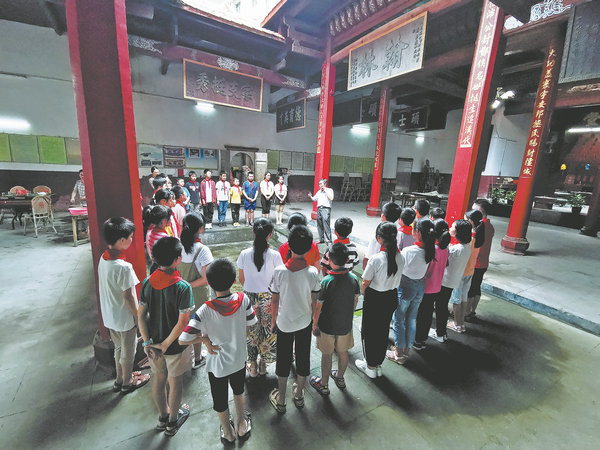
Huang sees the plaques as community connective tissue, as he points to a Ming-era plaque, Zhuangxi Caotang (Zhuangxi Thatched Hall).
"This piece of wood does two remarkable things," he explains.
The name itself led researchers to local archives and clan genealogies, which led to the discovery of an academy and its founder.
More significantly, the signature revealed the calligrapher was Luo Hongxian, then a top national scholar.
"This piece of wood is a tangible receipt, proof of a moment when our local story was validated by the highest tier of the national intellectual elite," Huang says.
The plaques are categorized like chapters in a social ledger. The tanghaobian (hall name plaque) announces lineage, while the gongdebian (virtue plaque) honors good works, a vibrant, living tradition.
Recently, the local clan of 90-year-old veteran Zheng Zhaolin, who fought in the War to Resist US Aggression and Aid Korea (1950-53), had a gongdebian carved, proclaiming him a "Paragon of the Clan".
The bian'e was paraded through the village with fanfare before being enshrined in the ancestral hall.
"It's our living system of ethics," Huang says.
"It takes abstract 'goodness' and makes it tangible, permanent, and public for every child to see."
The bian'e stands as a defining emblem of traditional Han culture. For millennia, it has served as a public testament to family honor, individual achievement, and scholarly distinction, while actively promoting the core Confucian virtues of morality, propriety, and benevolent conduct.
This tradition was carried south over a millennium ago, with the great migrations of Han Chinese scholar-official families from the north. As these displaced elites resettled in the rugged south, they clung to cultural pillars like the bian'e to maintain clan identity and social order in an unfamiliar landscape.
The southern Jiangxi area was one of their first major settlements.
Here, the plaque custom took root and uniquely evolved. Settling into tight-knit clans for mutual support, Hakka communities constructed ancestral halls, adorned with plaques declaring lineage and honoring virtue and longevity.
Thus, each plaque symbolizes the collective duty to strengthen kinship ties, honor filial piety, and inspire future generations, Huang says.
This system played a crucial, stabilizing role in maintaining family, clan, and local social order, he adds.
Beyond their social function, these plaques are treasured vessels of artistic heritage, preserving exceptional calligraphy and frequently embedded with intricate carvings, achieving a rare synthesis of high art and popular custom, thus providing scholars with invaluable material for studying social history, genealogical patterns, and regional art.
Words into wood
If Huang is the interpreter of this language, then Xiao Tianchang is its scribe.
In his 70s, Xiao is a provincial-level inheritor of the Gannan (southern Jiangxi) Hakka bian'e-making, which was listed as a national intangible cultural heritage in 2014.
In his workshop, the air smelled of camphor wood and tung oil. Dressed in a traditional Tang (618-907)-style suit, his black-rimmed glasses perched low, Xiao was busy making new plaques for the Spring Festival holiday.
"This is the time when families reunite, when clans complete their ancestral hall renovations, and we honor achievements," Xiao says, adding that winter, especially right before Spring Festival, is the season for ceremonies.
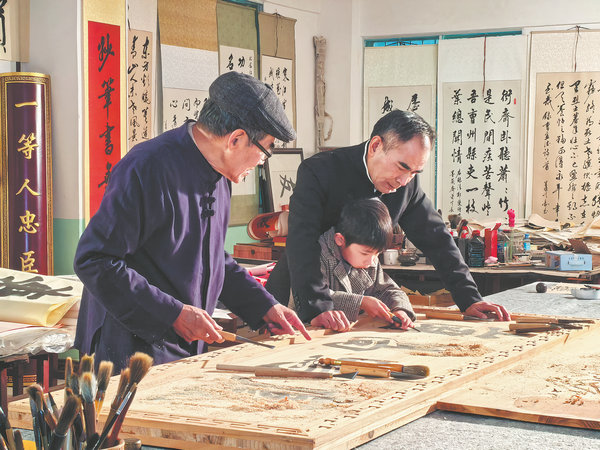
Plaques in various stages of completion lean against the walls of his workshop — some freshly carved, others awaiting layers of lacquer or the delicate application of golden foil.
Xiao explains that his current works have been congratulatory plaques for newly built or renovated ancestral halls.
"They carry blessings for the future, with phrases like 'Ten Thousand Generations of Prosperity'," he elaborates.
Then, there are the virtue plaques.
"These are for honoring living members of the clan — the student who earned a doctorate, the soldier who served with distinction, the elder whose lifelong generosity inspired the village," he explains.
In the days before the Chinese New Year, it has long been a tradition to make their contributions "permanent".
An observation of Xiao's work reveals a physical marathon layered with intellectual artistry that fuses poetry, calligraphy and carving.
"It usually takes more than a week to finish a plaque from scratch," Xiao says.
The most challenging part, he insists, isn't the carving but composing the perfect four-character inscription. "You must understand the family's history, the reason for the honor, and find words that are both timeless and precise for them," he says.
"It requires study, and you can't repeat old phrases."
A prodigy in calligraphy since his youth, Xiao masters styles from the flowing xingshu (semi-cursive script) to the solemn kaishu (regular script).
This gives Xiao irreplaceable value in an age of computer fonts.
"Families come to me for the hand, for the intention," he states.
Even as he upholds tradition, Xiao adapts to combat the elements on outdoor plaques and has developed a "rivet-reinforced" technique to prevent cracking.
Sacred rituals
The broader bian'e culture includes ceremonial hanging rituals and social customs. The journey from Xiao's workshop to its permanent home is a ritualistic crescendo known as guabian (hanging the plaque).
It is an eight-step communal ceremony, which Huang and Xiao both describe as the clan's formal petition.
The plaque will be paraded through the streets and escorted by roaring percussion and curling smoke from firecrackers, symbolizing solemn offerings to ancestors. A climactic, silent moment comes when the plaque is lifted and secured high in the ancestral hall.
"It is the loudest and then the quietest moment," Xiao notes.
"The noise is a public celebration. The silence is when the weight of history and expectation settles onto the wood. Everyone feels it."
Today, the bian'e tradition continues to serve as a social function that binds, honors, and guides locals.
Demand persists, not just locally but also from the global Hakka diaspora seeking tangible links to their roots.
As Xiao buries his head in his wooden works, he expresses an underlying anxiety.
"The craft requires the mind of a poet, the hand of a calligrapher, and the patience of a master joiner, making it a challenge to find successors," Xiao admits.
To date, he's found a little solace in his son and a long-term apprentice who both work with him, blending handcrafting with digital designs as layouts.
He notices that many young people are growing fond of creative cultural items in the form of miniature bian'e.
Huang sees a broader cultural negotiation beyond preserving the wooden boards.
"We are preserving a system of values, a way of seeing family and community. The bian'e culture resembles a textbook and reminds us of things that matter, without preaching," he says.
"It is our family's promise, carved not in stone, but in wood, because wood is alive. So, we hope, is the promise."
Contact the writer at yangfeiyue@chinadaily.com.cn
