

Editor's note: As protection of the planet's flora, fauna and resources becomes increasingly important, China Daily is publishing a series of stories to illustrate the country's commitment to safeguarding the natural world.
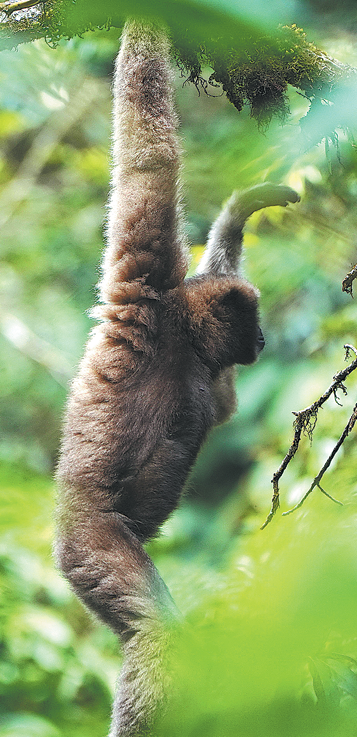
In the mist-shrouded valleys of the Gaoligong Mountains in Yunnan province, a unique dawn chorus echoes each morning — the song of the Skywalker hoolock gibbon, the only ape species to be named by Chinese scientists. With fewer than 200 individuals remaining in the wild in China, the survival of these endangered primates now rests with a dedicated team of forest guardians and a conservation strategy that has evolved significantly over the past two decades.
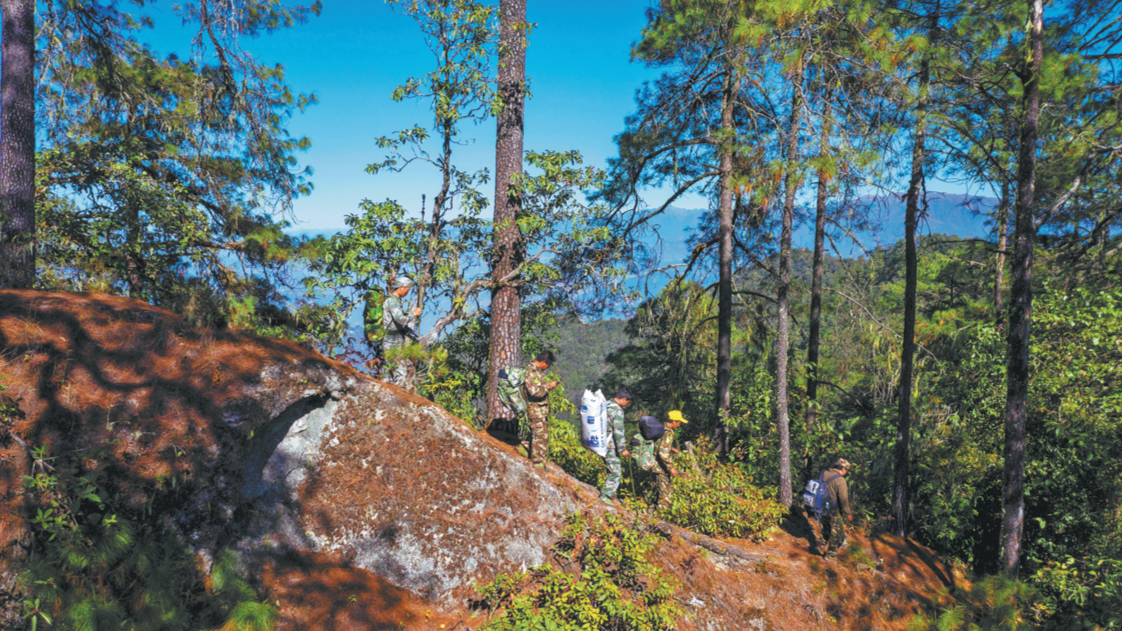
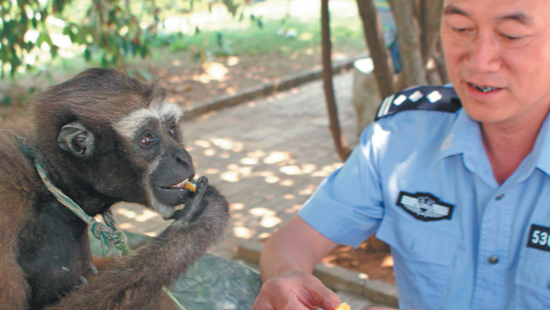
On a recent winter morning, well before sunrise, Yang Youshan began his ascent into the Gaoligongshan National Nature Reserve. The 50-year-old forest ranger was searching for an elderly pair of Skywalker hoolock gibbons he has tracked for 17 years — a bond so deep he has learned to read the forest through their eyes.
READ MORE: Love for coffee revitalizes a mountain
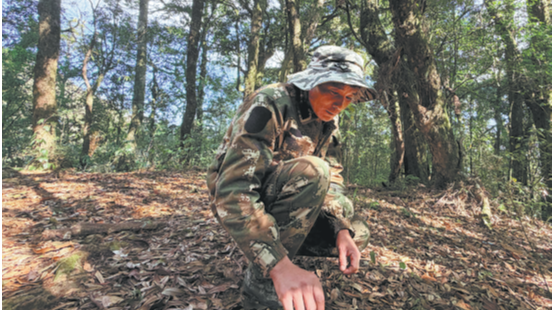
"I mainly rely on their food," Yang said, pausing on a steep trail lined with numbered trees. "Depending on the season — spring, summer, autumn, winter — we know what fruits they eat, what tender leaves they prefer." This knowledge, honed through years of patient observation, allows him to predict their movements across a landscape marked by more than 1,800 cataloged food trees.
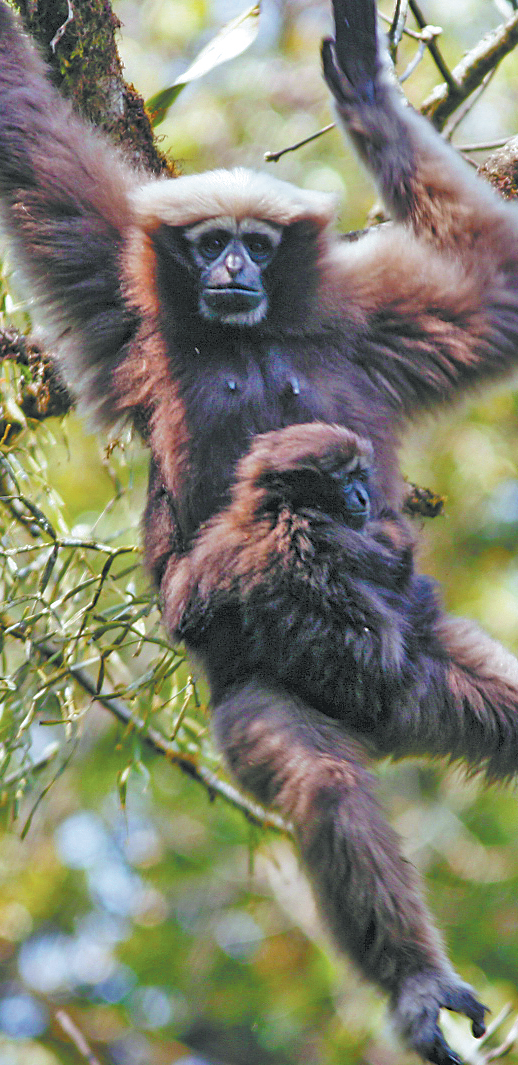
The gibbons he guards are showing their age. "Their movements have become slow, their fur has turned black," Yang noted. The female, once easily identified by her brownish coat, has darkened over time. DNA analysis of their feces and urine confirms the pair is long past breeding age. An infant Yang first spotted in 2008 has since vanished, likely taken by a raptor.
"If I didn't have feelings for them, I definitely couldn't have done this for 17 years," said the part-time ranger, who also tends a small coffee plot in a nearby village.
From rumor to science
Last year marked the 20th anniversary of the first photograph of what would eventually be recognized as the Skywalker hoolock gibbon — a creature long mistaken for its cousins across Myanmar, India and Bangladesh.
The journey from misclassification to discovery began in 2007, when researchers led by Fan Pengfei of Sun Yat-sen University started questioning the identity of China's gibbons. Photographs revealed subtle but consistent differences: males lacked the white beards and eye-patch markings of known species, while females showed less prominent white facial rings.
For the next decade, an international team pieced together evidence — examining 122 specimens in museums across China, the United States and Europe, analyzing teeth morphology, and sequencing DNA. They found China's gibbon population had diverged from the eastern hoolock gibbon around half a million years ago, a time frame comparable to other recognized primate species.
On Jan 11, 2017, the team formally described Hoolock tianxing in the American Journal of Primatology. The name combined "tianxing", an ancient Chinese term meaning "heavenly movement", with a nod to Star Wars — reflecting Fan's admiration for the franchise's Luke Skywalker.
When Li Jiahua arrived as the inaugural chief of the reserve's Nankang Management Station in late 1997 — where Yang now works — the gibbons were barely more than a rumor: occasional calls in the mist, fleeting glimpses before they vanished. Today, as deputy head of the reserve's Longyang bureau, he oversees a transformation from casual observation to precision science.
The breakthrough came on May 16, 2005, when Li's cousin and successor, Li Jiahong, captured the first clear photograph using an old film camera. That single image opened the door for researchers from multiple universities to study the mysterious apes.
Evolving conservation
Over the past two decades, monitoring methods have advanced in distinct waves, experts said.
Around 2008 and 2009, teams began using vocalization triangulation. By fanning out across the forest and timing the gibbons' morning calls from multiple positions, they could map family groups with increasing accuracy.
The early 2010s brought the "three-designated" system: designated people monitoring designated apes in designated groups, year after year. "When you first start monitoring them, they are very afraid of people," said Ding Jiatuan, current chief of the Nankang Management Station and Yang's supervisor. "You have to habituate them, get them used to you. You can't keep changing the monitors."
The latest innovation, introduced just two or three years ago, is acoustic monitoring. Small recording devices capture individual vocal fingerprints. "Each gibbon has a unique voice," Li Jiahua explained. This allows researchers to identify solitary individuals who rarely reveal themselves.
The recordings may eventually serve a new purpose: matchmaking. A documentary project, A Song For Love: An Ape with An App, used real-time audio to connect a captive male at a Beijing zoo with a solitary female in the Gaoligong Mountains. "They responded strongly to each other," Li said — planting the idea that recordings could one day help introduce isolated individuals across the fragmented forest.
The altitude challenge
Despite advances, the reserve's gibbon population has remained frustratingly stable — around 50 individuals across 19 groups, including 14 families and 5 solitary adults.
Meanwhile, populations in nearby Yingjiang county have grown to more than 100.
The difference lies in elevation, Li Jiahong explained. Gibbons naturally prefer altitudes around 1,500 meters, where the climate is warmer and food is abundant. But centuries of human activity — clearing forests for farming, planting sugarcane and coffee — have pushed Gaoligong's gibbons steadily upward. Today, they survive at elevations of 2,000 meters or higher in cold, marginal habitats.
"In Yingjiang, the elevation is around 1,600 to 1,700 meters, which is much more suitable," Li said. "That's why their population has expanded faster."
The solution, he believes, is helping gibbons return to lower elevations by restoring degraded forests on collectively owned land below the reserve — creating corridors and planting food trees like long-stamen magnolia that provide year-round sustenance.
Sometimes the barriers are smaller than a mountain. A road, a landslide clearing, a gap in the canopy — any of these can stop a gibbon that rarely descends to ground. In collaboration with researchers at Sun Yat-sen University, the reserve has begun installing simple rope bridges at key locations to connect fragmented forest sections.
The protection strategy extends beyond the reserve's core zone. In 1996, recognizing that the gibbons' habitat was becoming fragmented, authorities established a 4,800-hectare biological corridor connecting the Gaoligongshan National Nature Reserve with the Xiaoheishan Provincial Nature Reserve. "Before this, the state-owned forest in between was not well protected, and wildlife couldn't move between the two reserves," Ding explained, standing at the edge of the now-lush corridor. Today, this green bridge teems with life — infrared cameras frequently capture red panda, Chinese goral, and the increasingly numerous red spurfowl, proof that protecting the flagship gibbon shelters an entire ecosystem.
A legacy of listening
For all the technological advances, conservation remains fundamentally human. Li Jiahua has spent years training a new generation of rangers and researchers, building expertise in botany, ornithology, and insect ecology. He has become the reserve's unofficial storyteller, giving hundreds of talks to visiting scientists, officials, and local communities.
The outreach matters. Decades ago, hunters regularly entered the mountains with rifles; today, such activity has nearly disappeared. Some former hunters have joined the ranger force, transforming from poachers to protectors.
READ MORE: On timeless rivers, life finds a peak
As dusk settles, Yang Youshan points to a tall tree marked with a white, corner-notched sign — a designated sleeping tree, the 97th cataloged in his area. He knows the elderly couple will likely spend the night in one of these giants within their territory. For him, the thousands of marked trees are not data points; they are landmarks in a shared life.
Contact the writers at lilei@chinadaily.com.cn
