

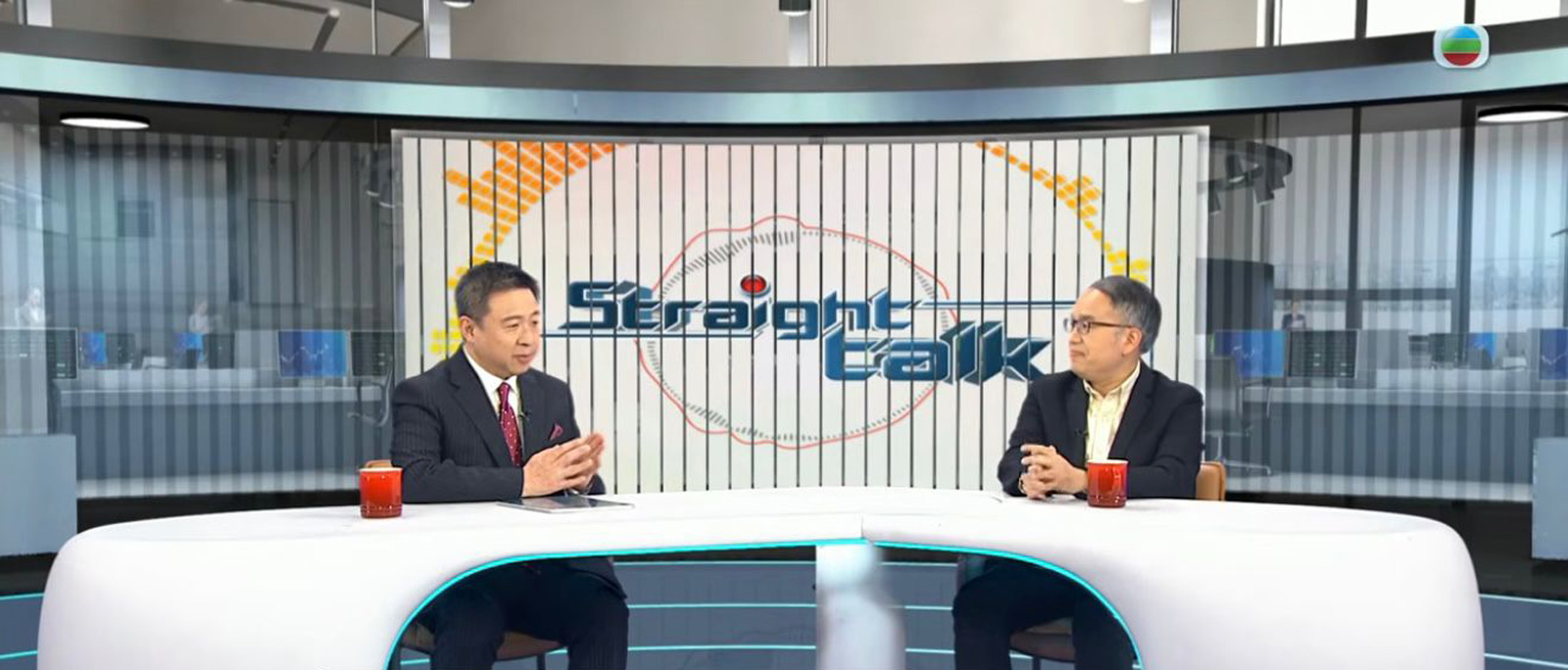
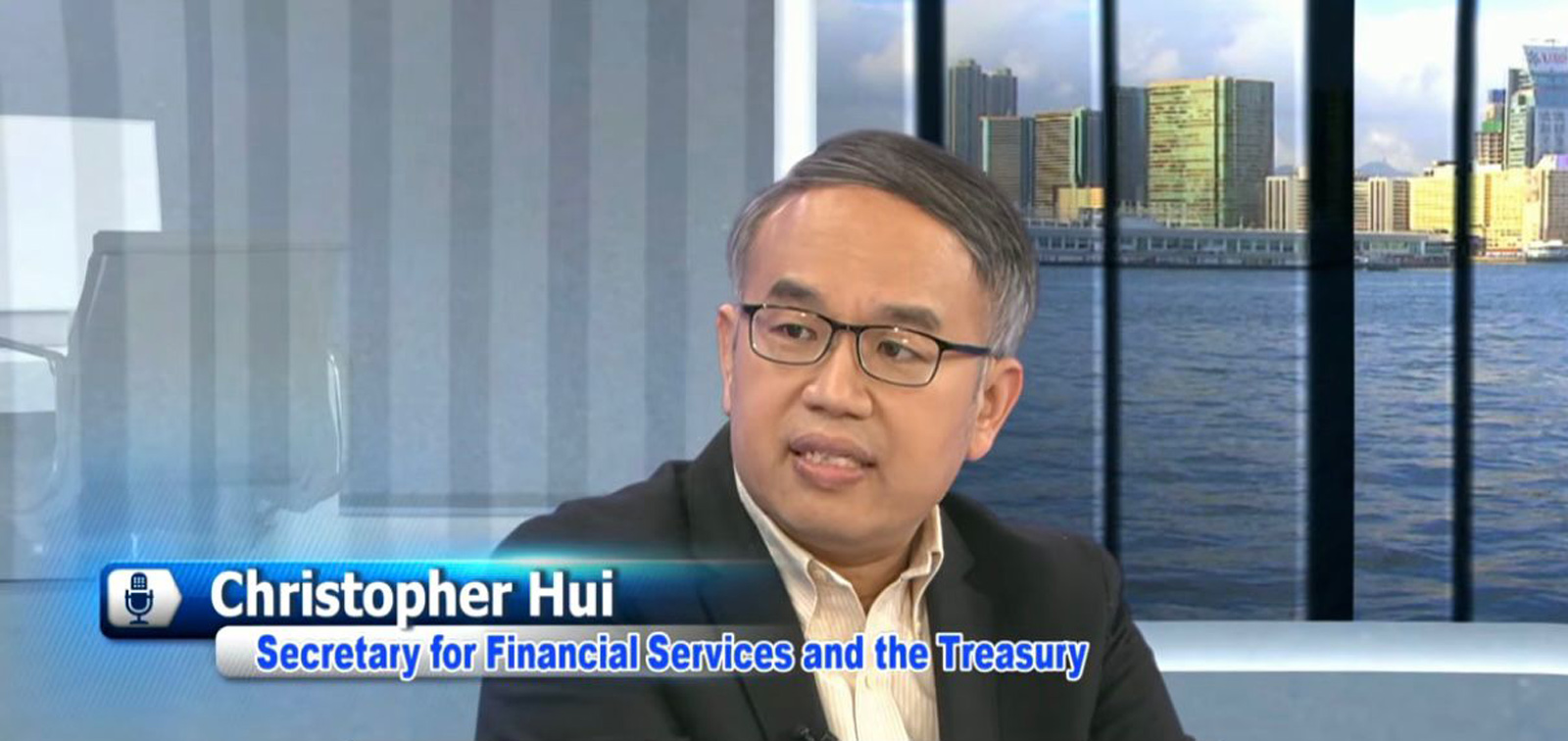
Secretary for Financial Services and the Treasury Christopher Hui Ching-yu is on the show to reflect on the Asian Financial Forum, which concluded on Tuesday, and what it means for Hong Kong’s role as an international financial center.
Check out the full transcript of TVB’s Straight Talk host Dr Eugene Chan Kin-keung’s interview with Secretary Christopher Hui:
What is AFF?
Chan: Welcome to Straight Talk! I'm Eugene Chan. The Asian Financial Forum, Hong Kong's flagship annual gathering of global financial and business leaders, has concluded today. Joining us to reflect on the forum, and what it means for Hong Kong's role as an international financial center, is Secretary for Financial Services and the Treasury Christopher Hui Ching-yu. Hui oversees Hong Kong's financial and treasury policies, and brings extensive experience across banking, markets, and public service. Secretary Hui, welcome to the show!
Hui: Thanks for having me, Eugene!
Chan: It has been a while, we have had you on the show, and you're coming at a perfect time that the AFF actually just concluded today. For the viewer's information, what exactly is AFF, and what is its importance to Hong Kong as an international financial center (IFC)?
Hui: In fact, this year, we are having the 19th anniversary of the Asian Financial Forum. Basically, it's the flagship event of my bureau to showcase the advantages of Hong Kong as an international financial center, and the ‘one country, two systems’. And this year, it's especially timely special for three reasons. First of all, it is the commencement year of the 15th Five Year Plan.
Chan: Right.
Hui: And that's why what we said it’s coinciding with the overall national strategy. And another key element that we have this year is the introduction of a collaboration that we have with the Shanghai Gold exchange, to develop Hong Kong as an international gold trading center, in line with the Chief Executive's overall direction, as set out in his policy address. This is a second distinguishing feature. And the third bit is that one of the key elements that we had this year is that even though we talk about finance, we are not talking about finance only. We are ensuring that the corporate businesses are being empowered by finance. That's why, on the second day of the forum, we have a special global business summit, congregating many Chinese companies and international companies who are going global through Hong Kong in such a way that we can highlight the professional and financial services that we can offer them.
Chan: Right, Chris. You know, there are many international financial meetings, and what distinguishes AFF compared to the others, and I'm sure, as a global, sort of a corporate, when you decide where to go, they must have their priorities. So, why is it Hong Kong, or what is our strength, that we can attract all these international leaders to Hong Kong?
Hui: I think, first of all, if we look at a turnout this year, we have more than 3,600 of them, from over 60 economies. At the same time, we have more than 100 speakers. So, it's really telling, in the sense that we are having a very international event, that's number one. And number two, if you look at the composition of the background of people coming here, not just finances, but at the same time, we have economists, minister of finance, at the same time, representatives from the multilateral organizations. Like, for example, we have the new president of the AIIB, the Asia Infrastructure Investment Bank, who's going to have an office here in Hong Kong this year, and this is the first time that she’s on this role, then having an international appearance or international forum. So, I think, on this regard, basically, you see the composition, and the background, and a number of our international turnout, that it's very obvious, that Hong Kong is getting increasing traction from the international community. Right, so that's the reason why we keep on …
Chan: It's important for the bureau to keep hosting this important event for Hong Kong, isn't it?
Hui: Yes, 19th year.
Chan: When you talk about events, especially forums, we all been to forums, and sometimes there are critics who say, all these forums will generate a lot of good ideas, good conversations, but little follow-up. So, what impact do you think this AFF is going to be on Hong Kong and our neighboring cities?
Hui: I think one of the key themes this year, as I said, is about the gold market development.
Chan: Right.
Hui: This is something that the Chief Executive has set out to do in his previous policy address, and we actually laid out a very clear pan in terms of how we're going to grow this ecosystem. First of all, we are collaborating with Shanghai Gold Exchange, where we actually sign an agreement with them at the forum to highlight our collaboration on the clearing side. At the same time, we are going to build our ecosystem by having more storage of gold facilities here in Hong Kong. And the Policy Address is already set out that we are going to increase by 2,000 tonnes in three years' time. And also, at the same time, we are leveraging our proximity to send in to ensure that our operators here, to take advantage of the smelting, and also processing facilities of gold in Shenzhen, in this whole ecosystem.
Chan: Right.
Hui: So, all in all, I think one of the key deliverables that we will continue to follow up is the gold market development.
Capital markets/IPOs
Chan: I see. So, Chris, I'm sure the viewers who watch the Straight Talk are really supportive of Hong Kong, and we all, we know that the geopolitics is getting quite complicated, and quite sensitive at this moment. And I'm sure one of your aims of this form is to restore the confidence that people have once sort of have been questioning about Hong Kong, and attracting new capital, or even redefining Hong Kong's role in the Asian financial center future. So, is this forum doing just that?
Hui: I must say, if you look at how Hong Kong has been faring so far, we've done very well in terms of financial market development. For example, on the IPO side, we have now more than 350 in the pipeline, awaiting approval. At the same time, if we look at the IPO proceeds that we had last year, we are seeing an almost two times increase. If you look at the number of companies listed in Hong Kong, we are seeing an almost 70 percent growth. So, all in all, you see, the money is coming back. Companies are getting listed. At the same time, the companies that are listening here are getting bigger, and also of a larger scale. So, all these, I think, is reflective, first of all, of our country’s strength, and also the economies there, where we're exhibiting a lot of potential, and also so called new productive forces. And another thing that's highlighting is the fundamental strength of Hong Kong as an international financial center. That's why we accommodate, such a large scale listings within such a short period of time.
Chan: Chris, you know that when you talk about market, I think, ultimately, what we call scorecard, I think, as you just said, the clearest indicators is the IPO market. In 2025, we have a very strong rebound. Do you see this as a one-off recovery, or we have actually fixed the underlying issue to ensuring sustainable for quality listings for years to come? Have we fixed everything?
Hui: I think we have this performance, not because of just a timely performance, but rather, it's based on our fundamentals.
Chan: Right.
Hui: If a look at what we've done so far, since 2018, for example, we have enhanced the listening regime to allow the biotech companies to list. And also at the same time, our journey to enhance our competitiveness in the capital market has never stopped. Like, for example, we have just implemented phase one of our reform to the spread table of our stock market. At the same time, we will soon announce a consultation, in terms of what we will do, to move from T+2 to T+1, to our clearing system. And also, at the same time, we also soon consult the market on the overall enhancement of our listing requirements, including the weighed voting rights. So, I would say, our reform process never stops. And also, actually, we move with times in terms of enhancing the competitiveness of our overall stock market.
Chan: Right. Indeed, it's very encouraging to hear all that's happening in Hong Kong. Another area, people will look at beyond liquidity, I mean, beyond the quality listings, and we always want to have liquidity, which is top concern for the masses. So, any sort of specific or actionable measures that the government's going to do to boost sort of daily training volume or even the market depth? Anything that you guys are doing?
Hui: If you look at the everyday turnover now is almost HK$250 billion a day, which represents almost like 90 percent increase. If you compare last year’s, from the year before last. That’s number one. So, what you're seeing is there's a widespread interest, regionally and globally and also locally, in our stock market. And the second thing that we are doing, apart from revamping our so called micro-infrastructure, including the spread table and others, we are trying to draw more quality listings from around the world, one thing that we have been pushing, will continue to be successful, is to bring more listings, other than from China, to Hong Kong.
Chan: Right.
Hui: And recently, we have, like, example, companies from ASEAN countries, the Middle Asian countries, like Kazakhstan, also listing in Hong Kong. So, I must say that this is an ongoing drive of ours, broaden the sources of list of companies here.
Chan: Right, Chris, since you're here on Straight Talk, we must ask you some hot topics, such as the stamp duty. Some argue that if we have minimal stamp duty, they could have more volume and even better market, but on the other hand, we need the stamp duty for revenue. How do you balance that? Or is there any ways of having the best of both worlds? Is it possible?
Hui: I must say that, just recently, we went to LegCo, and the Financial Security has made it very clear that we are not going to reduce it. This is number one.
Chan: Right.
Hui: And number two, if you look at the, what we have done on the stock market … the stamp duty regime so far, we've increased that, but also at the same time, we've reduced it, and the performance of the stock market. I think the relationship has not been clear. So, all in all, I would say that our position has been very clear throughout.
Chan: Alright, let's go for a short break now. We will be back with more Straight Talk.
Hong Kong’s Competition
Chan: We are back on Straight Talk with Secretary Hui, reflecting on the Asian Financial Forum. Before the break, we were talking about liquidity and market competitiveness. Let's now look at how Hong Kong positions itself against other global financial centers. So, Chris, for an international bank or fund to choose its Asia headquarters, I am sure all of us want Hong Kong to be the headquarters. I am sure the narrative has become more competitive compared to before. Beyond just being the gateway to China, what is Hong Kong's unique value that we can propose in 2026 that cannot be replicated elsewhere?
Hui: I think fundamentally it is definitely “one country, two systems.” In Hong Kong, basically you can operate within common law, and also in a lot of global commercial and business standards, yet at the same time, get access to the most promising and largest market of Asia, which is our own country. And this combination is unique in the sense that you can't find anywhere else other than Hong Kong to do that. That is number one. And number two, if you look at geography-wise, if you want to cover China, for example, as a market, you can do day trips from Hong Kong to Beijing and Shanghai, and also come back to Hong Kong for the evening. You can never do that in other cities of Asia. At the same time, if you look at the understanding of the Chinese market, Hong Kong is conversing both in English and Chinese, and Mandarin and Chinese culture. Again it is very unique in the sense that you can have these people who can, on one hand, bring international to China and also bring China to international. All these basically make a standout, as the financial and also commercial center of the region.
Chan: Right. Chris, there are two cities that I must mention, one is Singapore, the other one is Dubai. So, what do we still do better compared to these two cities?
Hui: I think fundamentally if you look at the breadth and depth of our stock market, for example, it really stands out as the financial center of Asia. As I said at the earlier part of this program, if you look at the number of IPOs, the proceeds that we get for them, at the same time the vibrancy of the market is basically unparalleled in the region. That is number one. And number two, I would say apart from underpinned by “one country, two systems”, one of the ways that we go about this is the quality of our financial regulation. All our financial regulators are world-class, in terms of how they are being viewed and how they conduct their businesses. I think all these are giving the stock market, the investment market, a very strong sense of predictability, which is badly needed now in this uncertain world.
Chan: Another area that we must touch on is family offices. You know both Southeast Asia and all the Middle East, they are spending heavily to not only attract but to retain them. In Hong Kong, we have tax concessions as I understand at the start. So, what is the most single compelling argument to all these billionaire families that they choose Hong Kong today? Is it the ecosystem? The access, as you just mentioned? Or the lifestyle, or our regulatory certainty?
Hui: I would say you mentioned the word “ecosystem”, that is exactly what we can offer. Like for example Hong Kong being a professional service center, you can ring around in terms of accountants, lawyers and also surveyors they can come to you within hours. It's very unique in Hong Kong where you can see such a high concentration of professional service providers within such a small city. It’s number one. And number two if you talk about the needs of these family offices, in fact we set out very clearly in a policy statement we issued five years ago that we're going to grow Hong Kong as a family office hub. And the reason that we set out all these measures in the form of eight measures covering including tax concession, the capital immigration scheme, the efforts to grow Hong Kong as a philanthropic hub and also our efforts to streamline the applications for charity organizations in Hong Kong because we see that the needs of these family offices are actually multiple. It depends on where you are and also who you are. For the first generation of people they may care about financial return but the second and third generation, now they're after social return or even art and charities. And given how diverse and also sophisticated Hong Kong is as an international financial and commercial center, at the same time a lot of work has been done on the art scene on our sports scene. Basically, we have everything to offer in terms of the multiple needs of global and also regional family offices.
Chan: Right Chris, in the beginning of the show you mentioned one of the reasons why it's important to have the AFF is the 15th Five-Year Plan Hong Kong being recognized at the financial center. But honestly supporting us isn't a guarantee right? So is there one or two sort of deliverables that you have you may want to achieve in 2026 to prove Hong Kong our indispensable role as the international financial center for our country? Is there anything that you would do?
Hui: Yeah I can categorize what I'm going to do in the form of three Gs. The first G is definitely that we have to continue to grow our market to make it more competitive. Just now I highlighted the reforms that we are having to our listing regime, to our secondary market because to stay relevant in this competitive landscape we have to continuously reinventing ourselves at the same time to enhance our competitiveness. So, growing our market is definitely one. And apart from the stock market and I think that we are trying to grow is the asset and wealth management market. That's why we'll soon put into law subject to the scrutiny of our legislature a set of tax concessions for funds and family offices in order to broaden the scope of eligible transactions to cover like carbon credits, digital assets and even gold. So, there's something that we will do this year in the form of new legislation. And apart from growing the market which is our first G, the other G that we are pursuing is the gold market. That's why one of the key themes this year for Asia Financial Forum is about an agreement that we have signed with Shanghai Gold Exchange to develop a centralized clearing system in Hong Kong for the OTC countries of gold. It's something that we're going to have in operation this year. So, at the third G apart from growing our market, about a gold market, is to serve the Chinese companies going global. Because one of the things that we see now is that the companies from China is getting so competitive that basically the competitiveness is widely felt regionally and globally. And many of them are using Hong Kong as the platform for them to not just through financing but also set up operations abroad. And that's exactly what Hong Kong has to offer in terms of accounting, legal and financial and even insurance services for these companies as they go global through Hong Kong.
Commodities, ESG & new growth engines
Chan: Right Chris thank you for bringing up the fact that we need to grow and actually go as well, isn't it? One area that you have early touched on a few times I'm sure that we would have picked up by now is commodities. You talk about the gold, as you know London has metals New York has oil and Shanghai has the volume. So, do you think Hong Kong can truly own this gold sort of commodities as one of our strengths in the world?
Hui: We have metals too and we have different types of metals. Like, for example, within a year since we are recognized by the London Metal Exchange as a delivery port for its non-ferrous metals futures, including copper zinc aluminum, basically right now we have 15 warehouses operating in Hong Kong within a year and hosting more than 20,000 tonnes of such non-ferrous metals. Definitely we have metals that's number one. And number two apart from these non-ferrous metals, as I said, we are growing and developing our gold market. Start with storage, because for commodities market we need to have storage to make sure that the prices that we command have credibility. And that's why we are increasing our gold storage within three years to more than 2,000 tonnes, half of that will be contributed by our airport and the other half will be by the private sector. So, it's something that we already set out to do and also directed by the chief executive in his Policy Address. And the third bit that we are trying to do apart from the storage is on the Gold Central Clearing System as I said. And recently at the Asia Financial Forum we signed an agreement with the China Gold Exchange to do that because they have expertise and also right now in terms of global market development, we have the UK, the US and China. Definitely, that’s a lot we can offer by working with Shanghai with our international center status to extend the influence of the country's gold market influence in the region.
Chan: Right. So, actually, before the show, I was asking you, for small investors, should we hold on to the gold as a future safeguard, or to sell it when it's fairly high right now? What is your personal opinion?
Hui: I wish I knew the answer but I think, as you know, it's very difficult to time the market. But that said I would say the current geopolitics basically present more opportunities to Hong Kong than risk, in the sense that a lot of investors want to diversify and Hong Kong is the best place for them to diversify their place to allocate their wealth at the same time the asset types that they are trying to invest in, and that's why we are growing our gold market here.
Way forward
Chan: Secretary, tonight I think it's a very intense sort of seminar for the viewers on different areas of the financial sector. So, we’ve talked about different growth areas and from say the market itself to commodities ultimately what matters is execution and prioritization. So, between this Asia Financial Forum and the end of the year, what are the key indicators of success for Hong Kong? Because is it the number of new family offices to be set up here? Or we have a specific set of legislation pass? Or a target safe for green bond issues?
Hui: I think definitely is family offices is one of our key priorities because if you look at the previous Policy Address we said very clearly that while we have met early our earlier commitment to get 200 more family offices either to set up or to expand in Hong Kong. We are having another three-year plan to get more than 220 new family offices or either new set up or expand in Hong Kong. So, we are, the first year of this three-year plan and we are about to achieve it in three years’ time. And another thing that we are pursuing as you said is about legislation because one of the key advantages of Hong Kong is that we have a common law system at the same time our tax treatment is fair to everybody so long as they meet our legal requirements. So, apart from the wealth management legislation that we're putting in place to re-enhance our legal and also the tax regime for funds and family offices in terms of broadening the scope of tax concessions, we are also reviewing our laws on the corporate treasury centers. So, this is another area that we are doing in terms of enhancing our legal regime to make our assets and wealth management sector more attractive. And another area that we're pursuing on the legal side is a digital asset space. If you recall we already have a law for stablecoin at the same time we have a law to regulate our digital asset exchanges and there are two more legislations that we are putting in place. One is about custodians and the other is about trading. All these are right now consulting the market and we will put the conclusions into law once we get the consensus.
Chan: Chris thank you so much for telling us what's going to happen. I think finally I think confidence is intangible but very critical. What will be your elevated pitch to the world about Hong Kong's financial future as we head into 2026? I'm sure the viewers are going to listen to you very carefully.
Hui: I must say many people talk about the fact that Hong Kong is back. But to me Hong Kong is never gone because we are always here being a robust and also very credible and also very international financial center. At the same time right now, we're trying to do is to make sure that not just the financial sector benefiting from this development but also more broadly the economy and the businesses. That's why it's about finance powering businesses and also finance powering the future trends of the economy including green including technology.
Chan: So, you're very confident of Hong Kong's future in 2026 and beyond?
Hui: Yes, definitely.
Chan: Only in the financial markets?
Hui: Broadly the economy as well.
Chan: Thank you very much. So, I'm afraid that's all the time we have to tap into your insights for Hong Kong's future. And we have heard tonight about the different forces shaping Hong Kong's capital markets amid global uncertainty and why Hong Kong remains a globally trusted international financial center, resilient, relevant and firmly connected to both the mainland and the world. Have a good evening and see you next week.
