

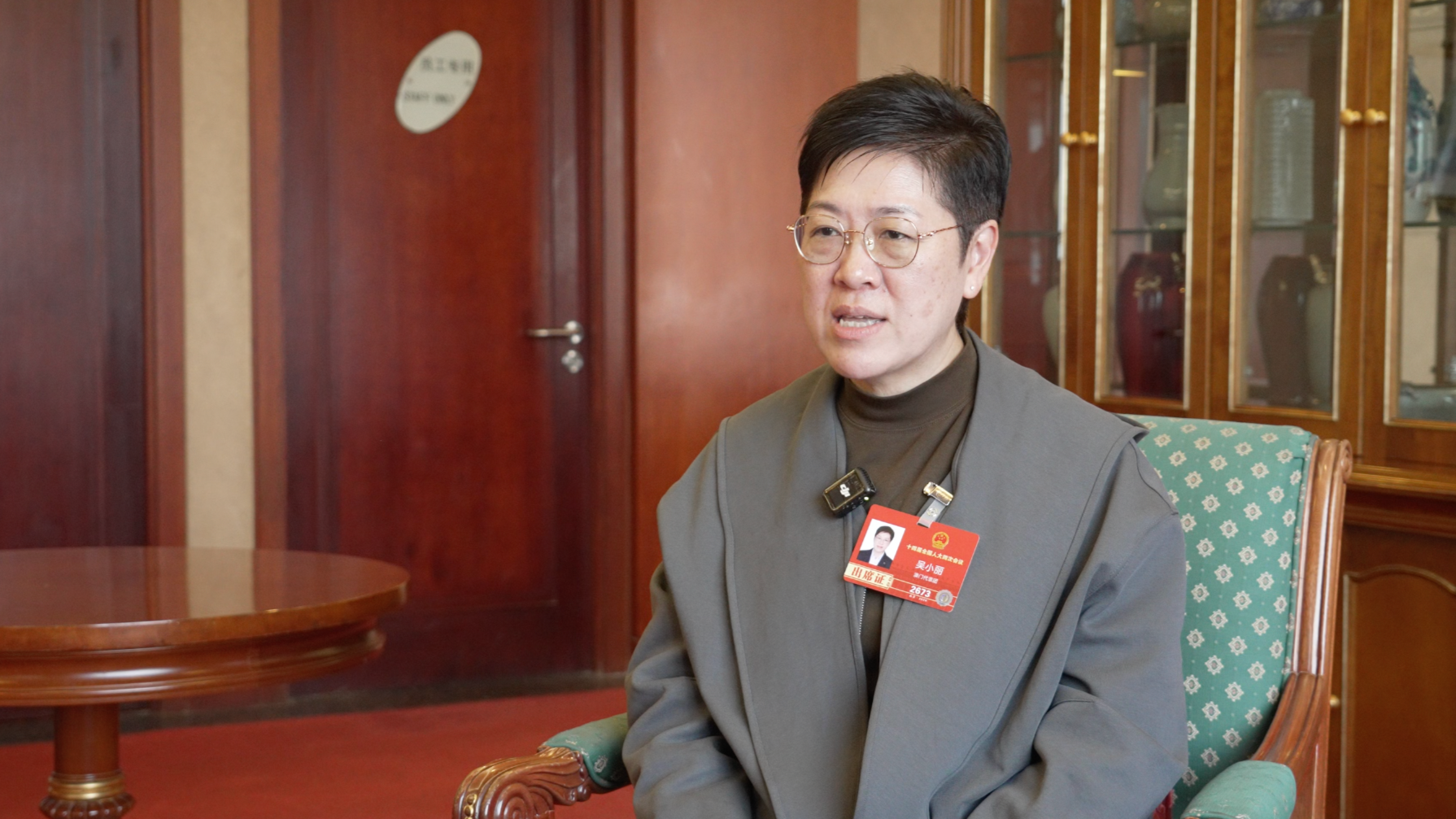
Hengqin can help remove policy barriers and ensure Macao residents share in more livelihood benefits as the city integrates into national development — including better cross-border transportation, community elderly care, and social services across the Guangdong-Hong Kong-Macao Greater Bay Area.
Ng Siu-lai, a deputy to the National People’s Congress (NPC) from Macao, made the remarks to China Daily on the sidelines of the two sessions, currently taking place in Beijing. Ng said she centered her suggestions on people’s livelihoods.
The two sessions are the annual plenary meetings of the NPC, China’s top legislature, and the National Committee of the Chinese People’s Political Consultative Conference, the country’s top political advisory body.
Ng’s suggestions covered topics that include Greater Bay Area integration, especially in the Guangdong-Macao In-Depth Cooperation Zone in Hengqin, a 106-square-kilometer island that sits between Macao and the Chinese mainland; cross-border transportation; elderly-care services; barrier-free accessibility; creating smoke-free cities; and the development of Macao community organizations on the Chinese mainland.
Ng said she believes that as Macao answers the call of the national 15th Five-Year Plan (2026-30) to actively integrate into national development, residents should tangibly benefit from the integration process — particularly through the Hengqin platform.
Ng said “population aging” has become a major concern for Macao society, and Hengqin can serve as a pilot zone for establishing a cross-border community elderly-care system.
ALSO READ: Leung: HK should ‘raise its hands’ for wider strategic role
As head of the General Union of Neighbourhood Associations of Macau, which runs over 30 local service centers and has expanded into Guangdong province, Ng has long worked on grassroots livelihood issues. She said that home-based elderly care with nursing homes providing supporting services, which has long been promoted by the Macao Special Administrative Region government, is also the preferred model for seniors and caregivers. It allows seniors to attend day-care centers offering comprehensive services that include medical care, personal care and hygiene during the day, and that allows them return home to their families in the evening.
She said she believes Hengqin’s spatial advantages make it ideal for advancing this elderly-care model, helping to alleviate the Macao’s aging pressures.
Ng said that the key to achieving such a cross-border elderly care system is institutional innovation, particularly the alignment of social welfare policies, involving the portability of Macao’s medical benefits and social services. This is also a major challenge for Macao residents choosing to retire in other Greater Bay Area cities, she said. To tackle this, she also suggested at this year’s two sessions to promote institutional opening-up to facilitate the rules alignment across the bay area.
To better serve these seniors and other Macao residents traveling between Maco, Hengqin, and mainland cities, cross-border transport and clearance services are also key focuses of her suggestions, which Ng said she believes is an essential support system to assist Macao residents better integrate into the motherland. For instance, she called for optimizing clearance efficiency at border checkpoints, and advancing the policy to allow Hengqin single-plate vehicles, owned by Macao residents, to travel beyond the cooperation zone into other Guangdong cities.
READ MORE: Industrialist-turned-legislator urges HK to embrace innovation
She said that that cross-border transport and clearance between Macao and Hengqin require bolder institutional breakthroughs, as more Macao residents now call Hengqin home — making cross-border efficiency vital to their daily lives. She called for tech-enabled “seamless clearance,” more residents-friendly policies such as facilitating Macao taxis and foreign domestic helpers to enter Hengqin, and more flexible customs procedures such as those for fresh goods. These measures would enable Macao residents to live and work in Hengqin with ease, contributing the city’s integration into the country, Ng said.
“The nation is using Hengqin as a platform to help Macao address challenges such as living space and economic diversification. We should make good use of this platform and not waste the country’s goodwill,” Ng said.
To support Macao residents living in other Greater Bay Area cities, Ng also drew on her community-group experience to propose better support measures. She said that Macao social service organizations operating on the mainland, combined with local support such as regular policy briefings, can greatly aid Macao residents integrate into local life.
Contact the writer at amberwu@chinadailyhk.com
