

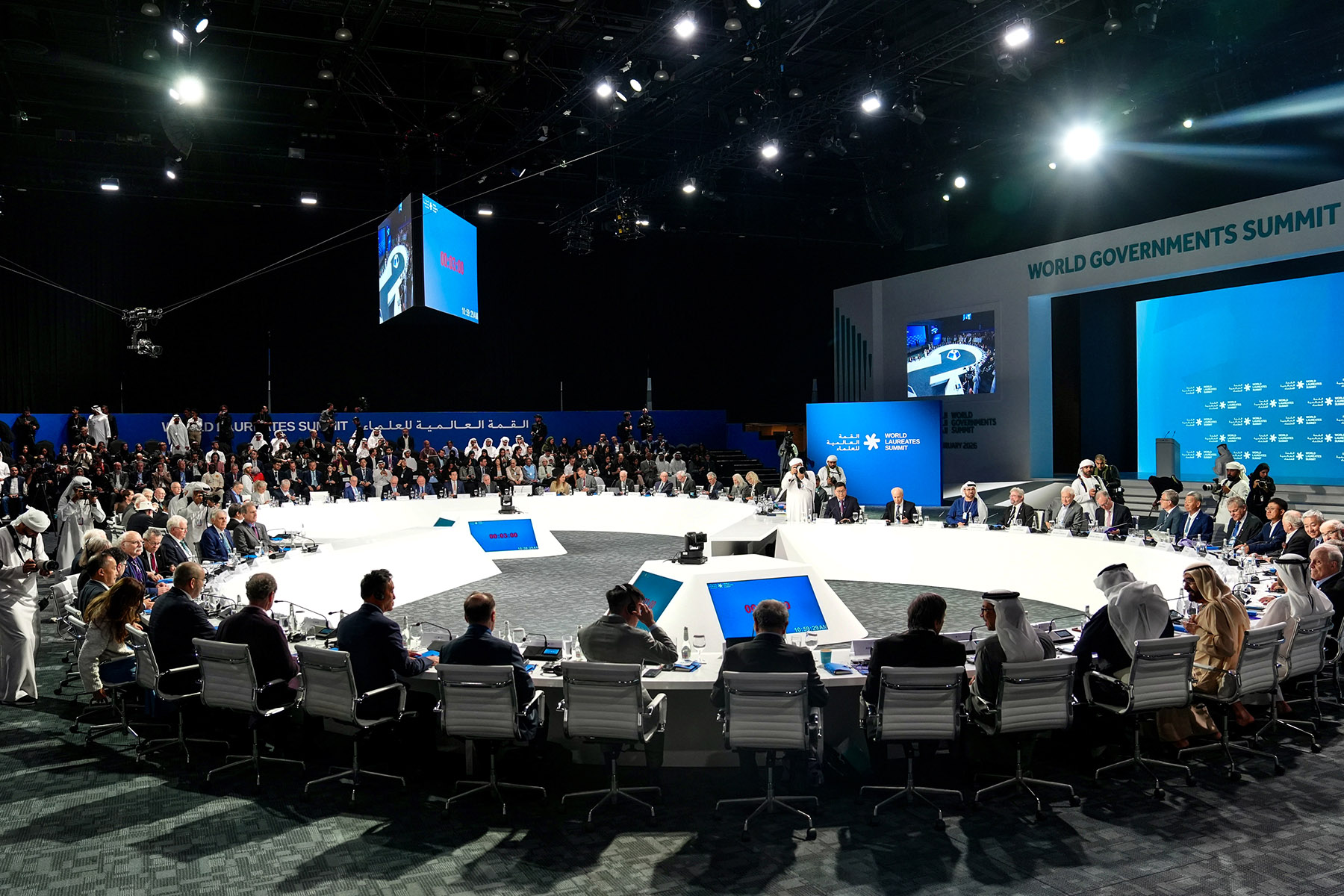
At a pivotal moment when AI is reshaping global economic and scientific development, nearly 70 leading scientists gathered on Sunday in Dubai for the World Laureates Summit, integrating basic research with global governance to tackle the world's most complex challenges.
They highlighted that China's choices in science and technology development strategies and policies are gaining increasing recognition from the global scientific community.
"Humanity is now in a historic phase with an unprecedented overlap of challenges," said Roger Kornberg, chairman of the World Laureates Association, which hosted the three-day event alongside the World Governments Summit 2026.
"AI is exerting an accelerating, comprehensive influence on science and technology, fundamentally reshaping the scientific ecosystem," he said.
READ MORE: AI push moves innovation into everyday life
Major countries' science and technology development strategies affect not only their own nations, but the entire world, said the 2006 Nobel laureate in chemistry. The Global South, such as the Middle East, Africa and South Asia, boasts unique advantages, including dynamic demographic structures, strong infrastructure investment and new models of openness, he said.
"In recent years, under the principles of openness, cooperation and sharing, China has made remarkable strides in basic research, particularly in AI, materials science, life sciences and new energy," he said. "Leveraging market-oriented innovation mechanisms, a strong engineering talent pool and broad application scenarios, China has achieved major breakthroughs to drive industrial innovation."
Christopher Pissarides, the 2010 Nobel Prize winner in economics, described China's 45-year economic transformation as a miracle of modern economic development. The growing global download volume of China's open-source AI models and its narrowing gap with world-leading standards demonstrate that sound infrastructure and an open ecosystem are vital for AI advancement, he said.
Addressing widespread concerns over AI causing unemployment, Pissarides argued against excessive anxiety.
"Historical evidence shows that new technologies typically phase out some jobs while creating new ones and upgrading operational models for most roles — and AI is no exception."
He urged governments to step up investment in energy and infrastructure to underpin AI development. AI, he said, will unleash enormous development potential once it matures and is embedded in daily production processes.
Ardem Patapoutian, the 2021 Nobel laureate in physiology or medicine, admitted that AI has transformed biological research in ways previously unthinkable in just a few years, with tasks that once took entire doctoral programs to complete now finished in minutes.
While its productivity gains are undeniable, he raised a pivotal question: Can AI truly discover new knowledge, or merely process existing information?
"Many believe AI only compiles existing knowledge and delivers the best past opinions, but others argue it will generate new ideas in the future," he said.
ALSO READ: AI, innovation and culture help China's gaming industry gain global appeal
This question — whether machines can match human insight — has split the laureates.
Duncan Haldane, the 2016 Nobel laureate in physics, expressed skepticism that today's AI can replicate the unpredictable nature of scientific breakthroughs.
"Will AI make me redundant? I don't know. Current AI, like large language models, only regurgitates existing knowledge, as it's built on past published research," he said.
By contrast, Whitfield Diffie, the 2015 Turing Award winner, said, "AI will be doing this huge range of things that you need, so you are stuck with it."
Contact the writers at cuihaipei@chinadaily.com.cn
