

Rising protectionism demands unified response to guard free trade, experts say
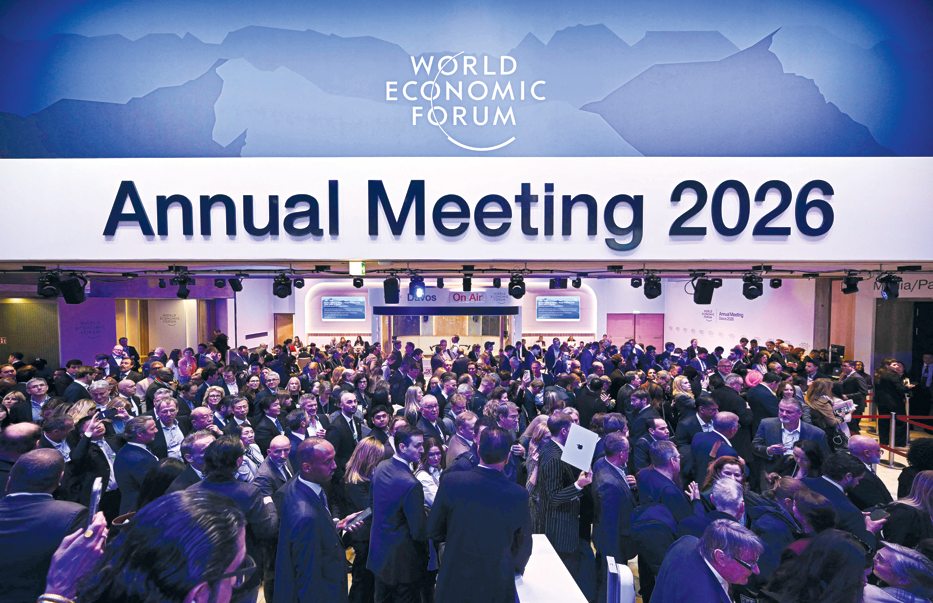
Editor's note: The World Economic Forum concluded in Davos, Switzerland, last week. This page takes a look at key issues and what leading voices were saying at the forum.
The recently concluded annual meeting of the World Economic Forum, a platform for discussing global cooperation, has laid bare the challenges straining globalization: intensifying geopolitical tensions and weaponizing economic ties.
Experts argue that escalating unilateralism and protectionism demand a unified global response to defend free trade and the international system centered around the United Nations. They also emphasize that China, as the world's second-largest economy, can act as a vital stabilizer in this turbulent environment.
Held from last Monday to Friday under the theme "A Spirit of Dialogue", the gathering of nearly 3,000 cross-sector leaders from 130 countries at the Swiss resort town of Davos has concluded with participants facing stark division and rare moments of unity. In speeches that captured the forum's tense atmosphere, leaders have voiced alarm over a disintegrating international order. Canadian Prime Minister Mark Carney, for example, warned of a "rupture" in the world order during his speech at the forum.
READ MORE: China to play 'stabilizing' role in Davos
Without naming any specific individuals, Carney criticized "American hegemony". "More recently, great powers began using economic integration as weapons, tariffs as leverage, financial infrastructure as coercion, supply chains as vulnerabilities to be exploited," he said.
Sharing this sentiment, French President Emmanuel Macron said on Tuesday in Davos: "It's a shift toward a world without rules. Where international law is trampled underfoot and where the only law that seems to matter is that of the strongest, and imperial ambitions are resurfacing."
US President Donald Trump, in his special address to the forum, renewed his push for the US to acquire Greenland, although he publicly ruled out using military force to take the island. He also sharpened criticism of Europe and NATO, further straining trans-Atlantic ties.
Experts observed that the forum's traditional economic focus was eclipsed by political fissures this year. This growing geopolitical tension is placing increasing pressure on global trade, they added.
Lyu Xiang, a research fellow at the Chinese Academy of Social Sciences, said a trans-Atlantic divide was particularly pronounced at Davos this year.
"Most European leaders kept their distance from their US counterpart during the forum, reflecting Europe's anger at the US' blatant desire to seize Greenland, even with force," Lyu said.
Wei Zongyou, a professor at the Center for American Studies at Fudan University in Shanghai, said,"Carney's speech reflects a widespread international perception of a shifting US role. The US is no longer the creator and defender of the 'liberal international order', but rather has become its 'gravedigger'.
"The US believes it has paid too much and gained too little under the current order, and therefore advocates for using its strength to obtain what it believes it deserves," Wei said.
This shift, he argued, has led allies to question the reliability of US commitments, significantly eroding trust.
"This year's Davos highlights that the fragmentation of the global economy and the intensification of geopolitical competition are now prominent features of international politics and are likely to remain so in the foreseeable future," Wei stated. "These trends pose significant challenges to the global economy."
Sung Soo Eric Kim, adjunct professor at the Graduate School of Business of Yonsei University and CEO of AI strategy advisory Datacrunch Global in South Korea, said this year's World Economic Forum is symbolic with the US president's design for a new world order, with the US and China at the center.
Experts noted the different world views conveyed by the US and Chinese delegations at the forum.
Chinese Vice-Premier He Lifeng used the WEF as a platform to call for firm global support for multilateralism and free trade, emphasizing that China's development presents important opportunities for the world.
Lyu said, "China's message is about turning its economic growth and large market into opportunities for the rest of the world, allowing all to benefit. This is a completely different worldview from the US approach of turning its market into a weapon to suppress others."
ALSO READ: China plays important role in advancing global disclosure standards, says ISSB's chief
Amid rising protectionism, China is emerging not only as a reliable partner but also as a growth opportunity for other nations, Lyu said."For example, China's International Import Expo is unique as the world's first national-level, dedicated import fair, symbolizing China's economic opening."
The 8th China International Import Expo, which concluded in November, saw the participation of 4,108 companies from 138 countries and regions, with deals set to total $83.49 billion.
Wei emphasized China's role as a beneficiary, driver, and defender of globalization. "Facing the headwinds of anti-globalization and protectionism, China, as the world's second-largest economy and top trading powerhouse, has the responsibility and is committed to upholding the multilateral free trade system," he said.
Lucio Blanco Pitlo III, research fellow at the Manila-based Asia-Pacific Pathways to Progress Foundation, said, "Coexistence, competition, and cooperation are the three key elements of China-US relations."
Xinhua contributed to this story.
Contact the writers at yangran1@chinadaily.com.cn
