

While standardization, connectivity and internationalization are among Hong Kong’s advantages in developing the low-altitude economy (LAE), the city also needs to strengthen its regulatory framework, build the industry ecosystem, proactively plan infrastructure, and increase commercial scale to establish a foundation for the sector.
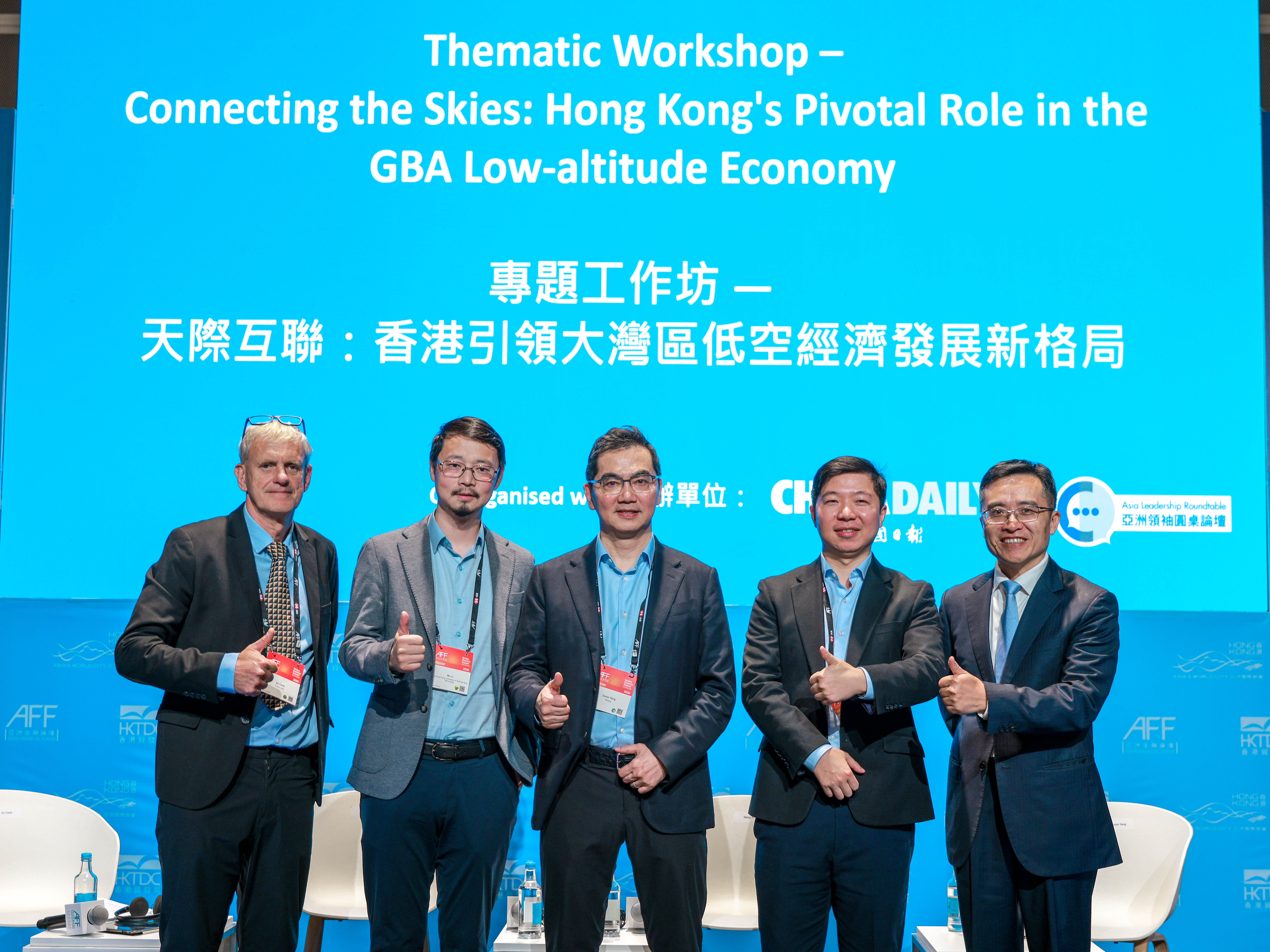
Panelists shared insights on how Hong Kong can play a pivotal role in hastening the LAE within the Guangdong-Hong Kong-Macao Greater Bay Area at China Daily’s Asia Leadership Roundtable, held during the 19th Asian Financial Forum in the Hong Kong Special Administrative Region on Tuesday.
Zhou Li, deputy editor-in-chief of China Daily and editor-in-chief of China Daily Hong Kong, said that both the nation and the Hong Kong SAR have stressed the need to develop the low-altitude economy.
He pointed to the SAR government’s launch of the first pilot projects under its LAE regulatory sandbox in March 2025, marking a shift from conceptual discussions to real-world testing. The LAE is also named in the recommendations for the nation’s 15th Five-Year Plan (2026-30) as a strategic emerging industrial cluster to be accelerated in the years ahead.
Zhou added that many media professionals are exploring applications for low-altitude technology. For instance, China Daily’s newsroom has been actively examining how drones can reshape storytelling and audience engagement ahead of the current policy focus on the LAE.
He said he believes that Hong Kong’s advantages lie not in manufacturing, but in high-value services, standardization, internationalization, and, particularly, “leveraging our aviation expertise to develop trust in low-altitude traffic management systems”.
Zhou said he hopes the forum will bring together academic and industry experts from research, technology and finance to explore how Hong Kong can leverage its strengths, including those under the “one country, two systems” framework and through the pioneering cross-border low-altitude corridors, to boost the emerging sector.
During the panel discussion, Li Mo, director of the Low Altitude Economy Research Center at the Hong Kong University of Science and Technology, said that given Hong Kong’s role as “Asia’s world city”, a promising path lies ahead in supporting the rollout of technologies, products and business models that have been verified on the Chinese mainland, facilitating their expansion overseas, and attracting international innovations to the mainland.
He noted that establishing replicable standards is essential. Recently, Hong Kong set up a task force to promote the LAE and launched a regulatory sandbox for the sector.
“First, (the sandbox) invites companies, industry, and partners to Hong Kong to practice their systems, products or business models. When they need to go beyond existing regulations or policy limits, there might be a chance to open up those limits — temporarily or in a certain region — for those projects to try”, he said.
At the same time, Li said, there is a critical need for supporting infrastructure, particularly in building or adapting existing communication networks to handle low-altitude activities at scale.
He said that while 5G could potentially be used for ground-to-air communication with drones, its signals are primarily projected toward ground users and leave significant blind spots in the air. Therefore, there is an urgent need for a cost-effective, wide-coverage, and probably dedicated communication system to support large-scale low-altitude operations, Li said.
Wang Xing, chief analyst for communications at Huatai Securities, said that the LAE has experienced rapid development over the past two years, with the gradual completion of airspace delineation, the prioritization of the low-altitude industry as a new type of productive force, and the substantial progress made in aircraft application scenarios.
“China has the world’s most complete new energy vehicle and consumer electronics industrial chains, along with leading communication and navigation infrastructure, giving it a superior advantage. Rapid development in the low-altitude sector can be achieved through reusing the industrial chains and infrastructure,” Wang said.
He stressed that future industry growth will depend on changes in policy, technology, and business models, specifically whether low-altitude airspace will continue to open up, whether aircraft performance and cost will improve, and whether various scenarios can be gradually implemented.
“Hong Kong offers distinct advantages for commercializing the low-altitude economy, thanks to its global connectivity, mature regulatory mindset, and unique geographical and institutional setting. Hong Kong’s compact, harbor-rich geography — including Victoria Harbour — is ideal for eVTOL (electric vertical take-off and landing) aircraft operations,” said Conor Yang, chief financial officer and director of the board at EHang — a Guangzhou-based passenger autonomous aerial vehicle manufacturer.
Yang said that Hong Kong’s Civil Aviation Department has accepted a sandbox flight application from EHang’s local partner, Kwoon Chung Group, under the Regulatory Sandbox X trial program, which will cover cross-border routes and more complex applications like passenger-carrying eVTOL aircraft.
He added that Hong Kong’s LAE strategic focus for the next five to 10 years should be on regulatory agility and sandbox results, deploying a tangible ecosystem, and increasing commercial scale and diversity.
Contact the writers at oswald@chinadailyhk.com
