

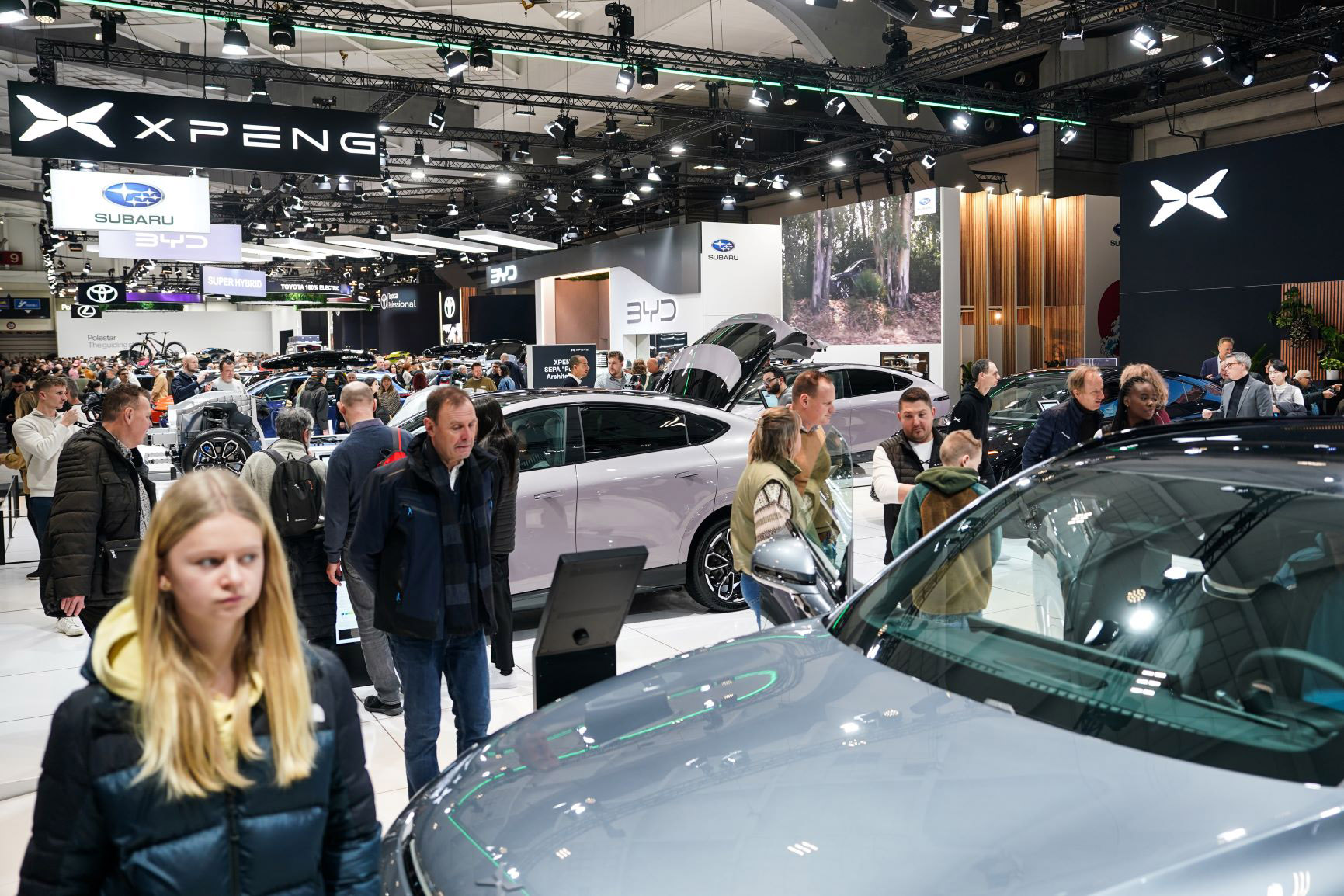
China and the European Union, after more than a year of talks, have agreed to set minimum prices for imported Chinese electric vehicles in lieu of hefty tariffs, which will help safeguard the global auto supply chain and support the rules-based global trading system, officials and experts said.
It also sends a clear signal that the two major economies have the capability and willingness, even amid rising geopolitical tensions and mounting protectionist pressures, to resolve differences through equal dialogue, they added.
The Ministry of Commerce said on Monday that both China and the EU "believe it necessary" to provide general guidance on price undertakings — commitments to establish minimum prices — for Chinese exporters of battery electric passenger vehicles to the EU.
READ MORE: China welcomes EU talks on setting price of electric vehicles
This move, the ministry noted in a statement, will enable Chinese exporters to address the EU's anti-subsidy case concerning Chinese EVs in a way that is "more practical, targeted and consistent with WTO rules".
"It shows that both China and the EU have the ability and willingness to properly resolve differences through dialogue and consultation under the framework of WTO rules," the ministry added.
Though the EU intends to achieve the same outcome through price undertakings as by imposing tariffs, for Chinese automobile exporters, this means the portion equivalent to the duty is retained as their own revenue, effectively increasing their profit margins, said Sun Xiaohong, secretary-general of the automotive branch of the China Chamber of Commerce for Import and Export of Machinery and Electronic Products.
In October 2024, Brussels decided to impose tariffs for five years of up to 35.3 percent on imports of Chinese EVs. These were levied in addition to the standard 10 percent duty, following a probe into unfounded allegations of so-called unfair subsidies in China's EV industry.
In parallel, Beijing and Brussels had floated the alternative WTO-compatible solution of lifting the tariffs through price undertakings for imported cars, and conducted various rounds of negotiations over the past year.
Also on Monday, the European Commission, the EU's executive arm, issued a guidance document on the submission of price undertaking offers for EVs from China.
"When the two economic powers, which hold significant influence within the WTO, choose to settle a major dispute through negotiation, it reinforces the rules-based global trading system in a particularly challenging international environment," said Tu Xinquan, director of the China Institute for World Trade Organization Studies at the University of International Business and Economics in Beijing.
In the document, the commission said it would assess each price undertaking offer against the same legal criteria in an objective and fair manner, following the principle of nondiscrimination and in accordance with WTO rules.
The submission of a formal price undertaking offer to the European Commission triggers a procedure for the assessment of its acceptability and practicability that will be carried out expeditiously.
"Properly resolving the EU's anti-subsidy case on Chinese EVs is a common expectation among upstream and downstream industries in both China and the EU," the China Chamber of Commerce for Import and Export of Machinery and Electronic Products said in a statement on Monday.
The chamber, on behalf of different types of Chinese car manufacturers, had put forward the price undertaking proposals during previous negotiations.
ALSO READ: Chinese business group urges fairness in EU tariff measures on EVs
"It will contribute to the security and stability of the related industrial and supply chains between the two sides, safeguard the overall interests of China-EU economic and trade cooperation, and uphold the rules-based international trade order," the chamber added.
Looking ahead, the chamber will encourage and support relevant car makers in making full use of the consultation outcomes by applying through the price undertaking mechanism, to secure their export interests related to the EU.
"Such an arrangement would facilitate the entry of Chinese EVs into the EU market through a mutually agreed pricing structure, thereby addressing the EU's concerns while sparing European consumers higher costs," said Shi Xiaoli, a professor of international trade law at China University of Political Science and Law in Beijing.
Chinese carmakers captured 12.8 percent of Europe's electric-vehicle market in November, according to researcher Dataforce.
Contact the writers at wangkeju@chinadaily.com.cn
