

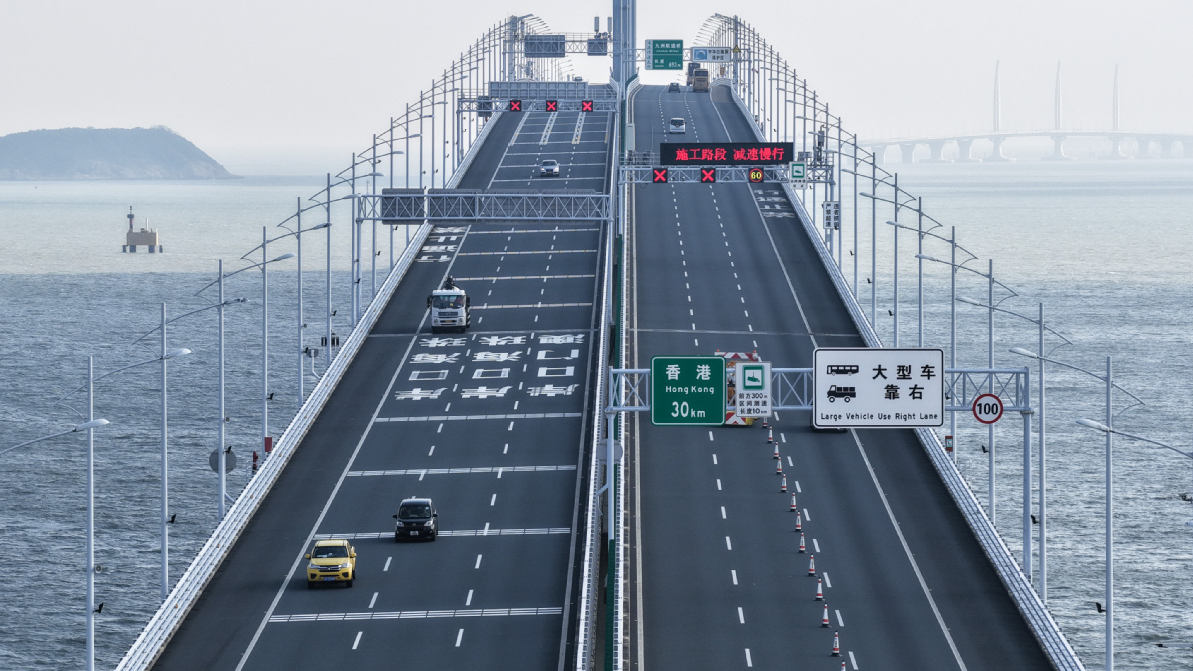
GUANGZHOU - The Zhuhai land port of the Hong Kong-Zhuhai-Macao Bridge has handled over 100 million inbound and outbound passenger trips as of Tuesday since it opened to traffic in 2018. This milestone came shortly after the Hong Kong section of the Guangzhou-Shenzhen-Hong Kong Express Rail Link saw its 100-millionth passenger trip.
These record-high figures underscore the deepening connectivity of infrastructure and rules and people-to-people ties within the Guangdong-Hong Kong-Macao Greater Bay Area (GBA).
To date, six major river or sea-crossing passages have opened to traffic in the area. This network of infrastructure has vitalized the area's integrated development, acting as its major "arteries."
Today, a high-speed train from the Guangzhou South Station in south China's Guangdong Province to Hong Kong's West Kowloon Station is a journey of just under 50 minutes at its fastest speed, and the journey from Shenzhen's Futian Station to West Kowloon Station is only about 15 minutes.
"The sustained and record-high passenger numbers on the Hong Kong section reflect the vibrant growth driven by deepening integration between the mainland and Hong Kong," said Jeny Yeung Mei-chun, CEO of Hong Kong's MTR Corporation.
The Hong Kong-Zhuhai-Macao Bridge has slashed travel times between Hong Kong and Zhuhai or Macao from three hours to about 45 minutes. "It took over five years to reach the first 50 million passenger trips, but only one year and eight months for the second 50 million," said Chen Faqiu, director of the bridge's border checkpoint.
ALSO READ: Hong Kong Marathon, Toys & Games Fair, WAIC UP! Global Summit
After more than seven years of operations, these two cross-boundary landmarks are transforming travel routines. For a growing number of people in the GBA, taking a high-speed train to attend a cross-border meeting or driving across the bridge to go shopping is shifting from a novel experience to a part of daily life.
The 100 million trips taken are tangible proof that the GBA's "one-hour living circle" is becoming a reality. "These two mega projects have directly facilitated the seamless flow of talent, capital and innovation within the GBA, accelerating the complementary integration of urban functions, socio-economic resources and industrial chains," said Erik Yim Kong, a member of the Legislative Council of the Hong Kong Special Administrative Region (HKSAR).
While ever-improving infrastructure provides the hardware, continuously facilitative policies provide the software.
In recent years, a series of policies have accelerated integration via the Hong Kong-Zhuhai-Macao Bridge, and clearance procedures have been optimized at major ports.
"Driving from Zhuhai to Hong Kong is an incredibly smooth experience!" a Zhuhai resident surnamed Cao, who drove his family to Hong Kong during the year-end shopping season, told Xinhua.
Travelers have noted that procedures have been greatly simplified, removing past concerns over vehicle restrictions and ferry schedules.
"The two cross-boundary railway projects will fully integrate the metro networks of Hong Kong and Shenzhen," said Mable Chan, secretary for transport and logistics of the HKSAR government, referring to the MTR Northern Link project and the Hong Kong-Shenzhen Western Rail Link project.
This has been a common sight for over a year at Gongbei Port: Instead of fumbling for documents, travelers simply face a camera and press a fingerprint, completing the clearance process in about 10 seconds. This smart channel system was among the first features trial launched at the Gongbei Port -- between Zhuhai and Macao -- and the Shenzhen Bay Port (between Shenzhen and Hong Kong) in November 2024.
"I work in Macao. Before, I had to take out my documents and queue every morning and evening. Now, with facial and fingerprint verification, it's all done in one step, which is very convenient," a woman surnamed Li from Zhuhai who works in Macao told Xinhua.
ALSO READ: Tourists go wild at GBA New Year celebrations
The improving infrastructure and facilitative policies are fostering more frequent exchanges and deeper integration among residents of Guangdong, Hong Kong and Macao.
"Coming to Hengqin makes me feel very relaxed and comfortable," said Sheeta Su, a Macao resident who works at a university in Macao. Attracted by Hengqin's environment and increasingly convenient clearance policies, she recently moved into a new community there. She now commutes daily using a single-plate vehicle for Hengqin, passing through customs in just minutes during off-peak hours.
Since moving in at the end of 2024, Su and her family have witnessed the community's gradual development. She finds the neighborhood environment, community activities and supporting facilities, including health stations and community services centers, to be very considerate. "Over the past year, more neighbors and children have moved in, and many from Macao have opened shops nearby. It's thriving," she said.
With her parents now traveling frequently between their hometown of Yangjiang in Guangdong and her home in Hengqin, Su's family embodies the integrated development of the GBA.
"We've explored all over Hengqin. Now our daily travel is expanding to cities like Zhuhai and Zhongshan," Su said. As distances shrink, accelerating flows of people and capital are bringing hearts and minds closer. "This is the general trend."
"The smooth flow of people naturally facilitates efficient logistics and the circulation of capital. North-south consumption and economic interactions are continuously solidifying the foundations of the GBA's integrated development," said Irons Sze Wing-wai, president of the Federation of Hong Kong Beijing Organisations.
