

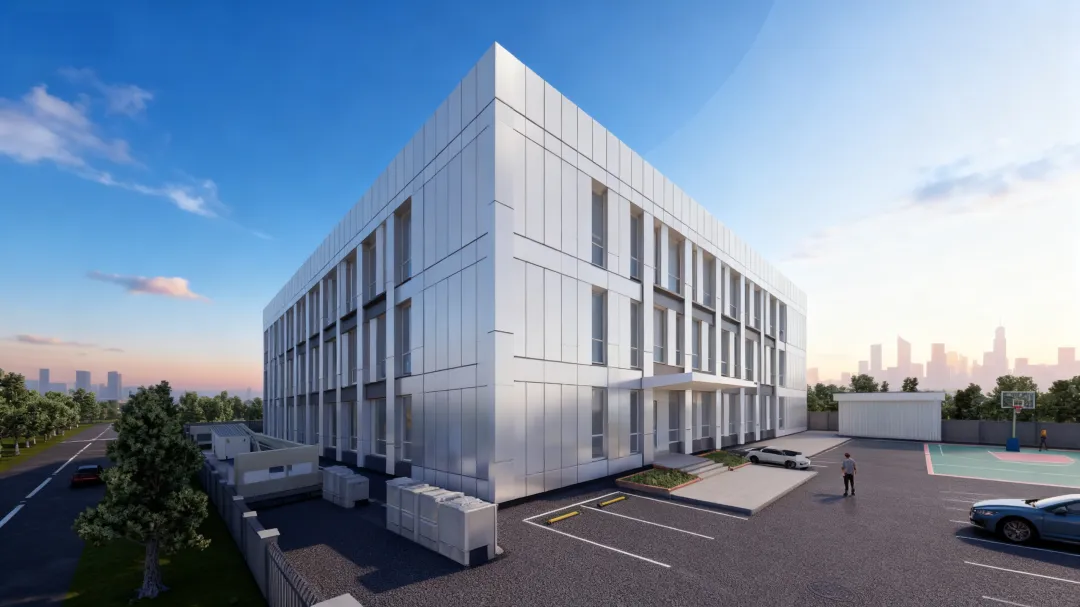
Shenzhen-based logistics and energy equipment maker China International Marine Containers Group (CIMC) has moved a step forward in expanding its presence in Africa by building a modular office building in the capital of Cameroon.
The project in Yaounde covers a total construction area of approximately 3,000 square meters. Consisting of 78 modular units manufactured in China, it is expected to be officially put into use in the second half of this year. The units were shipped to the central African country earlier this week.
Compared with traditional construction methods, the modular construction technique cuts the required time by half.
Once completed, it is expected to meet the office, meeting and catering needs of nearly 200 people.
ALSO READ: Unified certification in GBA gains momentum, boosting integration
Modular building is a type of prefabricated building model. Instead of doing all the construction work on-site, it allows more than 90 percent of a building project to be finished in the factory, thereby saving construction time by over 50 percent and reducing construction waste by over 50 percent.
“The project, which integrates research and development, design, manufacturing, transportation and assembly, demonstrates the company’s capability in building leading benchmark projects in the international market,” said Irwin Wang, assistant general manager of CIMC Modular Building System — a subsidiary of CIMC and the company in charge of the construction — and also deputy general manager of both CIMC Architectural Design Institute and CIMC Construction.
The project comes as economic development in central Africa is gaining momentum. According to a report from EcoMatin website citing Economic and Monetary Community of Central African States, economic activities in the region are projected to grow by 3.4 percent in 2026, driven by non-oil sectors, following a 2.7-percent expansion last year.
Specifically, Cameroon’s economic growth is expected to grow by 3.6 percent this year, it said.
With continuous optimization of the economic structure and rapid agglomeration of finance, technology and trade industries, demand for modern office and residential spaces in the region is rising.
Victor Zhu, managing director of CIMC Modular Building Systems, said construction of the Yaounde office building lays the foundation for the company to expand to other Global South markets. “We will take Cameroon as a pivot and continuously provide high-quality, low-carbon and reliable modular building solutions for African and other markets, and work with global partners to build a sustainable development future,” he said.
Modular construction is gaining increasing popularity worldwide. According to market research firm Fortune Business Insights, the size of global modular construction stood at $89billion in 2024 and is expected to expand to $151billion by 2032, representing a compound annual growth rate of 6.9 percent over the period. Asia-Pacific region dominated the market with a 45.32-percent share in 2024.
Despite the growth, Yan Yuejin, deputy head of Shanghai-based E-House China R&D Institute, pointed out that prefabricated construction faces several technical hurdles, including the complexity of design due to the need for standardization and modularization, the imperative to ensure component safety and integrity during transportation and hoisting, as well as the high precision requirements for on-site assembly.
Contact the writer at sally@chinadailyhk.com
