

Caigongzhuang makes more brass and woodwind instruments than anywhere else in the world
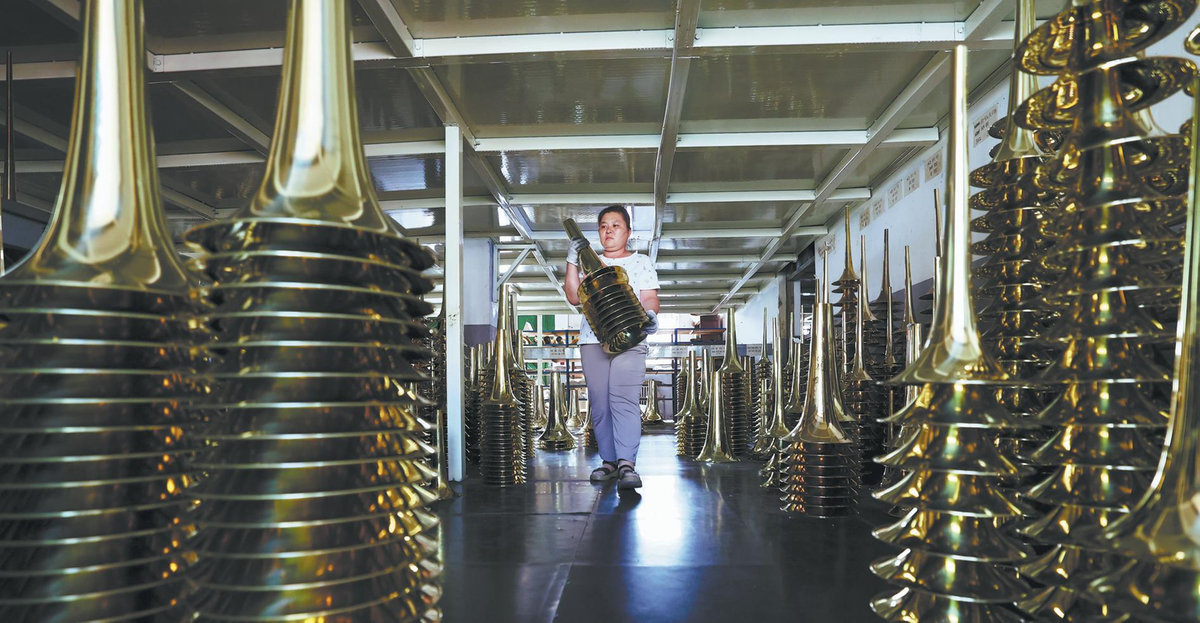
Not that it would ever blow its own trumpet, but the small town of Caigongzhuang, in Tianjin's Jinghai district, produces more than half of the world's brass and woodwind instruments.
Blissfully unaware, musicians around the globe play their saxophones, trumpets, flutes, piccolos and clarinets crafted in Caigongzhuang's family-run workshops and sprawling factories.
"In recent years, we've been getting high-end custom orders from Germany, Spain, Singapore and other countries," said Liu Xuehong, manager of Tianjin Shengyue Music Instrument, a decades-long veteran of the trade.
One of his latest projects was a custom saxophone for Jay Metcalf, a renowned saxophonist behind the BetterSax educational platform.
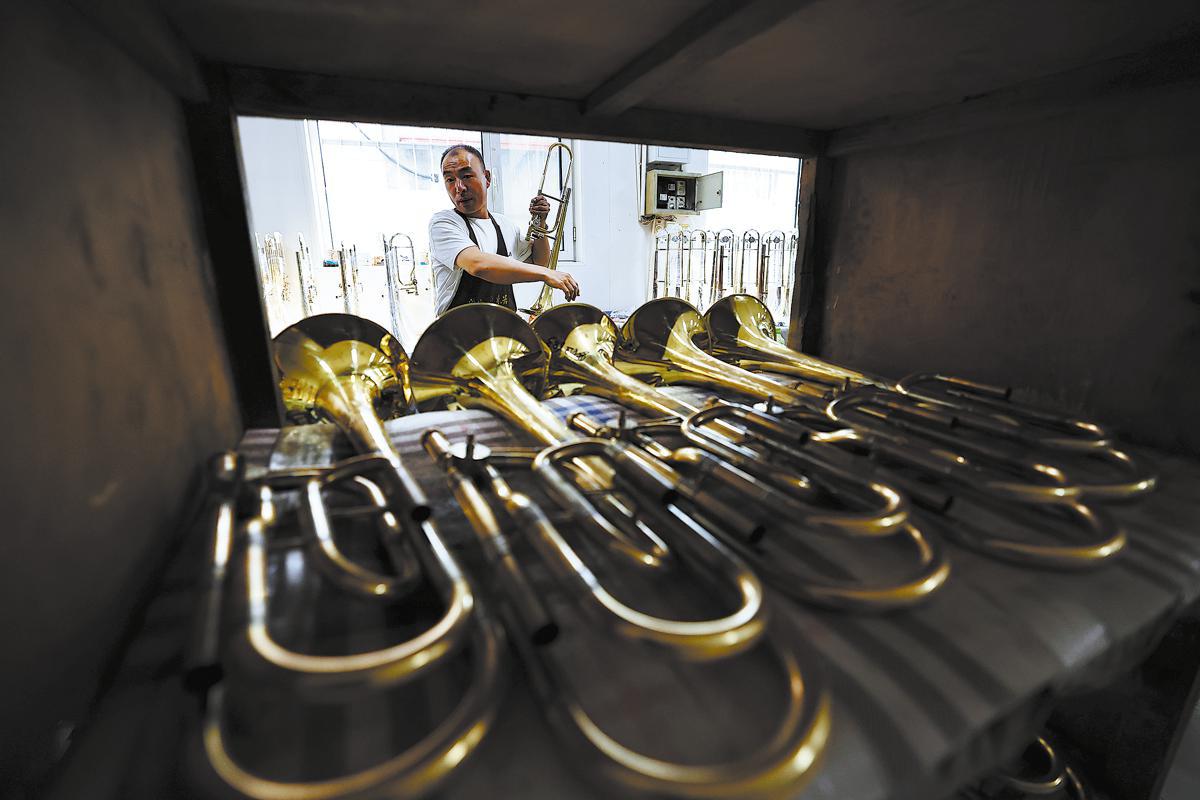
Holding an alto saxophone bearing Metcalf's logo, Liu said: "Our factory uses the best materials such as premium copper and pads. The colors of our instruments are highly favored by European musicians, and this saxophone will soon travel across the ocean to be played in European concerts."
The town produces more than 100 types of Western instruments, exporting to Europe, the United States, Japan and other major markets.
Caigongzhuang is a music town. Residents gather in the fields in the evening to play instruments together, according to Chen Zeyu, a Jinghai district official.
"Instrument-making has been passed down for generations, giving the town a unique artistic spirit," Chen said. Saxophones, trumpets and flutes adorn the town's walls in colorful murals.
According to local government data, Caigongzhuang produces approximately 450,000 brass and woodwind instruments annually, with 80 percent exported to Europe and the US.
"Instrument manufacturing demands extreme precision," said Ma Jikun, manager of Tianjin Oves Musical Instruments. "Taking the tuba as an example, its production requires over 300 parts. The bell alone requires about 20 steps, followed by rigorous testing to ensure perfect sound quality."
The tuba bell's material must be accurate to 0.2 millimeters, and it must be manually welded. A skilled worker can weld a maximum of 10 bells per day, Ma said.
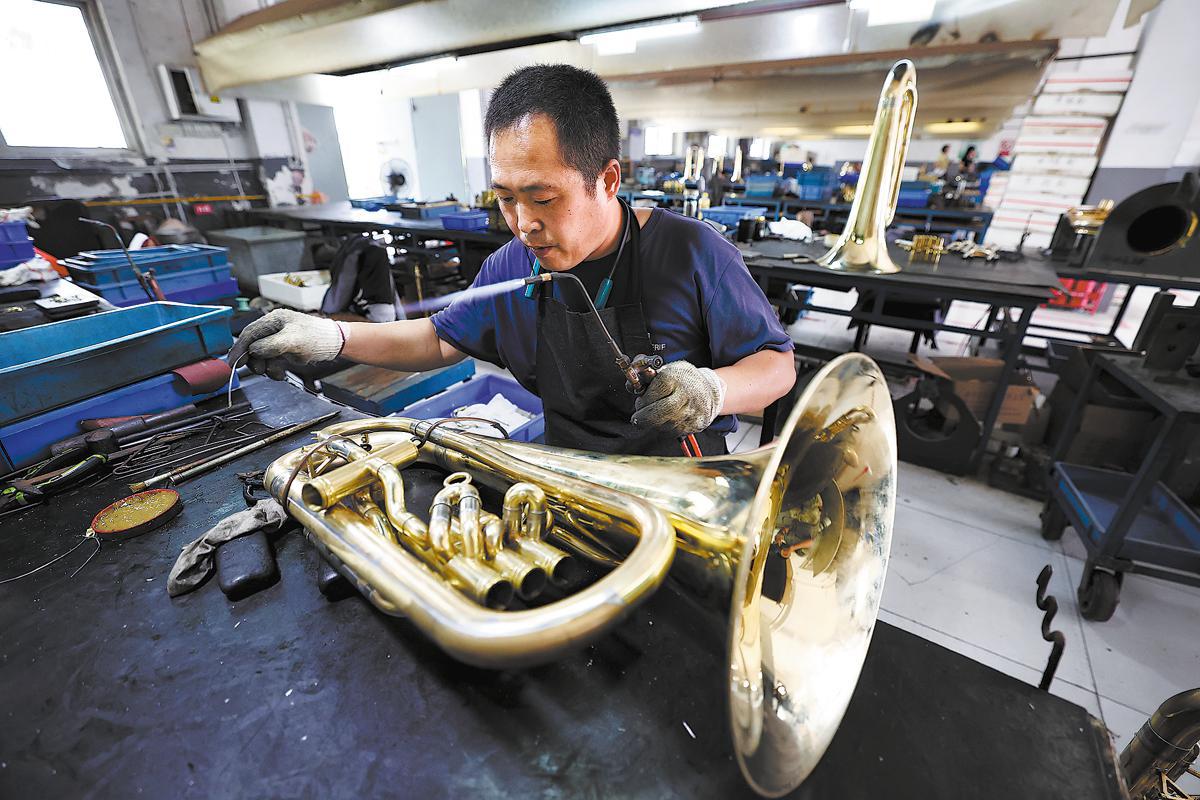
Founded in 2001, Oves is one of China's largest wind instrument manufacturers, producing over 100,000 saxophones, flutes and trumpets annually. The production process blends cutting, heating, quenching, welding and polishing with some steps repeated for perfection.
"Compared to production in places like Vietnam, our country has significant advantages in wind instrument manufacturing experience, product quality and worker skill," Ma said. "Our 80 to 90 percent inspection pass rate reflects that."
Since 2010, automation has boosted efficiency. "Currently, we have over 100 intelligent production machines," Ma said. Inside Oves' workshop, workers weld, polish and assemble instruments under the watch of technicians managing multiple machines.
Liu said the industry has a long history in the town. "In the 1970s, our instruments were distributed around the country through cultural stations. Many schools used our youth horns, and the military used our bugles. Later, with economic development, we shifted toward high-end customization and also started producing musical instrument-related crafts, which sell well."
Wang Han, director of the economic development office of Caigongzhuang, said the town's rise mirrors China's economic transformation. In the 1960s and 70s, only one small parts factory supplied State-owned companies. The 1980s saw more small parts factories appearing, and by the 1990s, local brands emerged with their own designs of complete musical instruments. After the year 2000, collective enterprises privatized, resulting in 114 music-related businesses — 51 manufacturers and 63 wholesalers.
"Over 3,000 locals work in instrument production, and nearly every household runs an online store," Wang said. "E-commerce drives 40 percent of the town's output, supporting over 6,000 jobs in online sales, express delivery and related services.
"Villagers who produce instruments in the factories during the day will then sell the products via livestream on social media platforms," he added. "One might sell several or dozens of instruments each day."
Bao Yan contributed to this story.
Contact the writer at: yandongjie@chinadaily.com.cn
