

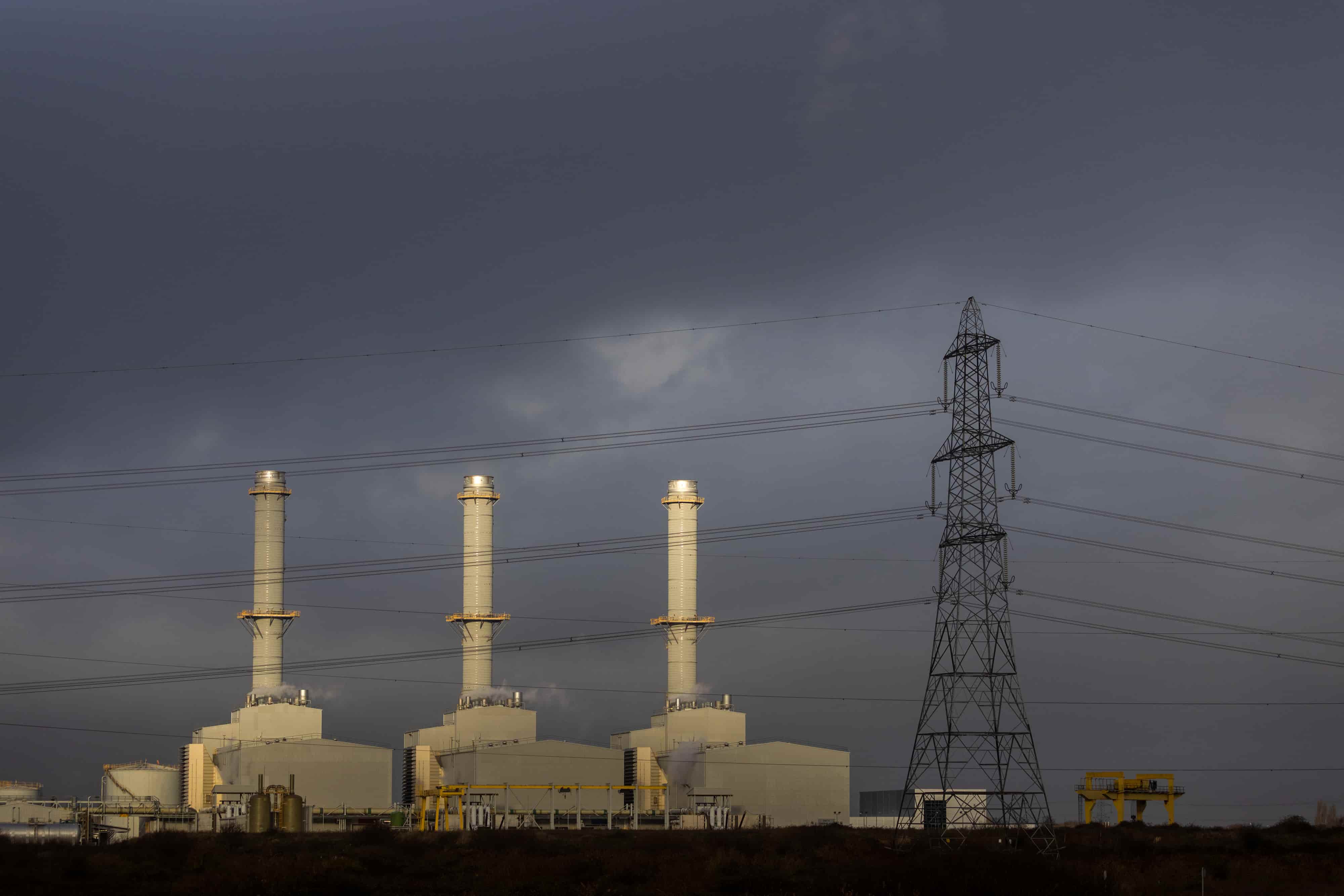
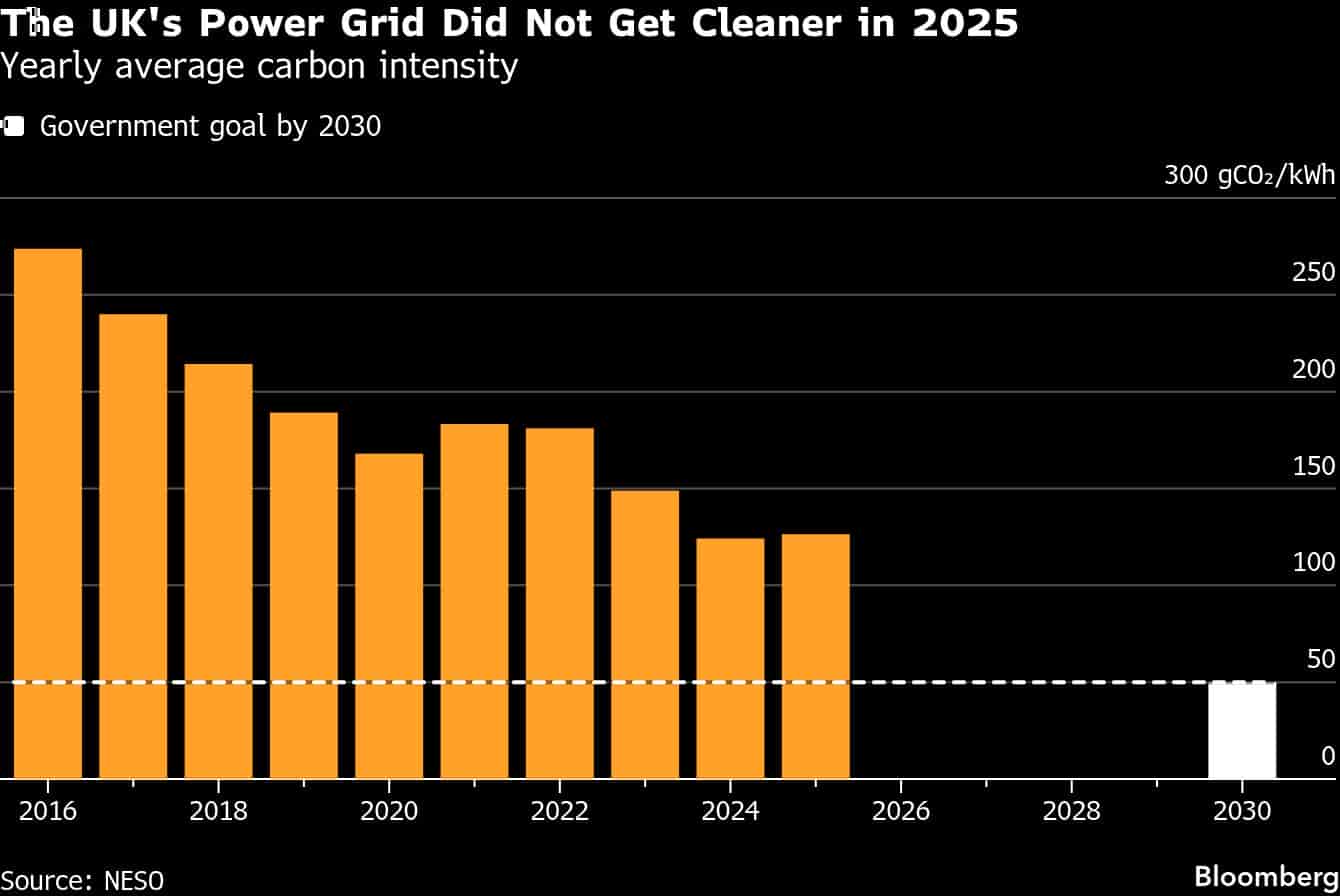
Britain increased the share of electricity generated from fossil fuels last year for the first time in four years, a reversal that highlights the challenges facing the government’s plan to run a clean power system by 2030.
Greater reliance on gas-fired power to offset a decline in nuclear output pushed up emissions, even as renewable generation hit a record. Data compiled by Bloomberg using National Energy System Operator figures show that expanding wind and solar alone will not be enough to meet the target, leaving the UK grappling with how to curb reliance on gas-fired power by the end of the decade.
The reversal underscores how the energy transition is entering a more difficult phase after early progress came from closing coal plants and rapidly scaling up renewables. While low-carbon sources now provide more than half of the UK’s electricity, firm generation such as nuclear and gas are still needed when weather conditions limit renewable output.
The drop in nuclear generation last year was caused mainly by planned outages but capacity is set to shrink permanently too.
A decline in the country’s nuclear fleet is making the government’s goals “extremely challenging” said Adam Bell, Director of Policy at consultancy Stonehaven.
The policy is a crucial part of the Labour government’s push to revive economic growth, and faces political backlash from opponents like Reform UK who insist the policy will cripple businesses and households through sky-high bills.
ALSO READ: Watchdog: It will take 700 years to replace UK water grid at current pace
Electricite de France SA has closed several nuclear plants in recent years and of the current fleet of nine reactors across five nuclear sites, only Sizewell B will be in operation after March 2030. The French operator is building Hinkley Point C but the controversial project looks likely to miss its end of the decade start date. EDF is also building Sizewell C, which it says will be quicker and cheaper to construct.
“A great deal rests on whether the first reactor at Hinkley C will be up and running in time for 2030,” Bell said. “Without that reactor the Government will need to further over-build wind and solar plus some storage to provide equivalent output.”
Without new capacity such as Hinkley Point C, the UK is facing a sharp drop in steady generation just as it is trying to finish decarbonizing the power system, a cornerstone of the government’s strategy to cut emissions and reduce energy bills.
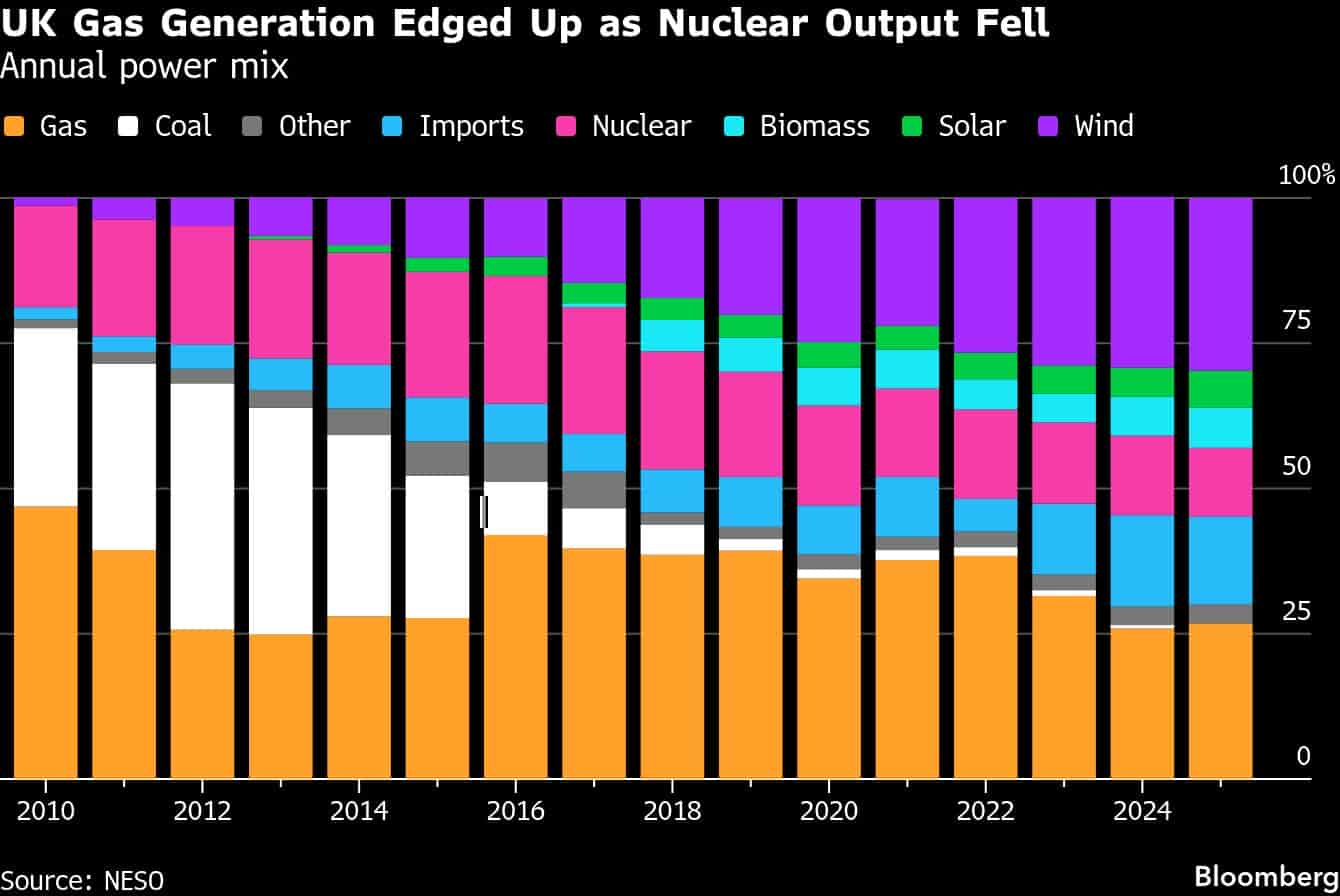
Nuclear generation fell about 11 percent to its lowest level in more than a decade amid maintenance outages and refueling, according to data from the National Energy System Operator compiled by Bloomberg. Lengthy planned outages at Hartlepool and Heysham plants were contributing factors, according to remit messages from Elexon. Gas-fired generation rose more than 6 percent to fill the gap, driving up power-sector emissions.
EDF said its output target for this year is higher than in 2025. The company’s ambition is to generate from the remaining stations for as long as it is safe and commercially viable to do so, and it will keep their lifetimes under review, a spokesperson said in a statement.
About 56.5 percent of the electricity fed into the grid last year came from low-carbon sources, which include nuclear and renewables, edging slightly lower from 56.7 percent a year earlier, the NESO data show.
“These statistics reflect decisions made by previous governments, including years of dither and delay on new nuclear,” a government spokesperson said.
NESO didn’t comment on the figures, saying it would publish its own roundup in the coming days.
For the past decade, Britain’s grid has become roughly 10 percent cleaner each year as renewables expanded. The only recent interruption to that trend came in 2021, when weak wind conditions limited output and more gas was burned to generate power.
Renewable generation still continued to grow. Output rose about 7 percent from a year earlier to a record 109 terawatt-hours. Wind power climbed to an all-time high of roughly 86 terawatt-hours, while solar output jumped more than 30 percent to about 18.5 terawatt-hours.
