

Before Benjamin Rene and Loic Michel left their hometown of Annecy in southeastern France in September 2024, China was, to them, a distant yet fascinating place, a name more often encountered in headlines than in everyday conversation.
"In France, China feels extremely far away," says Rene, 27. "It almost represents the end of the world — as far as you can go by walking."
The idea that would eventually turn this abstract distance into lived experience was born two years earlier, during a casual dinner of pizza and beer in Paris in November 2023. The two friends found themselves talking about repetitive work routines and the sense of being stuck in daily life. Surprising even themselves, they made a bold decision: to walk all the way to China, choosing a low-carbon and environmentally friendly way to travel.
ALSO READ: China's cultural creativity code
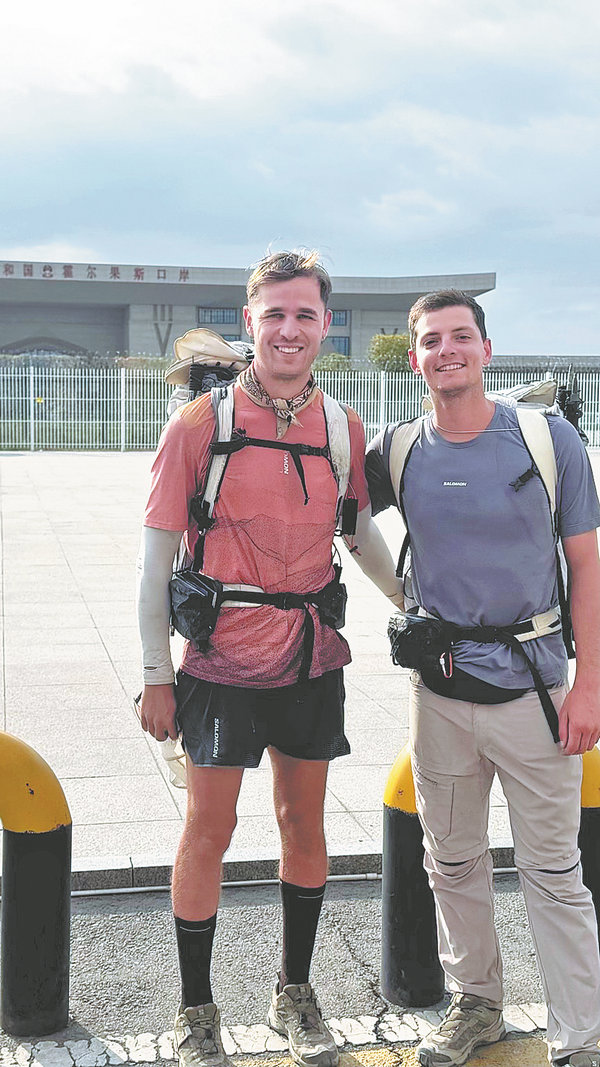
They spent more than half a year preparing. Maps were studied, visas researched, physical training intensified. Eventually, they quit their jobs in Paris, packed only the essentials into lightweight backpacks, and accepted that the road ahead would last well over a year. Their planned route would stretch roughly 13,000 kilometers, pass through 16 countries, and end in Shanghai.
China, which they entered on Sept 13 after nearly a yearlong journey across Central Asia, marked a milestone, not just in geographical terms, but emotionally. By the time they arrived in Lanzhou, the capital city of Northwest China's Gansu province, they had been on the road for about 450 days.
Trekking across continents
The idea of walking such a distance may sound bold, but Rene and Michel planned their journey with care and discipline. They divided the route into stages of three to four months, aiming to walk 40 to 50 kilometers a day. They crossed the Alps, traversed the Balkans, and endured long, isolated stretches of Central Asia. By the time they entered China, they had spent around 400 days on the road, walked nearly 8,000 kilometers, and worn through six pairs of shoes each.
Physically, adaptation came gradually."At the beginning, we walked maybe 20 or 30 kilometers a day," says Michel, 26."Now our bodies are used to it." On good days, they can walk up to 60 kilometers, though winter daylight hours and weather often limit their pace.
"Each step is very small," Rene says."You never suddenly feel far from home."Moving slowly, he explains, makes cultural transitions smoother. "You're not in shock when you arrive somewhere. You've seen it coming."
READ MORE: Walking the Silk Road
That slowness also opens doors. "If we had taken a plane or a train, we would never have come to Lanzhou," he says. "We would never have met all these people."
Along the way, especially in small towns and villages, they often encountered people who had never met foreigners before. Tea invitations, shared meals and help with directions became routine.
"People are really welcoming," says Michel. "Sometimes they even paid for our hotel or food."
The warmth and hospitality of the Chinese people became the most memorable part of their journey.
Before the trip, their understanding of China was limited. "Most of what we heard in France came from the news," he says. "Politics, the economy, big companies. We didn't really know about the people."
"The biggest discovery for us is the Chinese people," says Rene. "And we are very happy about that."
Following the ancient route
After completing their walk across the Xinjiang Uygur autonomous region, the two hikers entered Gansu province and continued east along the ancient Hexi Corridor. They passed desert-edge highways near Wuwei, visited the Leitai Han Tomb, and stood in awe before the red sandstone Danxia landforms in Yongdeng county before arriving in Lanzhou on Nov 27.
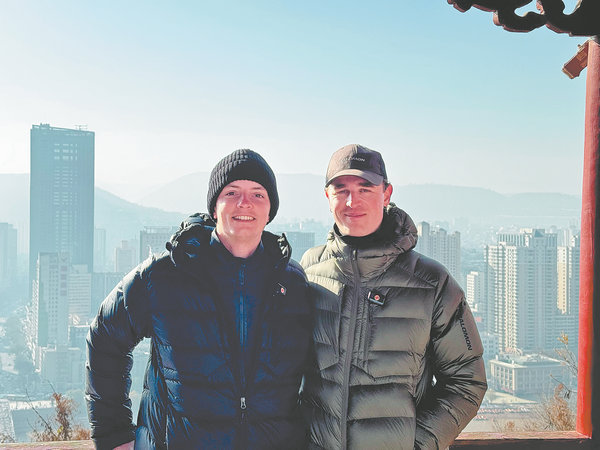
"We know that many Chinese people don't consider Lanzhou a big city," Rene says. "But for us, it's super gigantic."
High-rise buildings stretched across the valley, illuminated at night by LED screens, a striking contrast to most of the European cities they were familiar with. Yet, it was not modernity alone that impressed them, but the way it coexisted with history.
"I didn't expect a northwestern inland city to be this modern while still preserving so many traditional Chinese buildings," says Michel. "The contrast is beautiful."
From Santai Pavilion in Lanshan Park, perched on Gaolan Mountain, the two looked down at the Yellow River rushing beneath. From that vantage point, Lanzhou's distinctive urban form, shaped by mountains and water, became clear.
Museums quickly became an essential part of their exploration. At the Gansu Provincial Museum, they explored the legacy of the Silk Road: Majiayao painted pottery and the iconic Galloping Horse Treading on a Flying Swallow.
"After walking through these places ourselves, seeing the artifacts made everything feel connected," says Michel.
For them, the Silk Road was never just a trade route. "It's a bridge for dialogue between civilizations," says Rene. "In the museums, we could really feel the heartbeat of the city."
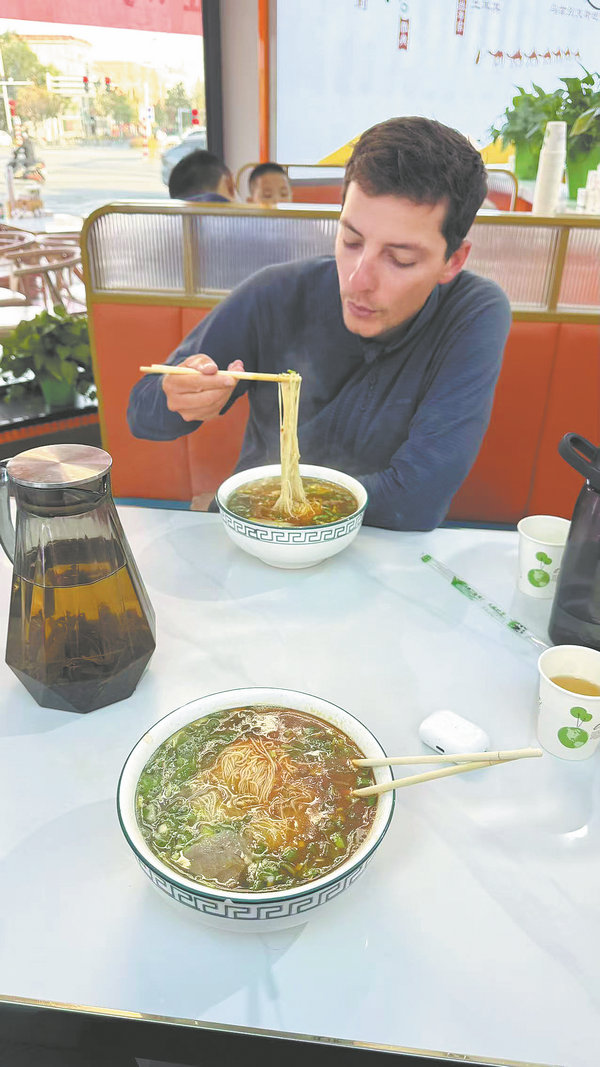
On Nov 29, Rene and Michel held a small meet-up at a local beef noodle restaurant, which they described as the soul of the city. They wanted to learn how the iconic dish was made and share stories from their journey.
"For walkers, beef noodles are perfect," says Rene. "They're fast, nutritious, and the soup gives us energy and hydration."
They watched a noodle master demonstrate the art of hand-pulled noodles before eagerly trying it themselves. "Eating noodles is easy, pulling them is not," they joke. Still, the steaming bowls they made with their own hands brought warmth to their winter journey. "I think we can cook them for our families and friends when we are back home," says Rene.
"For us, understanding a city means using our feet, our hands and our taste buds," adds Michel.
Sharing everyday stories
Throughout their journey, the two hikers have documented daily life through short videos and photos, sharing them on Instagram, Xiaohongshu, also known as RedNote, and Douyin. The goal, they emphasize, is not to simplify China, but to show its complexity.
"We want to give access to the real, everyday China," says Rene. "The small stories, like how we find food, how we talk to people, what surprises us."
As they prepared to leave Lanzhou and head toward Shaanxi province, anticipation was building. "We know Xi'an is one of China's great ancient capitals," says Michel."We're excited to experience that history ourselves."
From there, they will continue east toward Shanghai, their final walking destination. After reaching Shanghai, they plan to travel to more cities by high-speed railway and plane.
"We came to China because we knew very little," says Michel. "Now we want to share what we've learned — that China is diverse, complex, and full of good people."
For them, slow travel offers a more sustainable and meaningful way to understand the world. "What we want to say is that things are more complex than we are used to thinking, and that there are many ways of seeing the world," says Michel."Chinese culture is very different from European and French culture, and that difference helps us reflect on our own culture."
