

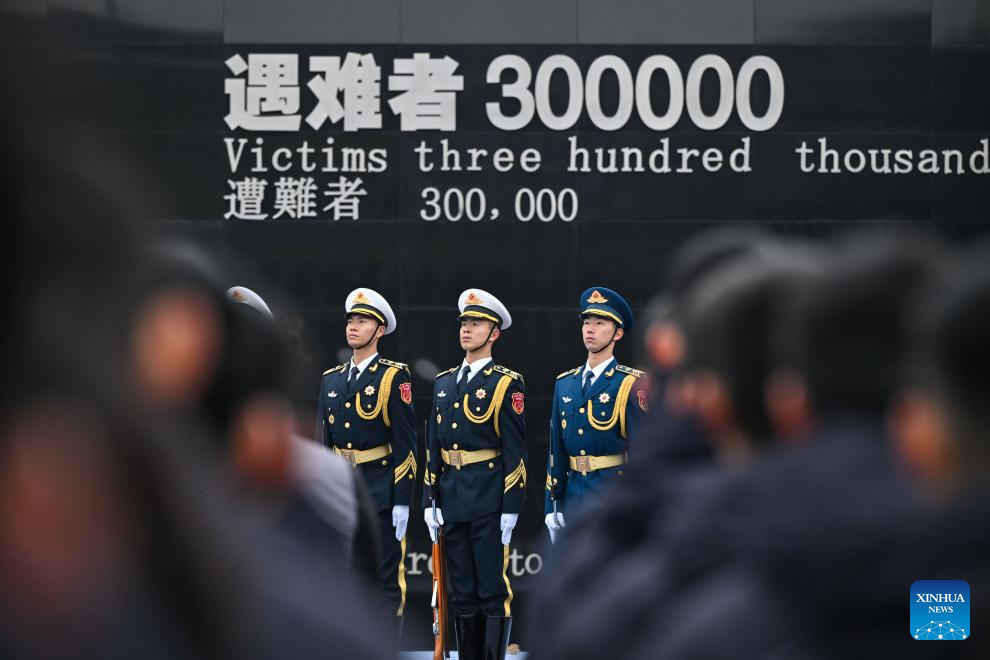
NANJING - Xia Shuqin, 96, sat eagerly in front of the television early Saturday morning, eyes fixed on the live broadcast of the 12th national memorial day ceremony in her hometown Nanjing, capital of East China's Jiangsu province.
Eighty-eight years ago, in that brutal, freezing winter, seven members of Xia's family -- her parents, grandparents and sisters -- were among the 300,000 lives lost in the Nanjing Massacre.
This year marks the 80th anniversary of the victory of the Chinese People's War of Resistance Against Japanese Aggression.
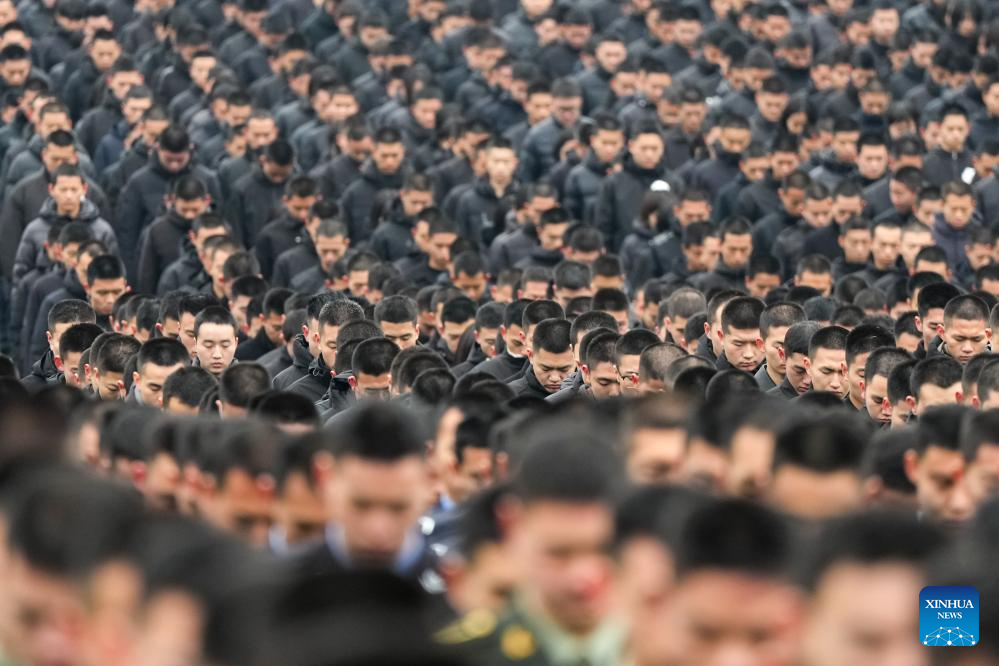
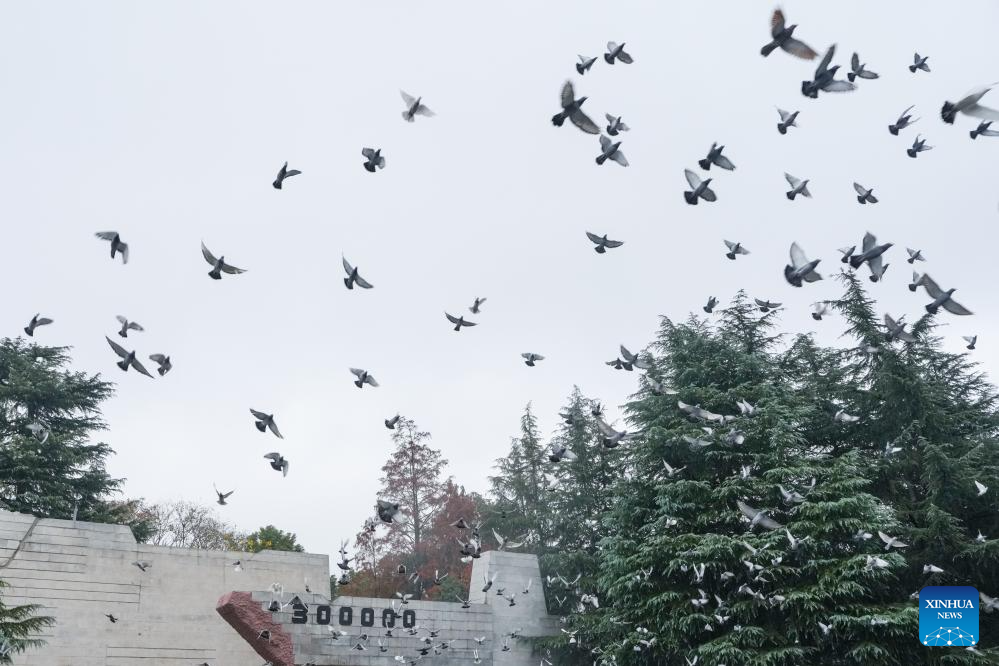
At the square of the Memorial Hall of the Victims in Nanjing Massacre by Japanese Invaders, thousands dressed in dark attire gathered with white flowers pinned to their chests. China's national flag was flown at half-mast in front of the crowd that included survivors of the massacre, local students and international friends.
"Eighty-eight years have passed and the Japanese government still has not officially acknowledged the Nanjing Massacre," said Xia. "If they refuse to face the crimes they committed, how can we guarantee such atrocities won't happen again?"
ALSO READ: China receives evidence from Russia on notorious Japanese Unit 731
The Nanjing Massacre took place when Japanese troops captured the then-Chinese capital on Dec 13, 1937. Over the course of six weeks, they proceeded to kill approximately 300,000 Chinese civilians and unarmed soldiers in one of the most barbaric episodes of World War II (WWII). One person was killed every 12 seconds.
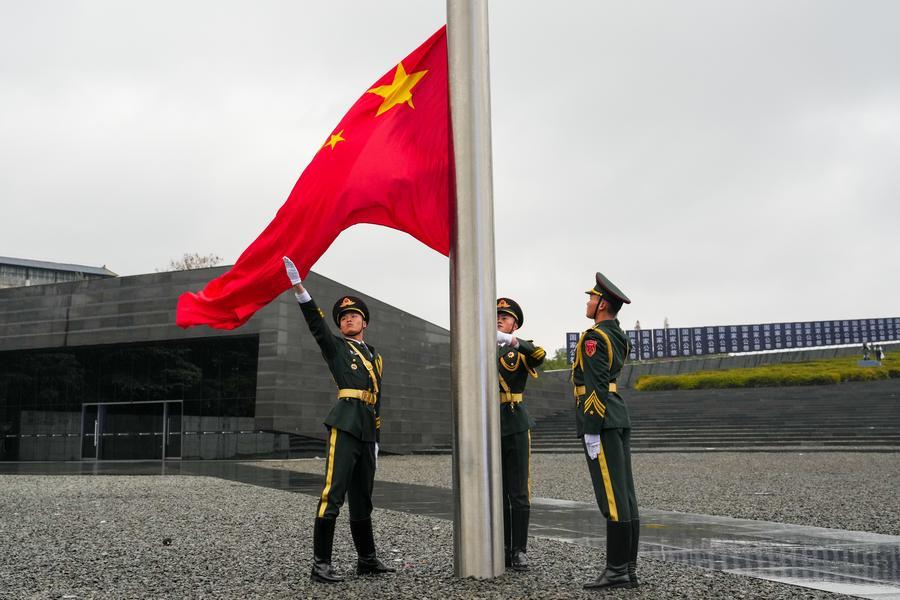
To forget akin to killing second time
Xia Shuqin still treasures a faded group photo taken 80 years ago to celebrate the victory, a photograph capturing only a part of her family. At the age of eight, she witnessed seven members of her nine-person household tortured and killed by invading Japanese soldiers who broke into her home. She herself was stabbed three times and lost consciousness, only to awaken to the sound of her four-year-old sister crying among the bodies.
"As long as I live, I will seek justice for the 300,000 compatriots who were slaughtered," said Xia, who became the first Nanjing Massacre survivor to travel to Japan after the war to testify to the crimes by Japanese troops. She was smeared as a false witness by Japanese right-wing groups and won a lawsuit against them in 2009.
Over the years, Xia has recounted her heart-wrenching story countless times, each retelling reopening old wounds.
In 2025 alone, eight Nanjing Massacre survivors passed away, leaving only 24 registered survivors still living, according to the Memorial Hall of the Victims in Nanjing Massacre by Japanese Invaders.
In San Jose, California, a public memorial will be held in a park named after Iris Shun-Ru Chang, the author of The Rape of Nanking, a bestselling non-fiction book detailing the massacre and atrocities committed by invading Japanese forces.
"In 1997, she awakened the world with her pen of sorrow and indignation. Today, facing the clamor of the right wing, we must solidify memory with memorials, because forgetting means a second massacre," said Iris' mom, Ying-Ying Chang.
She was quoting holocaust survivor and Nobel laureate Elie Wiesel, who wrote in his memoir Night: "To forget would be not only dangerous but offensive; to forget the dead would be akin to killing them a second time."
British poet W. H. Auden, who was in China during WWII, drew a parallel between what was happening in Europe and China in a poem. "And maps can really point to places, where life is evil now: Nanking; Dachau." Dachau was the location of the first Nazi concentration camp in Germany.
Thomas Rabe is the grandson of German businessman John Rabe, who joined other foreigners to establish an international safe zone during the massacre, saving over 250,000 Chinese lives. "Nazi Germany committed the holocaust, a crime against humanity that must never be repeated. After WWII, Germany made peace with its former victims and took responsibility, with Israel, France, Poland, and others. Unfortunately, not all countries have learned from the past," he said.
Chang said her late daughter aimed to advocate peace and urge Japan to confront its wartime history. "Apparently, certain Japanese politicians haven't reflected at all," she told Xinhua.
This year's memorial day came when China-Japan relations face renewed tensions following recent provocative actions by some Japanese politicians.
Chang saw Japanese Prime Minister Sanae Takaichi's remarks as "much more outrageous than when Iris wrote the book". Takaichi has hinted that the country could intervene militarily in the Taiwan question.
It's clear that the Japanese right-wing figures want to resurrect militarism, probably wage another war on China, and that leaves China no choice but to be more vigilant, Chang said.
Zhang Sheng, head of the Research Society of the History of Nanjing Massacre by Japanese Invaders, said that Japan has revised its textbooks and systematically distorted narratives of WWII history since the 1990s to downplay or even whitewash the country's war crimes.
"Such historical distortion has led to a notable decline in the number of Japanese people with an accurate understanding of the massacre," he warned.
Passing on memory to later generations
The truth of the massacre was not only witnessed by survivors and rescuers, but also captured and documented by international individuals residing in Nanjing at the time. During the Tokyo trial, a large amount of evidence of the Nanjing Massacre was confirmed, and the culprit, general Iwane Matsui, was sentenced to death.
Evidences show that the Japanese army used brutal methods such as mass shootings, live burials, knife strikes, and arson to kill Chinese unarmed soldiers and civilians. They carried out massive rape, looting, burning and destruction simultaneously.
According to records, eight charitable organizations participated in the recovery and burial of bodies after the massacre. The Nanjing branch of the World Red Cross alone collected and buried 43,123 bodies, while the charity organization Chongshan Hall in Nanjing collected and buried a total of 112,266 bodies.
In 2014, China's top legislature designated Dec 13 as the national memorial day to mourn those killed by Japanese invaders and expose war crimes committed by the Japanese. That year, Xia helped unveil a memorial ding, a traditional cauldron symbolizing state authority and prosperity.
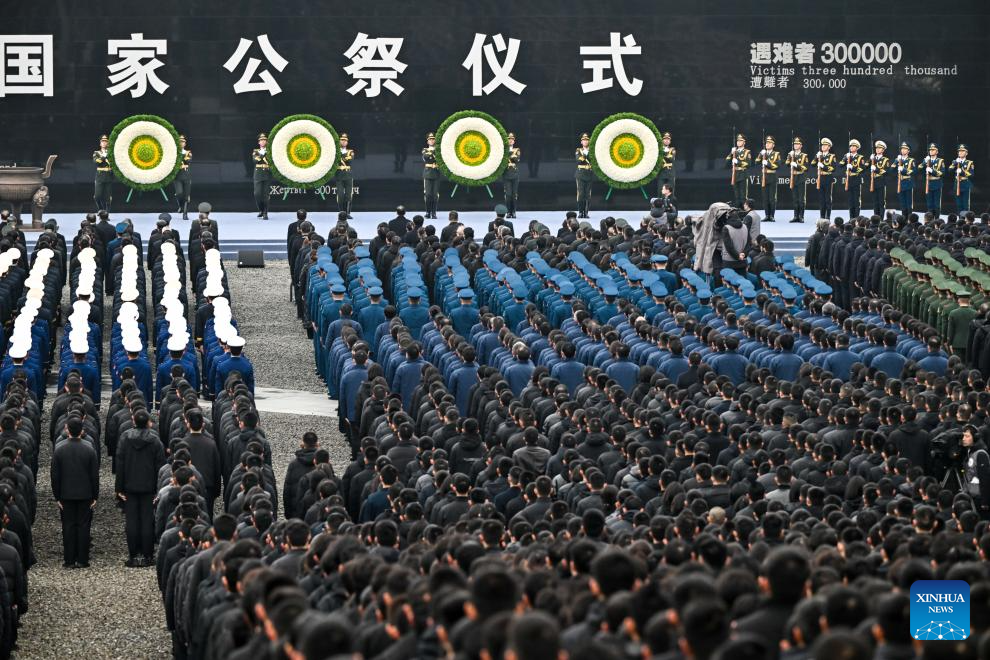
Throughout the years, China has intensified efforts to preserve historical memory through lectures, books and films.
Dead to Rights, a film screened in July based on verified photographic evidence and survivors' accounts, has grossed 3 billion yuan ($425 million) and will represent the Chinese mainland in the Best International Feature Film race at the 98th Oscars.
ALSO READ: 'Dead to Rights' smashes box office records, raises awareness
"With this film I am not trying to sow hatred," said director Shen Ao. "Instead, it is our wish that the history is never forgotten, reminding people today to cherish their lives, and cherish peace."
Survivor testimonies have been inscribed into UNESCO's Memory of the World Register, and exhibitions have been held in countries such as France. As the number of living survivors declines, the task of remembrance is shifting from relying on their personal accounts to a more systematic, institutionalized form of social transmission, said Wu Minchao, a professor in modern history at the Chinese Academy of Social Sciences.
Megan Brady, 23, great-granddaughter of American surgeon Richard Brady, who served in Nanjing during the war and witnessed the atrocities, became one of 38 officially recognized inheritors of the Nanjing Massacre memory. She composed a song Mercy in 2019, and participated in a workshop on the translation, publication and international communication of the Nanjing Massacre history.
"Acknowledging these facts is not about assigning collective guilt to any people today. Instead, it's about respecting truth and honoring the victims by ensuring that their suffering is not erased," Brady said.
In the "mass grave" of the massacre memorial hall, the remains of 208 victims lie preserved in their final postures. "Wars are more cruel than we can imagine," said a young man surnamed Yu from Shanghai. "Looking at the skeletons here, we can see that the Nanjing Massacre is far more than just some figures or several lines in history books."
The Gen-Z visitor told Xinhua that, like many of his peers, he enjoys Japanese animation such as Spirited Away and Demon Slayer, which have recently been released in China. "But it doesn't mean that we could forget the tribulation of our nation inflicted by Japanese invaders," he said. The ability to "distinguish and reflect", he added, is a sign of maturity among China's younger generation.
Many visitors shared this sentiment. "We believe that in the future the Chinese and Japanese people will maintain friendly relations. Our common enemies are the right-wing forces and anyone who opposes world peace," wrote visitors Gao Junfeng and Wang Lili in the memorial book.
Xia Shuqin's granddaughter, Xia Yuan, volunteers as a guide there, recounting her grandmother's story twice a month. In July, she traveled to Japan with a photo of Xia Shuqin and delivered an emotional speech at a university event.
READ MORE: Documentary related to 1937 Nanjing Massacre screened in Tokyo
Ahead of the national memorial this year, she and her son carefully retraced the names of their murdered family members on the "wailing wall" outside the memorial hall with black ink.
"The color of their names must never fade, and neither should their stories," she said.
