

Driven by the BRI, growing transport network is increasing passenger, trade flows across Southeast Asia

For more than a century, Europeans have boarded cross-border trains to crisscross the continent, from the iconic Orient Express to the high-speed trains used today.
In Asia, due to geography and geopolitical history, development has traditionally lagged. But all that has changed in recent years as cross-border rail in Southeast Asia, in particular, is undergoing a major transformation driven by infrastructure investment aimed at boosting regional connectivity.
Stemming from China's southwestern flank, a cross-border rail network is being woven, bringing neighboring economies closer together.
READ MORE: China-Vietnam rail projects to benefit region
From the mountains of Laos to the borderlands of Vietnam, these railways are reshaping trade flows, cutting logistics costs and bringing people-to-people exchanges to life. Together, they form a vivid picture of how the "iron dragon" — China's modern railway system — is connecting the nation more deeply with the world and driving shared prosperity across Asia.
Bridge to opportunity
No better can this be seen than in Laos, a landlocked nation whose roughly 500-kilometer northern border butts up against China's Yunnan province.
For 20-year-old Vilaysay from Oudomxay province in northwest Laos, after he boards the train to attend university across the border in Pu'er in Yunnan, his trip takes just over five hours at a cost of 173 yuan ($25).
A decade ago, his uncle would spend nearly three days by bus doing the equivalent trip for his own studies.
"The railway has changed everything," Vilaysay said. "Now it's easy to study, travel and explore new opportunities in China."
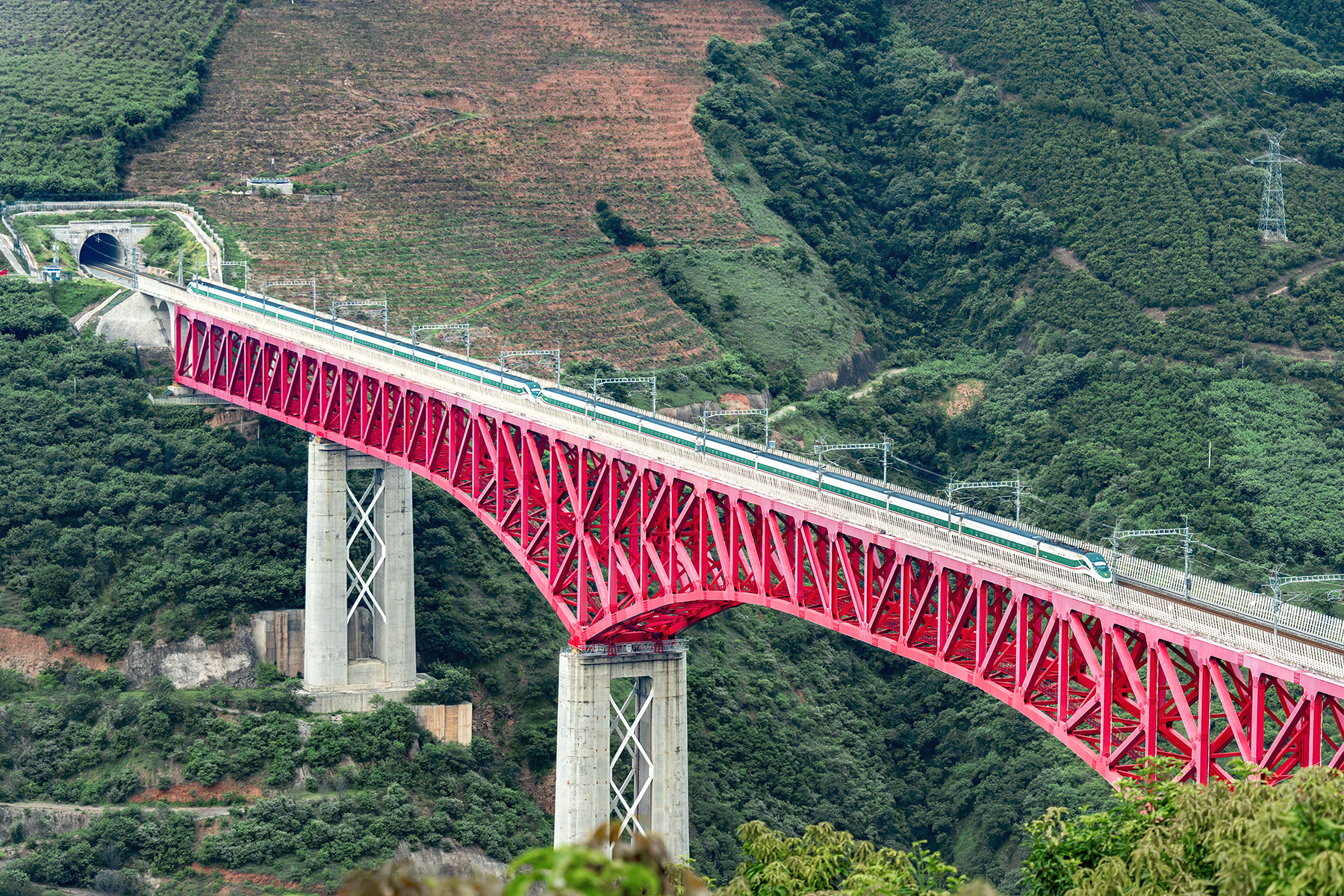
Since its opening in December 2021, the 1,035-kilometer China-Laos Railway has ended Laos' history of having no trunk line — a major, long-distance, high-capacity route — and brought about a new era of connectivity. The line has transformed travel times and trade routes, becoming a catalyst for development along its path.
A Chinese proverb says, "When a road opens, a hundred industries thrive". That has proved true in Laos. With daily trains linking cities and towns, new trade hubs, industrial parks and tourism zones have sprung up near stations. Chinese companies are investing in logistics, clean energy and manufacturing, while Laotians — even in their 70s — are enrolling in night schools to learn Chinese. "Parents want their children to speak Chinese because it means better job prospects," Vilaysay said.
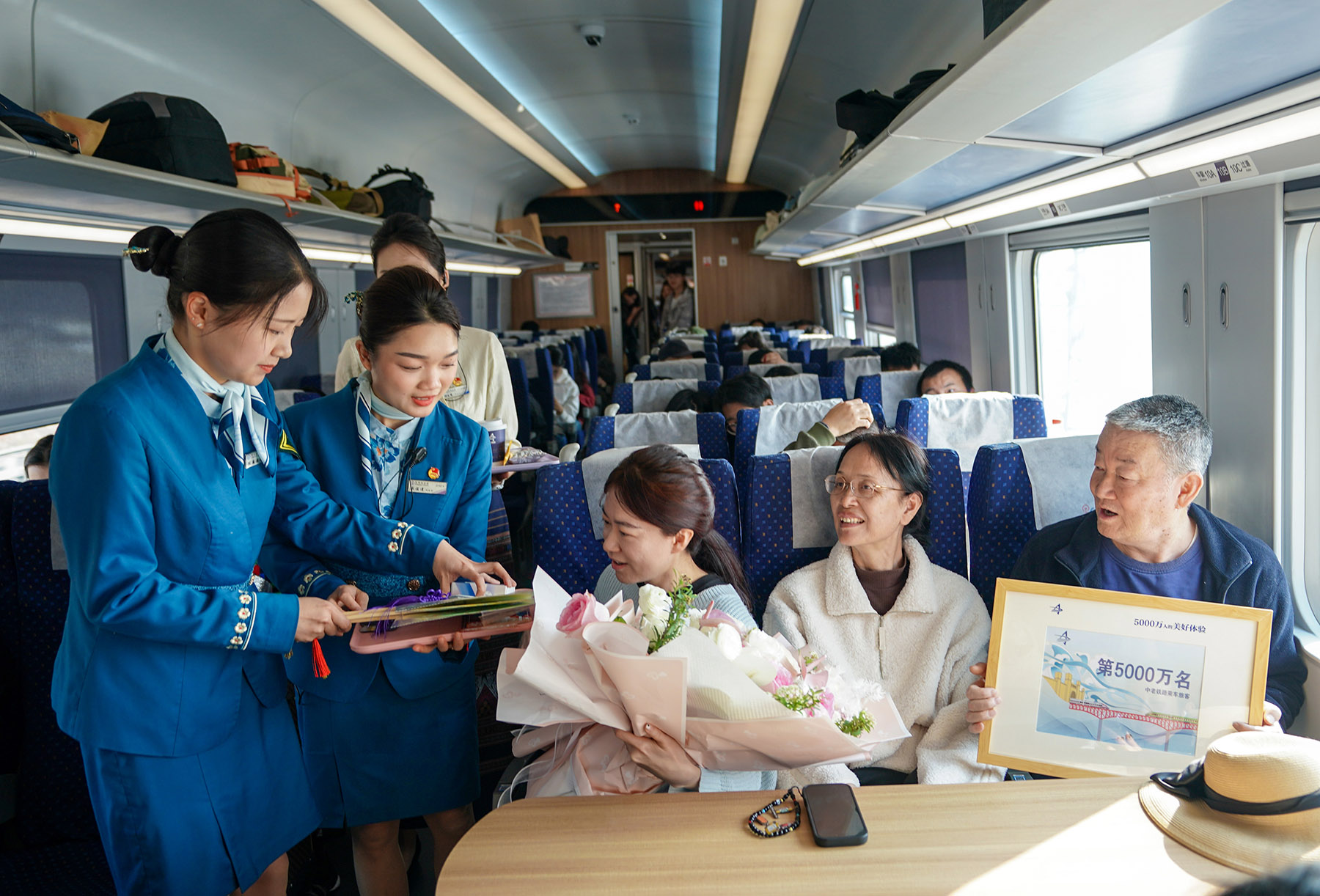
The railway has also proved a magnet for travelers. As of mid-October, it had operated 85,000 passenger trains and facilitated more than 60 million passenger trips, including over 600,000 cross-border trips for passengers from 115 countries and regions.

Fast freight
The success of the passenger service has been matched by freight growth. In less than four years, the China-Laos Railway has transported over 70 million metric tons of goods, becoming a vital artery for trade between China and Southeast Asia.
Products move in both directions — from rubber and tropical fruit from Laos and Thailand to Chinese-made machinery, new energy vehicles and photovoltaic products headed south.
The number of cross-border product categories has expanded from about 500 at launch to over 3,000, while the Mohan Rail Port has become China's largest rail gateway to Association of Southeast Asian Nations member countries.
According to China State Railway Group, freight volume rose from 12.46 million tons in 2022 to 17.76 million tons in 2023, and further to 19.65 million tons last year, reflecting steady growth.
The Lancang-Mekong Express, launched in early 2022, connects Kunming with Thailand and beyond, linking producers and markets across borders.
As of September, it had operated over 2,400 train trips, carrying some 1 million tons of cargo, and introduced innovative intermodal routes such as the "Lancang-Mekong + China-Europe Railway" service, creating a direct rail corridor from Southeast Asia to Europe.
"Each morning during durian season, trains loaded with Thai durian arrive at Kunming's container terminal," said Zhang Dehuan, deputy general manager of an international logistics operator based in Kunming.
"We unload, sort and repackage them for transport to major Chinese cities like Chengdu, Guangzhou and Zhengzhou. At the peak of the season, we handle over 100 containers a day."

The influx of tropical fruit has reshaped markets. Premium Thai durian that once cost 1,500-1,600 yuan per box now sells for about 800 yuan — a price drop locals jokingly call achieving "durian freedom".
"Riding the Lancang-Mekong Express, Thai durian reaches Kunming in three days and Lao bananas reach Beijing in seven," Zhang said. "Our refrigerated containers are so popular that they're always fully booked."
To meet the booming demand, Yunnan has upgraded its logistics system. At the Yunnan Hongyun International Logistics Park in Kunming, a 16-hectare hub has been built adjacent to the China Railway container terminal. New facilities integrate freight yards with warehousing, packaging and cold-chain storage.
"This model lowers logistics costs and boosts cargo turnover," said Li Rongping, the park's director. "By linking rail and road more efficiently, we're building a one-stop logistics platform that better serves regional trade."
Customs efficiency has also improved. Under a new "express rail clearance" model offering 24/7 pre-scheduled services, companies can complete customs declarations before trains arrive.
Containers pass through the Mohan checkpoint in as little as 2-5 hours, down from as much as 40 hours previously. Cross-border freight trains through Mohan have risen from two per day at launch to 18, peaking at 23, reinforcing its role as China's busiest rail port to ASEAN.
China-Vietnam link
In September, as the evening sun bathed Nanning Railway Station in the Guangxi Zhuang autonomous region, train T8701 prepared to depart for Hanoi, Vietnam. Among the passengers were French travelers Lise Dubos and Guillaume Pattier, eager to continue their Asian rail journey.
"We've traveled all over China by train — Beijing, Shanghai, Chengdu, Guilin," Dubos said. "Now we're taking the next step to Vietnam. Rail travel is comfortable, affordable and low-carbon."
Chinese businessman surnamed Zong, a regular passenger for more than a decade, echoed the sentiment. "I board at night in Nanning and arrive in Hanoi the next morning. It saves both time and money," he said.
Since the resumption of the Nanning-Hanoi and Beijing-Hanoi services in May, cross-border travel between the two countries has surged. By late September, the routes had recorded over 8,000 passenger trips, with August alone seeing an 89 percent increase from July.
ALSO READ: Spokesperson: China to devote more to peace, prosperity in SE Asia
Freight has been equally impressive. Data from China Railway Nanning Group shows that by late October, China-Vietnam freight trains departing from Guangxi had transported 29,000 standard containers, up 143 percent year-on-year, with goods sourced from 25 provinces across China.
"We consolidate small shipments in Nanning before loading them onto trains bound for Vietnam," said Zhu Shiqiang, logistics manager at Sinotrans Guangxi. "This approach speeds up deliveries, strengthens customer relations and enhances our competitiveness in ASEAN markets."
As two-way cargo flows accelerate, these railways are evolving from simple transport routes into economic corridors, enabling deeper industrial cooperation and regional supply chain integration.
From fast-moving durian to young students and European travelers, China's cross-border railways are weaving new stories of trade, travel and transformation. Promoting international railway cooperation has become a signature achievement of the Belt and Road Initiative, offering a tangible model of open connectivity.
Yang Ting contributed to this story.
Contact the writers at luowangshu@chinadaily.com.cn
