

In Part 2 of a series that turns the spotlight on new and upcoming museums in Hong Kong and how they stack up against their counterparts on the Chinese mainland, Chitralekha Basu explores the ways in which smart architecture and landscape design can aid the process of showcasing art and heritage while creating a space for visitors to feel at home.
 Rocco Yim’s design for the Hong Kong Palace Museum intrigues the mind, preparing it for the surprises in store. (PHOTO COURTESY HONG KONG PALACE MUSEUM)
Architects of the Swiss architecture firm Herzog & de Meuron ran into a hurdle while designing the M+ museum building. An Airport Express tunnel passing under M+’s West Kowloon Cultural District site was creating a design issue. Eventually, the solution was to write the emptiness that had been unearthed into Jacques Herzog’s design of the museum.
“Most architects would want to hide such a thing,” says Marisa Yiu, cofounder of the Hong Kong architecture firm, Eskiyu. “But Herzog & de Meuron celebrated it. They wanted to reveal it like an excavated space, giving it more of a 3D spatial quality. I thought that was a smart move.”
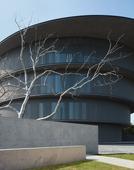 Roxy Paine’s metallic silver installation is etched against the slatted walls of the He Art Museum in Foshan, Guangdong province, like a painting. (PHOTO PROVIDED TO CHINA DAILY)
Hailed as a “found space”, the hollow in the ground now sits at the bottom of a sleek tower-on-podium structure — a take-off on Hong Kong’s most ubiquitous architectural form but served with a twist, by stretching the generic pencil tower horizontally. The sea-facing tower façade comes with a giant 65.8 meters by 110 meters LED screen and the promise of an audio-visual treat for the people of Hong Kong when it goes live next year.
“That screen will be a space where museum content is delivered,” says M+ museum director Suhanya Raffel. “Many people will have their first encounter with M+ via that screen.”
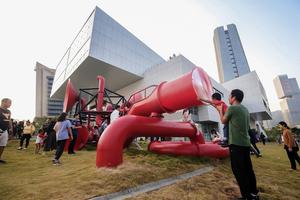 Social Network Factory, a playground installation by People’s Architecture Office, on the lawn of Design Society, Shenzhen, Guangdong province. (PHOTO PROVIDED TO CHINA DAILY)
Treasure chest
Architects have been trying to build an enticing, often playful, attitude into their designs for Hong Kong’s future museums. For instance, Rocco Yim’s design for the Hong Kong Palace Museum looks like an inverted Aztec pyramid from the outside — not the kind of structure one would readily associate with an institution meant to showcase precious items from the Palace Museum in Beijing’s Forbidden City.
If the HKPM building has a box of treasures look, the surprise element lies inside. The building’s soft fluid, curvilinear ceilings combine elements of the Frank Gehry-pioneered crumbled box style of architecture as well as “the mathematically derived aesthetics of the British architect Zaha Hadid’s signature parametric design,” says Lee Ho-yin, director of Architectural Conservation Programmes, Faculty of Architecture, the University of Hong Kong.
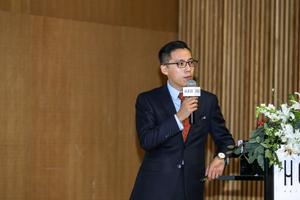
“While there is no apparent connection with traditional Chinese culture, I think it is a bold step for Yim to design the HKPM architecture in a way that contrasts with the exhibition rather than echoing it,” says Lee. The design scores in terms of “provoking thoughts and revealing surprises,” realizing the ambition of many architects around the world who want to do “more than designing a complementary stage for the exhibition a museum houses,” he adds.
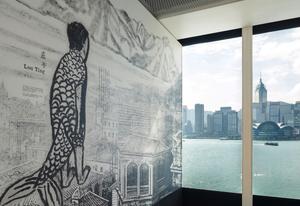 Lam Tung-pang’s video installation, Image Coated, shown at the Hong Kong Museum of Art, highlights the many imprints time has left on the scene at Victoria Harbour, Hong Kong. (PHOTO PROVIDED TO CHINA DAILY)
As far as bending of rules and subverting conventions go, some of the new museums on the Chinese mainland have pulled it off to spectacular effect. Lee sounds hugely impressed by Fumihiko Maki’s postmodern design for Sea World Culture and Arts Center in Shekou, Shenzhen, where the Design Society museum is located. The three wings of the structure — overhangs looking out into an idyllic panorama of hills, lush green rolling lawn and the sea — are held together by a green rooftop and many external staircases.
“The conventional notion of site and building, ground and roof, have been subverted by blurring the distinctions,” says Lee. “Postmodern museum design uses playful forms that have the benefit of expanded accessibility, which is a good way of drawing in the audience by making people literally walk all over the building.”
“I think Maki’s main contribution is the creation of orientation,” comments Design Society director Ole Bouman, “and hence it’s a celebration of the incredible values of the landscape around us: mountain, skyline, greenery, seaside horizon, a history of connections. The idea is to not just see all this, but to feel it.”
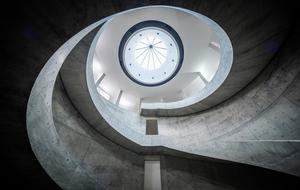 The double-helix staircase designed for the He Art Museum by Tadao Ando culminates in an opening in the ceiling, bringing in ample natural light. (PHOTO PROVIDED TO CHINA DAILY)
“What we have done to deepen and amplify this strategy is to see all programs as an invitation to participate, to vary program for different kinds of audiences, and give everyone a stake,” Bouman says.
The crowds have returned to SWCAC to take back ownership of the premises since the end of March, when the pandemic-triggered restrictions were eased in Shenzhen. The public sculptures on its expansive lawn, like Social Network Factory — a jumble of pipes, funnels and other industrial shapes, magnified and painted in a disarming shade of red — seems to be a hit with young and mature visitors alike.
“It’s super fun,” says Yiu, who happens to be the cofounder of the Design Trust, a Hong Kong-based foundation that funded Social Network Factory, which was created by the design collective, the People’s Architecture Office. The sculpture lends itself to “a range of social activities that are a great form of creative engagement,” Yiu adds.
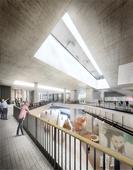 Herzog & de Meuron turns a tunnel under the M+ building site into a functional area and calls it a “found space. (PHOTO PROVIDED TO CHINA DAILY)
The double-helix effect
He Art Museum, in Shunde, Foshan, Guangdong Province, scores a first in museum architecture, with its double-helix slick concrete staircase spiraling upward, reaching out for a piece of the sky.
“When audiences standing in the middle of the central atrium look up above, they see a natural light, shining down from the sky,” says the He Art Museum director Shao Shu, adding that for many visitors “the architectural atmosphere” of the museum is as much of a draw as the art exhibitions.
The He Art Museum recently installed a large-scale installation, Ballast, by Roxy Paine, in the museum compound — a series of bare tree sculptures with a metallic-silver finish etched against the grey-blue slatted façade of the stacked discs-shaped building.
“Ballast by Roxy Paine seems to be challenging the hierarchical relationship between the museum and exhibit,” says Lee. “Instead of having the museum design tailored to specific exhibitions, it appears now that exhibitions are tailored to suit the museum’s architecture — metallic-silver dead trees matching a concrete-grey austere building — reversing the hierarchical relationship between museum and exhibition.”
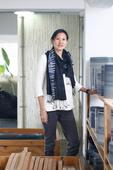 Architect Marisa Yiu says Herzog & de Meuron’s use of the railway tunnel in the M+ building site was smart. (PHOTO PROVIDED TO CHINA DAILY)
 He Art Museum director Shao Shu says the museum’s “DNA staircase” is an architectural breakthrough. (PHOTO PROVIDED TO CHINA DAILY)
Art meets nature
Such overturning of hierarchies ties in with the reality that people do not always visit museums to look for art, and that’s perfectly legit. The Hong Kong Museum of Art, which reopened after a massive three-year renovation in November 2019, is a case in point.
The Architectural Services Department of Hong Kong team led by Vivien Fung pulled down the building’s former functional box, borderline brutalist, façade and replaced it with a glass front. The close-range and uninterrupted view of the Hong Kong skyline across Victoria Harbour that HKMoA now commands, seems inspiration enough to want to go spend time at the museum.
“One of the favorite spots in the museum is the sea-facing corridor, where people can sit and look at the most famous scene of Hong Kong,” says HKMoA director, Maria Mok. “And that creates a sense of belonging. The view and the sense of the place are synchronized with the experience of art appreciation.”
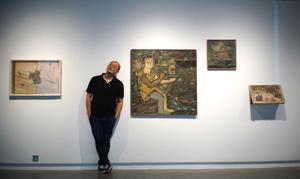 Artist Lam Tung-pang feels the sea-facing windows of the Hong Kong Museum of Art can stir people’s interest in art. (PHOTO PROVIDED TO CHINA DAILY)
The marvellous interface of nature and architecture was utilized by a number of artists at HKMoA’s inaugural show. For instance, Raymond Fung paid homage to Wu Guanzhong (1919-2010), recreating the intense concentration and repetition of motifs in the master painter’s ink and color landscapes by covering the glass panes on HKMoA’s first-floor with bird shapes made from recycled tiles.
Lam Tung-pang used an anonymous mid-19th century lithograph of Victoria Island (as Hong Kong Island was called then) from HKMoA’s Paul Chater collection to create a video installation, superimposing an old landscape on the museum windows with a harbor view. He also added his own drawings to the mix, including that of an intriguing human figure, covered with scales and wearing a fish tail.
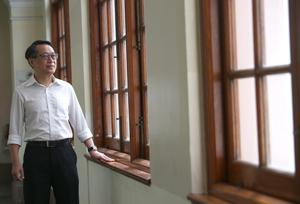 The University of Hong Kong’s architecture professor Lee Ho-yin applauds museum architects who are subverting convention. (PHOTO PROVIDED TO CHINA DAILY)
Lam says he wished to capture the idea of a Hong Kong that is continuously evolving — “being shaped, imagined and re-shaped, taking on layers of meanings, from time to time.” The juxtaposition of the mythical man-fish (Lou Ting) with a landscape painting of Victoria Harbour from 19th-century colonial Hong Kong and Lam’s own artistic response to the way the city is today, are meant to be “in a dialogue with each other.”
“If Hong Kong itself is a museum, then the sea-facing windows of HKMoA are like a frame on it,” says Lam. “I think the sea-facing floors are a good place to remind people of the changing landscape of Hong Kong, where the view can stir one’s imagination and make them relax. Who knows if one day a visitor who came to the museum to enjoy the great view might not get interested in the art in the building?”
Click here to read a Q&A with Shao Shu, director, He Art Museum
Contact the writer at basu@chinadailyhk.com
