

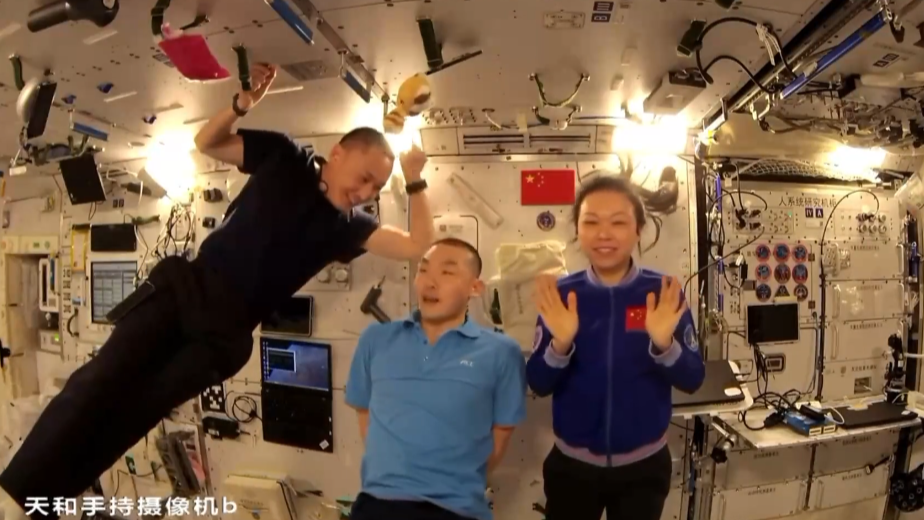
Lai Ka-ying, Hong Kong’s first astronaut, and her crewmates on the Shenzhou XXIII manned space mission, successfully conducted various experiments, including in-orbit brain testing and research, after living and working on the Tiangong space station for over five months, according to the China Manned Space Agency.
A video released by the CMSA on Sunday showed the Shenzhou XXIII crew — Zhu Yangzhu, Zhang Zhiyuan, and Lai — using electroencephalogram (EEG) equipment last week to carry out several experiments, such as brain-network-atlas-driven monitoring, studies on visual-motor processing, and investigations into behavioral responses to lighting.
Using near-infrared brain-imaging equipment, the crew conducted experiments on the time-varying characteristics of brain networks in space to shed more light on the long-term effects of spaceflight environments on the functional networks of the human brain, the CMSA said.
ALSO READ: Shenzhou XXIII crew harvests rice samples on Tiangong
The astronauts also performed in-orbit tactile perception experiments and force-control tests and completed tasks such as cleaning the sample chambers of the containerless processing facility on the space station.
They also completed last week scheduled inspections and tests of their intravehicular pressure suits, conducted in-orbit emergency survival training, and carried out maintenance on the space station complex. the CMSA added.
The three astronauts were launched aboard the Shenzhou XXIII spaceship on May 24 for a six-month mission.
