

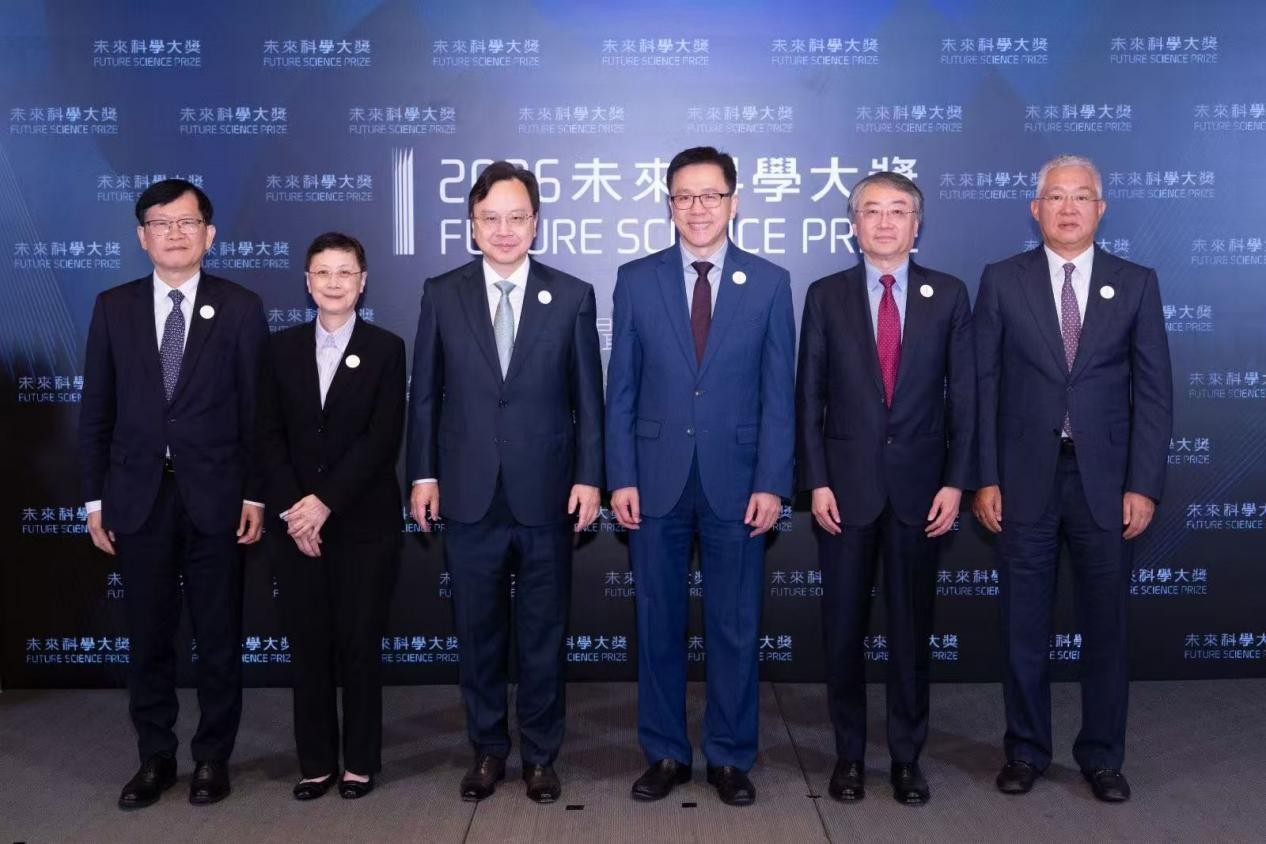
The Future Science Prize on Thursday named three Chinese mainland scientists as its 2026 laureates, with announcements made simultaneously in Beijing and the Hong Kong Special Administrative Region.
This marked the fourth consecutive year that the prestigious award had held major activities in the SAR.
Hong Kong officials and scholars said they believe that the event will further strengthen Hong Kong’s role as an international science and technology hub, ignite public enthusiasm for science — especially among young people — and showcase regional scientific strengths.
The winners were announced during live broadcasts of news conferences held concurrently in Beijing and Hong Kong.
The Life Science Prize was awarded to Zhang Hong of the Chinese Academy of Sciences Institute of Biophysics for his pioneering research into the mechanism and physiological function of autophagy in multicellular organisms.
The Physical Science Prize went to Zhao Dongyuan from Fudan University in Shanghai, recognizing his work on researching mesoporous materials in the context of synthetic control, mechanistic understanding, and industrial application.
Yuan Xinyi from Peking University won the Mathematics and Computer Science Prize. He has made fundamental contributions to arithmetic geometry, and developed the theory of arithmetic bigness in Arakelov geometry.
Initiated in 2016 by scientists and entrepreneurs to honor the outstanding achievements of researchers from the Chinese mainland, Hong Kong, Macao and Taiwan, the event is now in its 11th edition.
The award offers a $1 million prize for each category. So far, 46 scientists have been honored, including many from Hong Kong.
Addressing the news conference in Hong Kong, Sun Dong, secretary for innovation, technology and industry of the Hong Kong SAR, said that the event aligns closely with the national strategy for innovation and technology development, reflecting an elevating level of self-reliance and strength in science and technology.
He said the prize has developed into one of the SAR’s flagship global events, and signals the nation’s strong scientific research abilities on the global stage.
The award’s accompanying activity, Prize Week, is set to be held from Nov 6 to 9. Nearly 100 renowned scientists — including laureates of the Nobel Prize and Fields Medal — will attend two high-profile science symposiums, a forum focusing on artificial intelligence development, a laureates’ dialogue with young researchers, and the awards ceremony.
These events will contribute to global scientific development and consolidate Hong Kong’s role as an international innovation and technology hub, Sun said.
He also highlighted the city’s commitment to embracing AI, with plans to promote AI adoption and knowledge across the city.
Vivian Yam Wing-wah, co-chair of the 2026 Future Science Prize Week Program Committee and vice-president of the Hong Kong Academy of Sciences, said that Hong Kong’s hosting of multiple editions underscores the city’s enthusiasm for science.
Yam said that the future of science lies in passing on knowledge — an ethos central to the Future Science Prize. She added that it is not only about gathering top scientists but also about engaging the public.
In Beijing, Guan Kunliang, rotating chairman of the 2026 Selection Committee of the Future Science Prize, said the prize will continue to promote internationalization, institutionalization, and sustainability, stepping steadily toward its long-term goal of becoming a centennial science award, and cultivating the next generation of scientists.
Two “Hello Scientists” lectures will feature Hong Kong microbiologist Yuen Kwok-yung, a 2021 Future Science Prize laureate; and Dai Xi, a 2025 laureate from the Hong Kong University of Science and Technology. They will deliver speeches on Sept 19 and Oct 27 respectively.
The Future Science Prize will host a monthlong exhibition at the Hong Kong Science Museum from Oct 16 to Nov 18, along with numerous science outreach activities for secondary school students.
Contact the writer at atlasshao@chinadailyhk.com
