

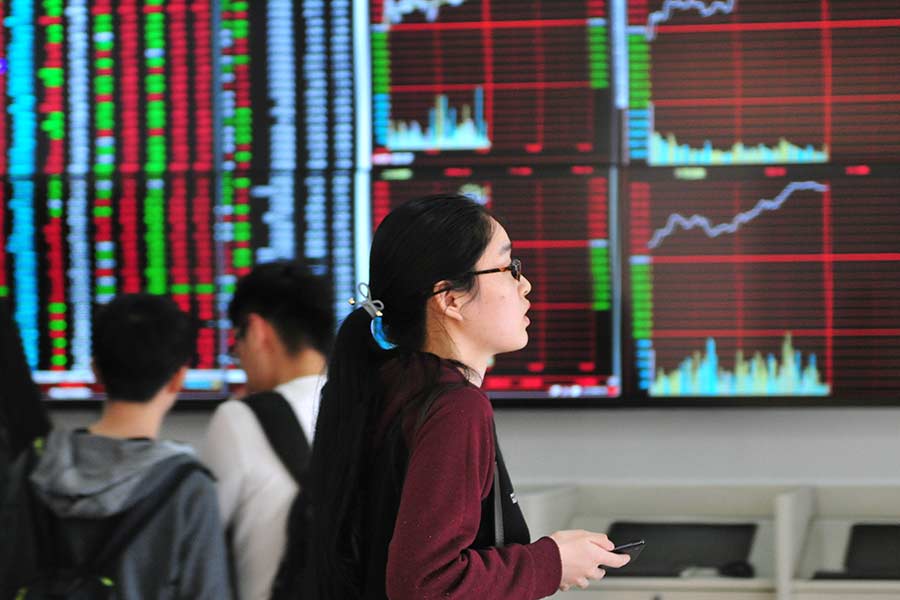
An executive meeting of the State Council, China's Cabinet, underscored on Friday the importance of the capital market to the broader economy and called for a stronger role for State-backed funds in stabilizing it, sending Chinese shares soaring in a tech-led rally.
Chaired by Premier Li Qiang, the meeting stressed that the capital market is vital to overall economic development, calling for efforts to strengthen countercyclical adjustments and tackle critical reform tasks at the same time.
It was the first time that a statement from a State Council executive meeting had explicitly referred to the "national team", a term for State-backed investors that buy shares during periods of market stress.
The meeting said that efforts should be made to give greater play to the "national team" in steadying the market and to optimize the quasi-stabilization fund function of State-owned Central Huijin Investment — an arm of China's sovereign wealth fund and a key member of the group — to provide sufficient liquidity.
Analysts said the move has given unusual prominence to the capital market's role in economic development. In a rare move, the meeting statement was released during the midday trading break, highlighting the priority that policymakers have attached to shoring up investor confidence.
The market responded with a strong surge.
The Shanghai Composite Index soared 3.73 percent to close at 3,606.49 points, while the growth-oriented ChiNext Index jumped 11.61 percent, with both posting the biggest single-day gain since October 2024. More than 400 A-share stocks hit their daily upper limits.
Liu Chunsheng, an associate professor of economics at the Central University of Finance and Economics, said the capital market helps companies raise funds for industrial upgrading, while its performance affects household wealth and consumer confidence.
By describing the market as vital to the broader economy, the meeting gave it greater prominence than earlier statements that emphasized its role as a pivot within the financial system, Liu said, a shift that suggests the additional policy support under consideration could be more substantial.
"Market stabilization is shifting from emergency policy reactions to a standing policy framework," said Tao Chuan, chief economist at Guolian Minsheng Securities, with the pledge of a bigger role for the "national team" giving investors a clearer sense of the support they could expect during bouts of volatility.
The meeting also stressed the need to improve market-stabilizing mechanisms, give full play to existing policies, and consider and introduce new measures to promote steady and sound development of the capital market.
Efforts should be made to encourage listed companies to pay more dividends and step up share repurchases, improve policies to support and guide medium- and long-term funds into the market, and take resolute action to investigate and deal with practices such as financial fraud and noncompliant share reductions, according to the meeting.
China Daily learned from people close to the matter that securities regulators are moving to revise buyback rules to make repurchases easier, expand access to a central bank lending facility for buybacks and share purchases, and encourage listed companies with disclosed plans of buybacks and share purchases to accelerate the implementation process.
In its financial stability report released on Friday, the People's Bank of China, the country's central bank, also vowed its support for capital market stability, saying it would make effective use of its two monetary policy tools that support the capital market and roll out investment products and risk management tools tailored to long-term investors.
Analysts said that Friday's market uplift may mark a turning point for China's A-share market following months of adjustments, as global investors reassess returns from investments in artificial intelligence, with the correction having made shares of some high-quality companies more attractive.
Goldman Sachs expects the CSI 300 Index to gain about 10 percent in 2027, while UBS sees the MSCI China Index rising about 13 percent next year. JPMorgan recommends overweighting Chinese mainland and Hong Kong stocks in Asian portfolios.
Meanwhile, earlier this month, Oxford Economics raised its forecast for China's GDP growth in 2027 to 4.6 percent from 4.3 percent.
Allianz Global Investors has turned overweight on Chinese equities, said Michael Krautzberger, chief investment officer for public markets at the German asset manager, with holdings spanning AI, robotics, automation and autonomous driving, as well as suppliers of energy and storage components.
China's energy infrastructure, scientific talent and vast market provide advantages for innovation, with opportunities increasingly extending to small and medium-sized companies, he said.
Howard Davies, a veteran financial regulator and former chairman of the UK Financial Services Authority, said that overseas portfolio investment in China is likely to increase as the country's growing innovation capabilities and opportunities for portfolio diversification draw growing international interest.
Contact the writer at zhoulanxv@chinadaily.com.cn
