

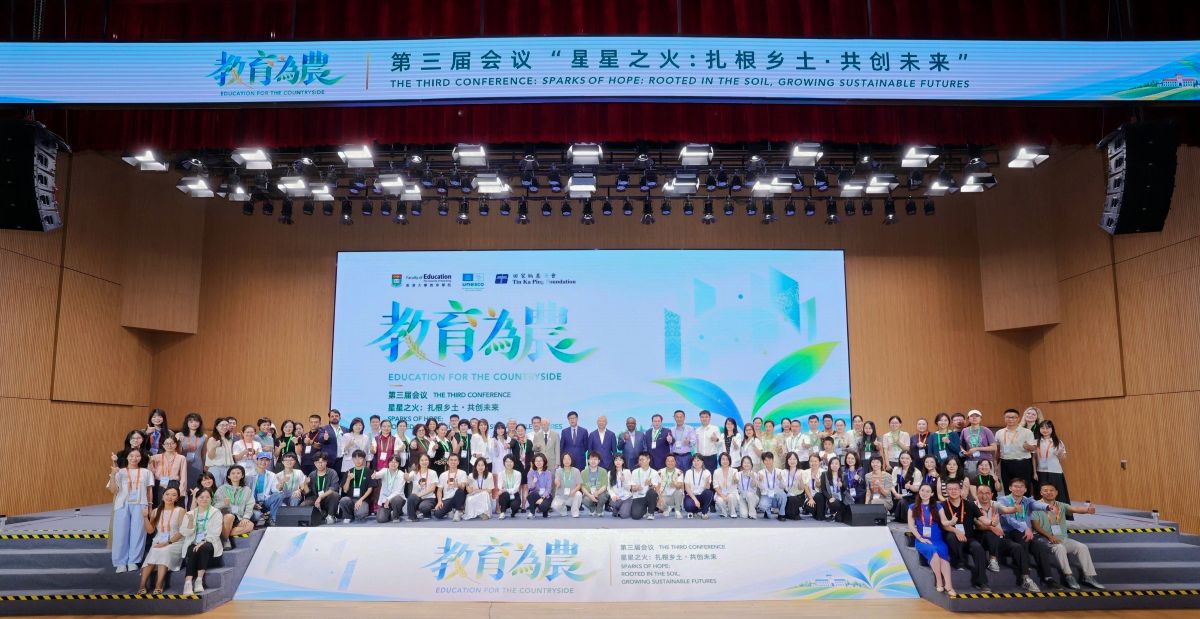
Educators from more than half a dozen countries and regions have launched a new global framework aimed at transforming rural schooling from an imitation of urban models into an engine for local revitalization and sustainable development.
Unveiled at the close of the Third Education for the Countryside Conference in Sanya, Hainan province, the Sanya Action Initiative sets out three concrete commitments – establishing an “Education for the Countryside Alliance” to formalize long-term collaboration; compiling and translating exemplary rural education cases into Chinese and English for global dissemination; and utilizing digital platforms for joint online teaching research and curriculum co-development across borders.
The conference, held on Nov 7 and 8 and themed “Sparks of Hope: Rooted in the Soil, Growing Sustainable Futures”, explored how education can drive rural revitalization, strengthen school-community ties, and advance global sustainable development.
It drew more than 100 educators, researchers and representatives of international organizations from China, Brazil, Sweden, Cyprus, Kyrgyzstan, Russia and beyond.
The event was co-organized by the Faculty of Education at The University of Hong Kong and the International Centre for UNESCO ASPnet (ICUA), backed by the Tin Ka Ping Foundation and with academic support from the Institute of Curriculum and Instruction at East China Normal University.
Addressing the opening session, HKU Vice-President and Pro-Vice-Chancellor Gong Peng said narrowing the urban-rural education gap requires more than upgrading physical infrastructure. Schools must also reform evaluation systems, modernize educational philosophies, and harness emerging technologies such as artificial intelligence to boost teaching effectiveness in rural areas, he said.
Zheng Haitao, vice-president of the Hainan Provincial Institute of Education Research and Training, and David Day, general secretary of the Tin Ka Ping Foundation, stressed the urgency of directing high-quality educational resources toward rural communities.
Subsequent keynote speeches challenged conventional assumptions about the purpose of rural schooling.
Luiz Zarref, representing Brazil’s Landless Rural Workers’ Movement, cited how rural schools in his country reorganize academic calendars around agricultural cycles, integrating farming directly into the curriculum to nurture rooted community changemakers.
Hu Jing, a professor at South China Normal University, highlighted how emerging forms of the rural collective economy can provide sustainable financial backing for local schools, while Professor Li Xueyin of Southwest University demonstrated how a hands-on agrarian course can bridge intellectual learning with physical practice to foster well-rounded talents.
Dedicated sessions on Chinese innovations and international practices showcased frontline models from schools worldwide.
Practitioners from Cyprus, Kyrgyzstan and Russia shared strategies ranging from school-community partnerships and traditional craft instruction to cross-border student exchanges.
During eight panel discussions tackling teacher training, place-based curriculum design, educational governance, and civic engagement, speakers said elevating rural education depends on close collaboration among schools, local communities and non-profit organizations.
Wang Dan, associate professor at HKU’s Faculty of Education and initiator of the conference, urged educators to move beyond narrow exam-oriented metrics and place holistic human development alongside community sustainability at the heart of rural schooling.
ICUA Executive Director Zhang Wei said the Sanya gathering marked a decisive shift from concept to concrete action, pledging that the center will leverage digital platforms and its global network to provide rural schools with curriculum resources, teacher training and international visibility.
