

Winner of the Blancpain-Imaginist Literary Prize, novelist Suo Er draws on years of research to tell stories of displacement and belonging, Yang Yang reports.
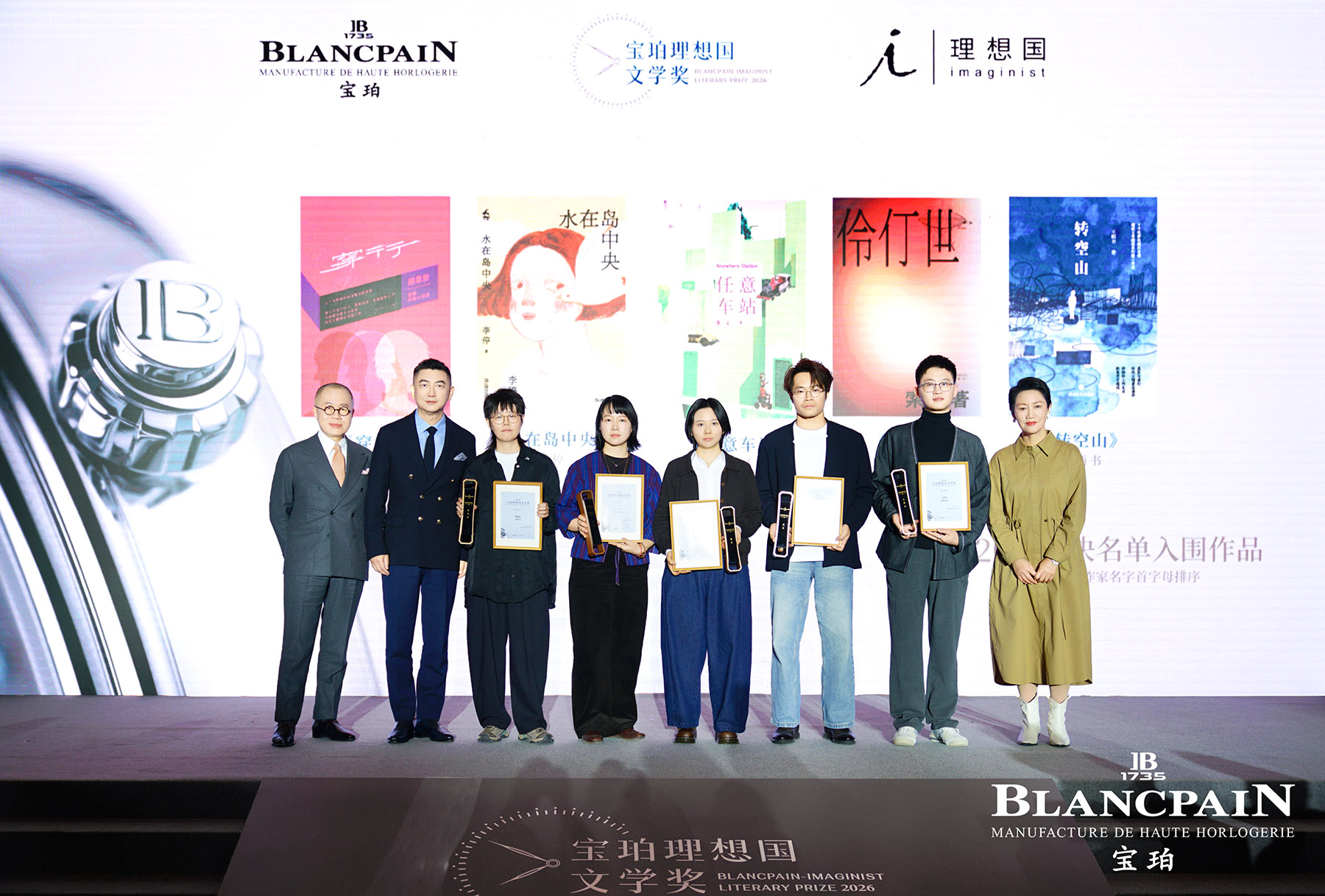
At 34, writer Suo Er has won the 2026 Blancpain-Imaginist Literary Prize for his novel Lingding Shi, a work spanning different times and places that traces the intertwined lives, memories and journeys of ordinary people across the southern reaches of China and beyond.
On Nov 3, Suo won the award, beating four other short-listed writers. The novel, whose title can be loosely translated as A World of Solitude, was recognized for its expansive vision and experimental narrative.
Cofounded in 2018 by Swiss luxury watch brand Blancpain and Chinese publisher Imaginist, the annual prize was established to discover Chinese writers under the age of 45. The winner receives a cash prize of 300,000 yuan ($42,022), and a Blancpain watch.
READ MORE: A tale of trials and tribulations
The other four short-listed works include Chuan Xing (Passing Through), a novella collection by Chen Si'an, Shui Zai Dao Zhongyang (Water in the Middle of the Island), a novel by Li Ting, Renyi Chezhan (Anywhere Station), a fantasy short story collection by Liang Ling, and Wang Moshu's short story collection Zhuan Kongshan (Turning the Empty Mountain).
Presenting the award on behalf of the jury, Chinese writer Ge Fei said: "Lingding Shi is a novel with a grand vision and imaginative flair, as well as having a bold narrative approach. Anchored by the dream of the 'guava airship' in its opening and closing chapters, the novel unfolds through four relatively independent yet interconnected life stories." In doing so, Ge said, it turns literary writing into a new way of understanding the world, making a distinctive contribution to the expansion of novelistic narrative and the exploration of contemporary experience across different times and spaces.
In the novel, the death of the protagonist's grandmother sets off a long journey of discovery. Her complex, largely unspoken past and the mystery surrounding the "guava airship" she left behind prompt the narrator to investigate the family history. As the story unfolds, figures from four different settings in the last century gradually emerge: a Southeast Asian merchant who left his homeland, a family of boat dwellers who refused to settle on land, two displaced sisters returning from Saigon, and an outsider working in what was then known as the "world's factory".
Though seemingly transient and disconnected, these individuals carry their own memories and destinies, which gradually reveal unexpected connections.
The novel grew out of an experience Suo had in 2019 while traveling through Malaysia, from Malacca to Penang Island. There, he encountered familiar temples, arcaded houses and grand traditional Chinese residences, and was struck by how deeply and visibly Chinese communities had put down roots in a foreign land. He was moved by the experience and found himself wondering: "Why do they seem more Chinese than I do?"
The question stayed with him, prompting six years of field research and writing.
In search of answers, he traveled extensively through Fujian, Guangdong, Yunnan, Guizhou, and Hainan provinces, Guangxi Zhuang autonomous region and overseas destinations. He interviewed Tanka boat dwellers and Vietnamese Chinese, retraced the paths of refugees and sifted through hundreds of historical documents, weaving real historical events and figures into the novel.

Suo began writing Lingding Shi in 2021 and completed it in 2025. Spanning more than 200,000 Chinese characters and featuring over 40 roles, the novel builds a multilayered narrative universe of the South, using individual lives and historical fragments to explore the complexities of the 20th century.
In an earlier interview, Suo said that his previous writing had tended to focus more on his own experiences. With this novel, however, he sought to step outside himself and adopt the perspectives of others, trying to understand their complicated journeys of departure, return, survival and choice.
For him, this shift represented both a challenge and an adventure in testing the boundaries of narrative.
The title "Lingding Shi" draws inspiration from the concept of the "Anthropocene". Geological epochs often use the suffix "-cene". In Suo's novel, however, "Shi" is closer to century, world, or society.
Through the title, he seeks to convey the solitary and marginalized condition of human existence against an expansive backdrop of time and space.
"What I have always wanted to write about has never been a particular region, but rather to break through it and reach toward a broader, unknown territory. In that time and space of the past, territories and borders were not as fixed and important as they are today. Ordinary people were like driftwood carried by the current: when the sea was lean here and rich there, they moved from old homes to new lands in endless flows and cycles — all simply to make a living," Suo said.
Commenting on the novel, Ge Fei said, "Both the life experiences and the novel's style feel unfamiliar, and the language is particularly powerful."
This unfamiliarity comes from the author's sharp sensitivity to the "nonhuman world". He describes himself as someone who "tries to sense the environment through smell and footsteps". In his writing, the plants, climate, and ocean of the South take on narrative roles, becoming vessels of memory and metaphors for human destiny.
ALSO READ: Writing the village as universe
The novel's language is equally experimental. Suo draws on dialects from Fujian, Guangdong and Hubei provinces, Southwestern Mandarin, the Miao language and the vernacular of Tanka boat dwellers, creating a distinctive linguistic landscape and an unconventional reading experience.
Dan Hansong, a professor of English language and literature at Nanjing University, described the novel as possessing the ambition of a postmodern masterpiece. "A miraculous work of southern narrative, every word testifies to the novelist's rare linguistic gift — and to that absolute freedom within the current of language."
Suo's next work will continue to explore the "polymorphism of life" that runs through Lingding Shi, but with a shift in focus toward the present. He plans to examine how different living environments, from waterways to mountainous regions, shape diverse forms of life and ways of perceiving the world.
Asked why he writes novels, Suo said many questions that remain unresolved in reality become clearer during the process of writing. For him, writing is like a form of "self-detoxification and healing", offering a way to resist the pressures and uncertainties of life.
Contact the writer at yangyangs@chinadaily.com.cn
