

Proposals at forum include reforming existing institutions
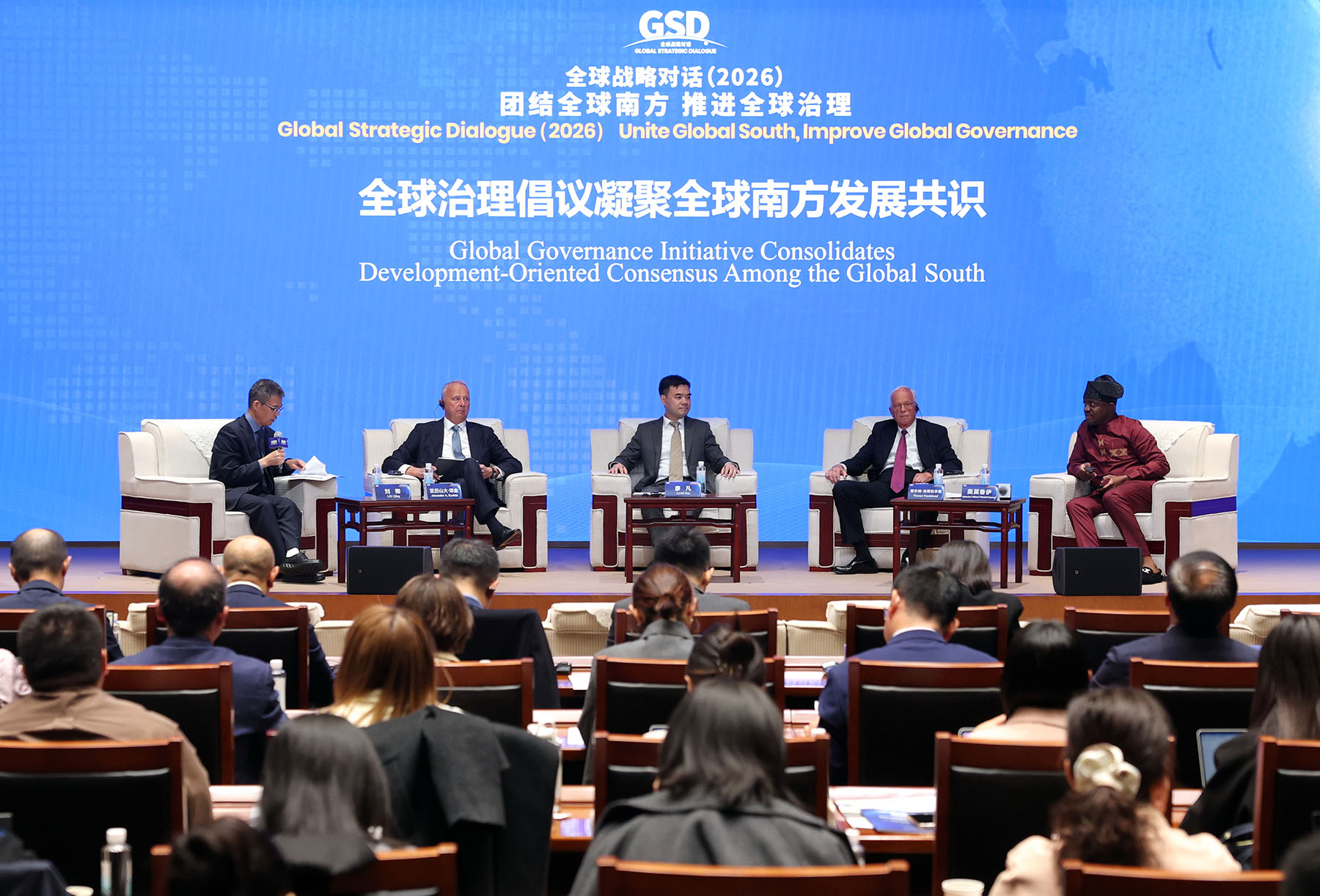
Countries of the Global South must translate their growing economic strength into coordinated action to defend multilateral cooperation, speakers at a Beijing forum said on Wednesday, as geopolitical tensions and unequal representation constrain their influence and development choices.
Their proposals included reforming established institutions, developing additional cooperation platforms and strengthening coordination among existing mechanisms to enable developing countries to play a greater role in international decision-making.
Discussions at the Global Strategic Dialogue (2026), jointly hosted by the Chinese Academy of Social Sciences and China Daily, highlighted a widening gap between an increasingly multipolar world and international institutions whose power structures have changed far less.
READ MORE: Unity key to greater voice of Global South
Werner Fasslabend, Austria's former defense minister, warned of a shift from a system based on rules toward one increasingly governed by power. Russian scholar Alexander Dynkin likewise said the authority of the United Nations and the World Trade Organization had weakened.
The erosion of multilateral institutions compounds longstanding obstacles to fairer global governance.
Djoomart Otorbaev, former prime minister of Kyrgyzstan, said some powers had abused their veto power in the UN Security Council when urgent action was needed. He also pointed to the International Monetary Fund's voting system, under which some decisions require an 85 percent majority. Because the United States holds more than 15 percent of the voting power, it can effectively block such decisions, he said.
For the Global South, the mismatch between economic weight and decision-making power has consequences beyond diplomatic status.
Liao Fan, director-general of the CASS Institute of World Economics and Politics, said the limited representation of developing countries allowed the geopolitical concerns of powerful economies to overshadow priorities such as industrialization, infrastructure development and poverty reduction.
"The question, therefore, is not whether international relations should be governed by rules," said Pompeo Della Posta, a professor at Beijing Normal University. "It is what kind of rules, who makes those rules, through which procedures, and whether they are applied consistently."
However, growing economic strength and the expansion of cooperation platforms have not automatically given developing countries a unified voice.
Dynkin, an academician at the Russian Academy of Sciences, argued that Western countries remained more consolidated in their international positions than the Global South.
Ehizuelen Michael Mitchell Omoruyi, a Nigerian scholar at Zhejiang Normal University, identified a deeper challenge: participation alone does not guarantee influence, and effective cooperation requires credible commitments to build lasting trust.
"A country may attend every meeting without influencing the rules," he said.
To address these gaps, Liao proposed that China's global initiatives serve as "a mechanism of mechanisms", connecting diverse cooperation platforms around shared development priorities.
He said the Global Governance Initiative's principles of sovereign equality, abiding by international rule of law, multilateralism, a people-centered approach and a focus on real actions offered a framework for developing countries to participate more fully in global governance.
Practical steps could include coordinating positions through the UN, BRICS and the Shanghai Cooperation Organization; reforming voting arrangements at the IMF and World Bank; and strengthening cooperation in infrastructure, technology and climate action.
Della Posta's assessment reinforced this approach.
ALSO READ: Xiong'an Vision charts global governance goals
"Reforming established institutions and developing additional forms of cooperation are complementary processes," he said.
China could contribute by supporting institutional reforms and providing financing, facilitating technical exchanges and implementing projects that strengthen countries' own development capabilities, he added.
Zou Jiayi, president of the Asian Infrastructure Investment Bank, cited a wind power project in Laos supplying Vietnam as an example of cooperation delivering benefits across borders. She also stressed that stronger representation for developing countries could improve collective decision-making and expand opportunities for all.
The goal, speakers emphasized, is to build a more inclusive international system that can withstand coercion and deliver tangible development benefits. Omoruyi said solidarity should enable developing countries to strengthen their collective voice while working constructively with all nations, creating a basis for cooperation that respects differences and gives smaller economies greater influence over their future.
Contact the writers at yaoyuxin@chinadaily.com.cn
