

Chinese artificial intelligence company iFlytek is positioning itself as a second option for global AI developers by combining homegrown foundation models with domestic computing power, CEO Liu Qingfeng said in an exclusive interview with China Daily, stressing that the company's overseas expansion is driven by real-world applications rather than simple tool exports.
iFlytek now has 600,000 overseas developers spanning more than 220 countries and regions, Liu said, adding that among the 29 countries that signed an agreement in Shanghai on July 16 to establish the World Artificial Intelligence Cooperation Organization, more than half have AI cooperation with iFlytek.
Liu acknowledged that the United States still leads in computing infrastructure and the ability to push models to their limits. Chinese open-source models such as Alibaba's Qwen have also gained significant international influence. Yet overseas developers and governments continue to choose iFlytek, he said, because the company offers a full-stack, independently controllable system that can train on both the US company Nvidia's platforms and Chinese computing platforms.
READ MORE: Smart economy gateway to immense potential
The deeper reason, according to Liu, is that iFlytek's models have been deployed at scale in China. The company built some 70 percent of the country's AI-powered smart education demonstration zones and over 20 of the 25 AI application pilot schools selected in Beijing last year.
In healthcare, more than 90 percent of AI applications in 800 counties and districts — used to improve primary-level diagnosis and reduce misdiagnosis and incorrect medication — are iFlytek's.
"We also hold the largest market share among central State-owned enterprises, with deployments in agriculture, finance and energy, including over 80 percent of AI models used by China's energy sector," Liu said. "Foreign partners are attracted when they see tangible scenarios on site, not just a model, open-source or closed."
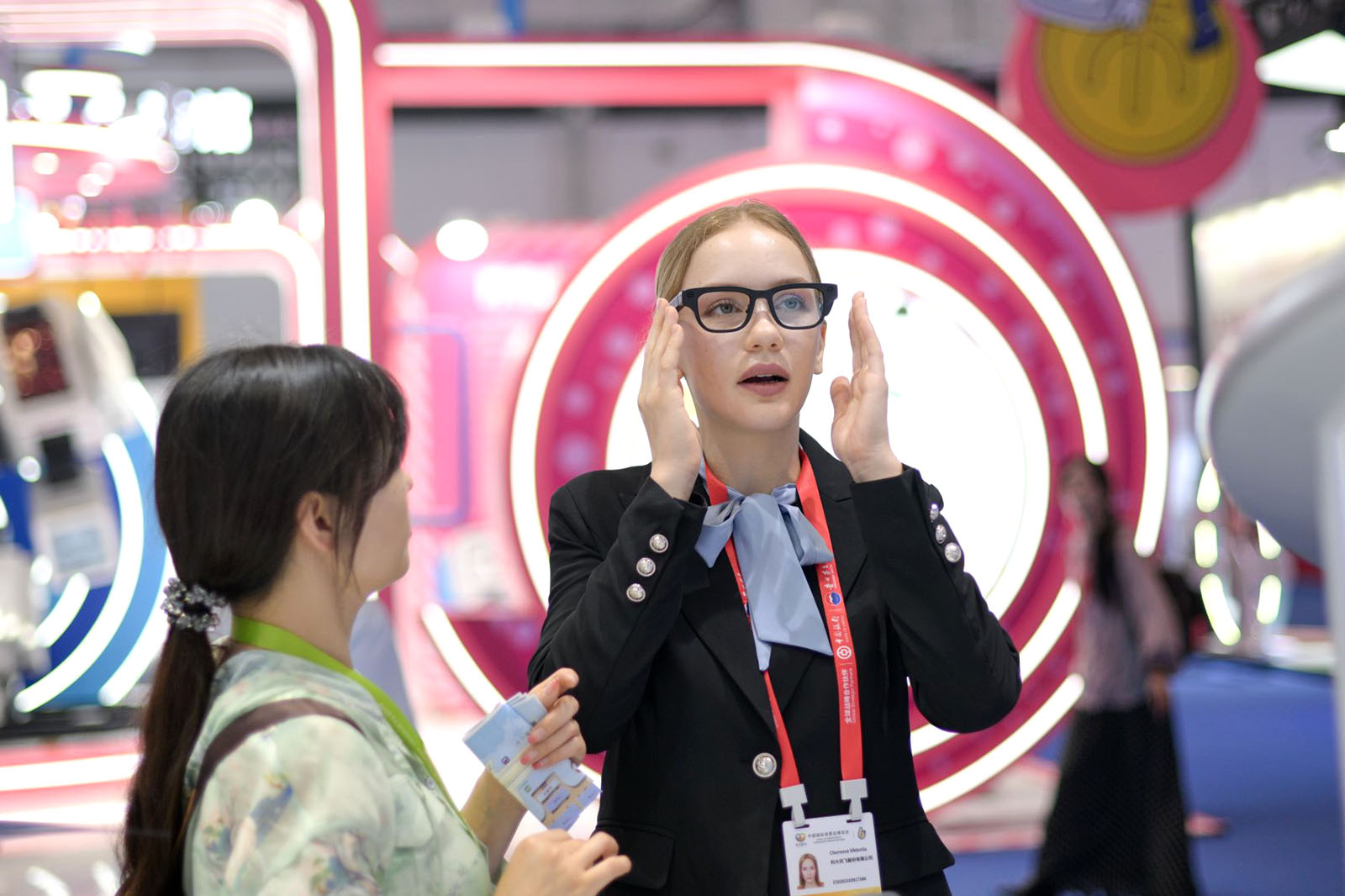
Beyond models, iFlytek is betting on integrated software and hardware, combining voice technology with large language models to serve far-field, multi-person and robotics scenarios in homes and other environments — capabilities Liu said few competitors can match.
For instance, iFlytek's multilingual AI transparent screens have been deployed at two major shopping destinations in Bangkok, Thailand, offering real-time translation and convenient services to travelers from around the world. Meanwhile, the company's GuideX digital human at Bangkok's Don Mueang International Airport provides interactive services in more than 30 languages, including Thai, Chinese, English, Japanese and Korean.
Samantha Zhu, chairperson of Accenture Greater China, said AI is driving the accelerated global reconfiguration of enterprise value. In China, industries across the board are now moving from trials in AI technology to large-scale deployment.
"China is emerging as a critical testing ground for the global development of AI, with robotics, intelligent vehicles and industrial scenarios converging at an accelerated pace. AI is no longer just a tool; it is rapidly evolving into a versatile, cross-scenario capability that is permeating business-critical processes and every facet of enterprise operations," Zhu said.
ALSO READ: Chipmakers driving AI boom
Accenture's 2026 index of Chinese enterprises' digital transformation, for which 160 Chinese companies were surveyed, reached the largest single-year increase in recent years, and digital application scenarios such as AI assistants, intelligent research and development, and AI-powered customer experiences are rapidly becoming the mainstream in China, Zhu noted.
In 2025, China's core AI industry surpassed 1.2 trillion yuan ($180 billion) in value, with over 6,200 AI enterprises operating across the country, according to the Ministry of Industry and Information Technology.
Contact the writers at masi@chinadaily.com.cn
