

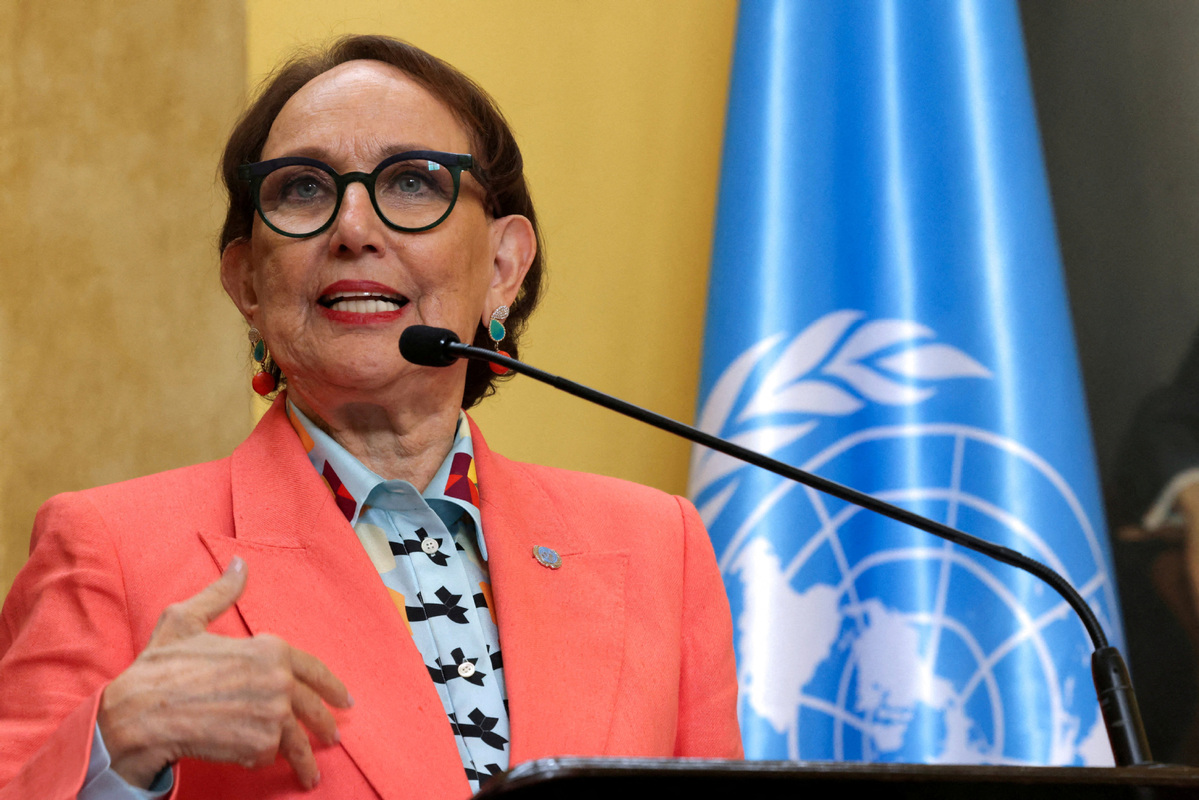
As the end of 2026 draws near, the window for the UN Security Council to select a candidate for the next secretary-general is narrowing, with Costa Rica's Rebeca Grynspan remaining in the lead after the latest round of voting on Wednesday.
Grynspan received nine "encourage" votes and six "discourage" votes in the latest informal, closed-door straw poll among Security Council members. As the secretary-general of the UN Conference on Trade and Development and a former Costa Rican vice-president, Grynspan has led four of the five informal straw polls held by the Security Council so far.
The results, however, left the outcome uncertain. While Grynspan remained ahead, her support slipped from 10 votes in the previous round on Sept 29, while opposition to her doubled from three to six. The two candidates behind her also lost support and received more "discourage" than "encourage" votes on Wednesday.
READ MORE: UN formally initiates selection process for next secretary-general
Carolyn Rodrigues-Birkett, Guyana's permanent representative to the United Nations and a former foreign minister, received five "encourage" votes, down from eight.
Rafael Mariano Grossi of Argentina, director-general of the International Atomic Energy Agency, received six "encourage" votes, also down from eight, according to results reported by PassBlue.
The latest results also do not show whether any of the "discourage" votes came from the council's five permanent members: China, France, Russia, the United Kingdom and the United States, any of which can block a candidate.
A candidate needs at least nine votes in the 15-member council and must avoid a veto by any of its five permanent members before being recommended to the 193-member General Assembly.
The Security Council has so far used confidential, nonbinding straw polls that do not distinguish between votes cast by permanent and elected members. Color-coded ballots, once introduced, would reveal whether a "discourage" vote came from a permanent member.
Sources told China Daily that this year's selection is expected to follow the practice of the previous race, with color-coded ballots introduced only in the final rounds. In 2016, the council held six straw polls before recommending current UN Secretary-General Antonio Guterres, with color-coded ballots used only in the sixth and final round.
Greece, which holds the rotating presidency of the Security Council for October, said that the council is expected to make significant progress toward selecting a candidate this month.
"October is the month when we need to make progress and perhaps even agree on the new secretary-general," Greek Permanent Representative to the United Nations Aglaia Balta told reporters at a news briefing last week.
"I do not believe that we will arrive on Dec 31 and not have a recommendation," Balta said at the Security Council's presidential news briefing.
The next secretary-general is supposed to take office on Jan 1, 2027, succeeding Guterres, whose second five-year term ends on Dec 31.
Gender and geography have also loomed large over this year's selection.
In the more than 80-year history of the United Nations, all nine secretaries-general have been men.
While regional rotation is not formally required under the UN Charter, candidates from Latin America and the Caribbean have drawn particular attention in this selection cycle.
List of candidates
Four other candidates remain in the race: Maria Fernanda Espinosa Garces of Ecuador, a former president of the UN General Assembly and former foreign minister; Ecuadorian diplomat Ivonne A-Baki; Olara Otunnu of Uganda, a former UN under-secretary-general; and Macky Sall, former president of Senegal.
The candidate field could still change as there is no formal deadline for new nominations, and candidates are not limited to Latin America and the Caribbean, according to a spokesperson for the president of the UN General Assembly.
Under the UN Charter, the secretary-general is appointed by the General Assembly upon the recommendation of the Security Council.
Answering a question from China Daily about what the president of the General Assembly expects from the candidates, Melissa Summers, spokesperson for Khalilur Rahman, president of the 81st session of the UN General Assembly, said he would be guided by the UN Charter.
"The president has been very clear that he's going to be guided by the language in the Charter, the different complementary roles that the Assembly and the Council will play in this matter," Summers said after the Security Council held its latest straw poll on Wednesday.
Contact the writers at minluzhang@chinadailyusa.com
