


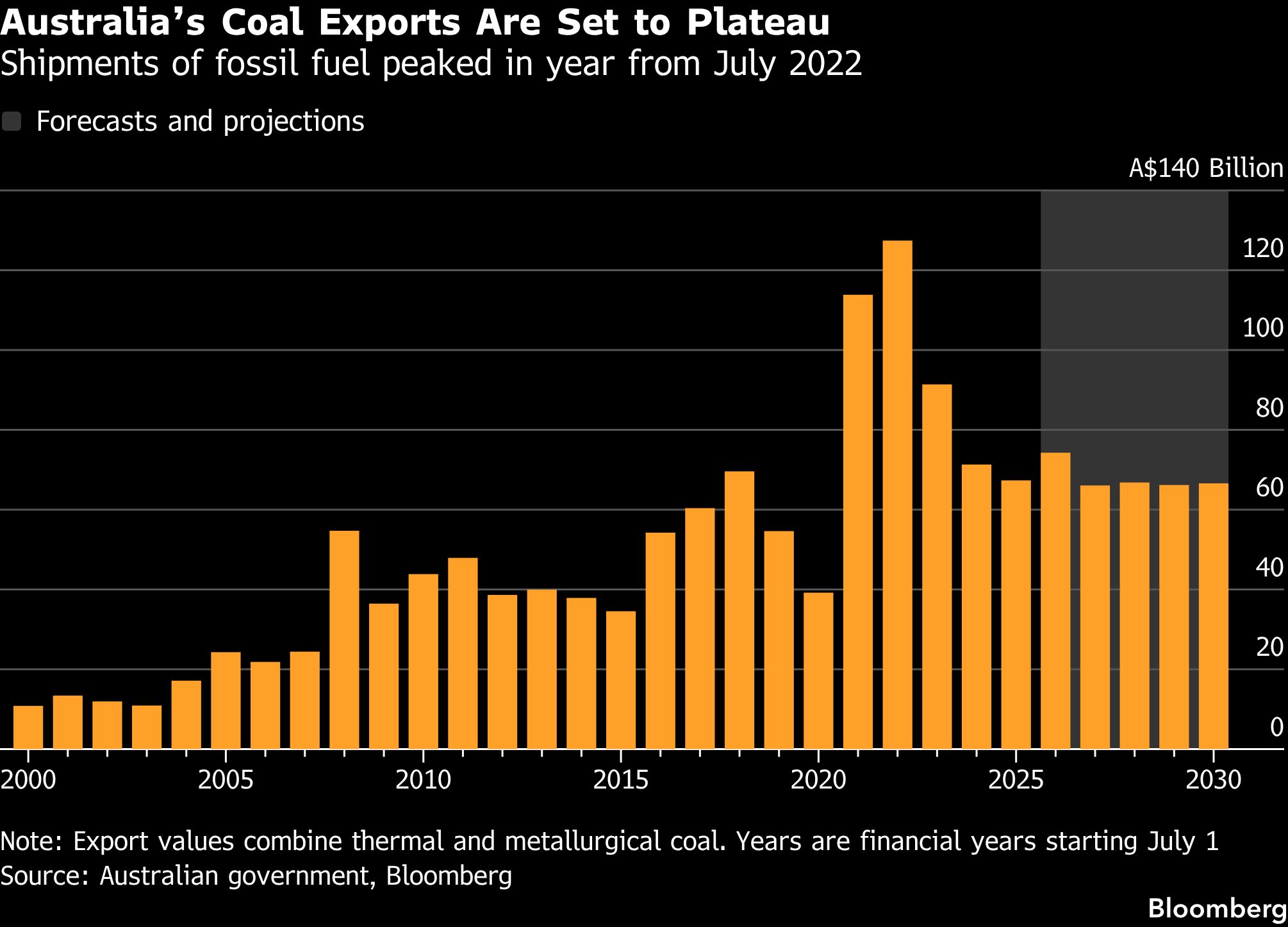
Australia’s highest court ruled planning authorities weighing coal mine projects should consider climate change impacts triggered by the use of the fuel, potentially adding challenges for an export sector that generates A$70 billion ($49 billion) a year.
The High Court of Australia on Wednesday rejected an appeal by Mach Energy Australia Pty related to the expansion of its Mount Pleasant coal mine in New South Wales state. A lower court had previously determined that impacts of Scope 3 greenhouse gas emissions — those generated by the burning of coal by a mine’s customers — constituted 98 percent of the site’s potential pollution, and needed to be properly considered.
Authorities were obliged to decide whether “all GHG emissions, including scope 3 GHG emissions, are minimized to the greatest extent practicable,” Justice Robert Beech-Jones said in the judgment. The rejection of Mach’s appeal was endorsed by three of five judges.
“This is a momentous win for the climate,” said Nic Clyde, a coordinator for Lock the Gate Alliance, an organization that opposes fossil fuel project developments. “Today’s decision sends a strong message to the planning system: the price households and communities are paying for coal pollution must be weighed properly.”
The ruling applies directly to planning approvals made in New South Wales, the country’s second-largest coal producing state, and will likely set a precedent for similar decisions nationwide, according to campaigners. There are about 30 current proposals for new or expanded coal mines that are seeking government approval, said the Australia Institute, a think thank.
Australia, one of the world’s biggest exporters of fossil fuels, has been frequently criticized for continuing to support massive coal and natural gas projects while pursuing more ambitious cuts to domestic emissions, and advocating for stronger climate action overseas. The nation has again been challenged on the issue as it prepares to helm global negotiations at COP31, the annual United Nations-convened climate change talks, in Turkiye next month.
ALSO READ: PM Albanese: Australia to lead COP31 negotiations under hosting deal with Turkiye
Miners in Australia argue that the quality of their fuel means it is less polluting than supplies from other nations, and that delays to approvals risk jobs and the country’s reputation as a reliable energy partner.
“Developing a coal mine in Australia is already difficult enough because of long approval times, lawfare by activists and high royalties and other taxes,” Tania Constable, chief executive officer of the Minerals Council of Australia, an industry group, said in a statement. “Now mines may have to work out how to reduce emissions from their export customers, or scope 3 emissions.”
The High Court judgment came after a local community group in New South Wales state’s Hunter Valley challenged the expansion of the Mount Pleasant mine. An appeals court ruled in July 2025 that approval of the site’s 22-year extension was unlawful and that planning authorities are legally required to consider the local impacts of Scope 3 emissions.
“While we are disappointed with the outcome, we accept the court’s decision and will carefully review the judgment to understand its implications for future project assessments and environmental approvals,” Mach Energy said in a statement. Mount Pleasant was granted a separate, six-year extension in August, the company said.
Planning reforms in New South Wales mean that approvals now consider the impact of Scope 3 emissions, including a decision last month to sanction a major coal expansion by a venture between Glencore Plc and Yancoal Australia Ltd, the state’s Finance Minister Courtney Houssos said in a statement. “We believe the current planning framework is capable of addressing these issues,” she said.
Environmental campaigners have mounted a slew of legal challenges to Australia’s fossil fuel export sector in recent years, including unsuccessful attempts to constrain developments by companies including Woodside Energy Group Ltd, Santos Ltd and Whitehaven Coal Ltd.
The value of Australia’s thermal coal exports will remain flat at about A$31 billion in the year through June 2027, according to government forecasts, with volumes seen slipping almost 3 percent to 209 million tons. Exports of metallurgical coal for steelmaking are forecast to rise almost 7 percent over the same period to 161 million tons, with a value of A$44 billion.
