

Asiad bronze represents the chance for a new generation to emulate the achievements of the last Chinese side to medal at the Games back in 1998
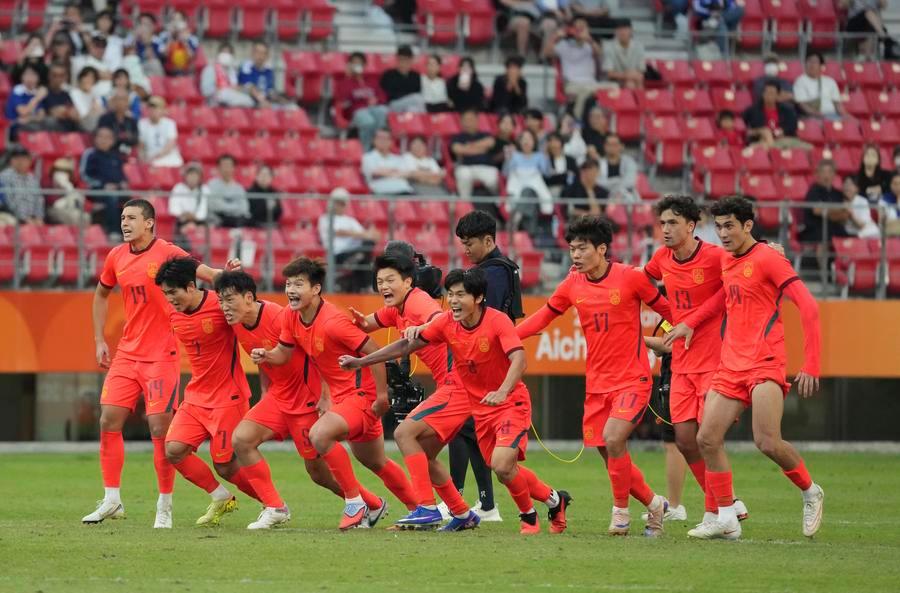
The ball was already on its way when China goalkeeper Li Hao knew his team was about to end a 28-year wait.
He had already saved two penalties, and Peng Xiao was tasked with taking China's final spotkick. If he scored, China would be on the Asian Games podium for the first time since 1998.
Peng made no mistake.
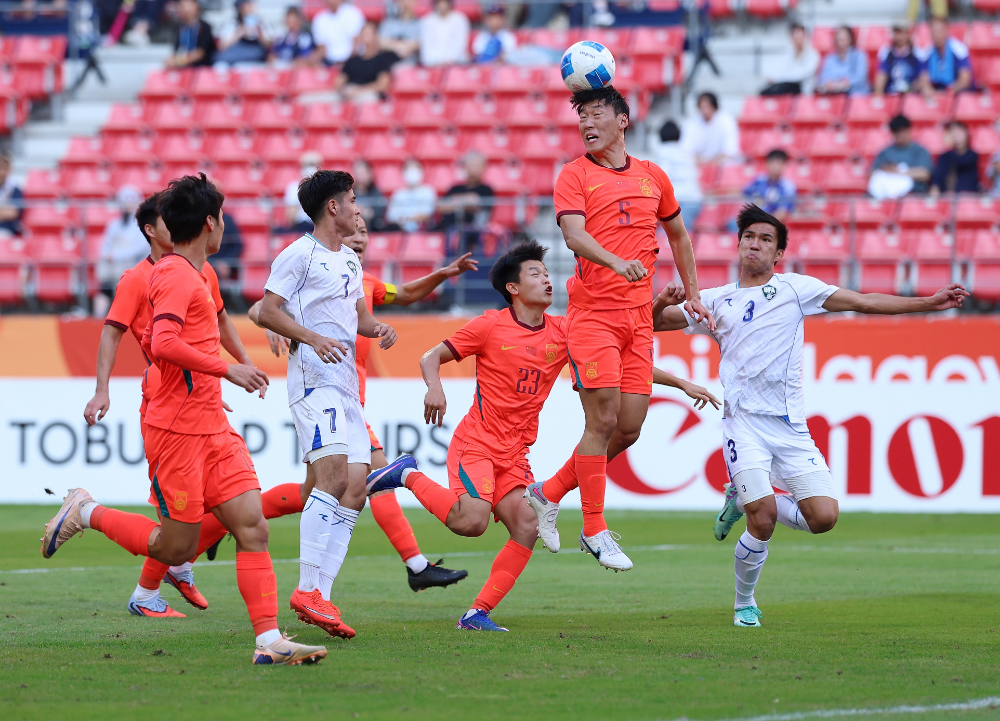
China beat Uzbekistan 4-3 on penalties after a 2-2 draw in the men's bronze-medal match on Saturday afternoon at Toyota Stadium, securing a place in history at the Aichi-Nagoya Asian Games.
For a generation of players who had grown together through China's youth national teams, the result marked the culmination of years of development — and for many, the final chapter of their U23 journey.
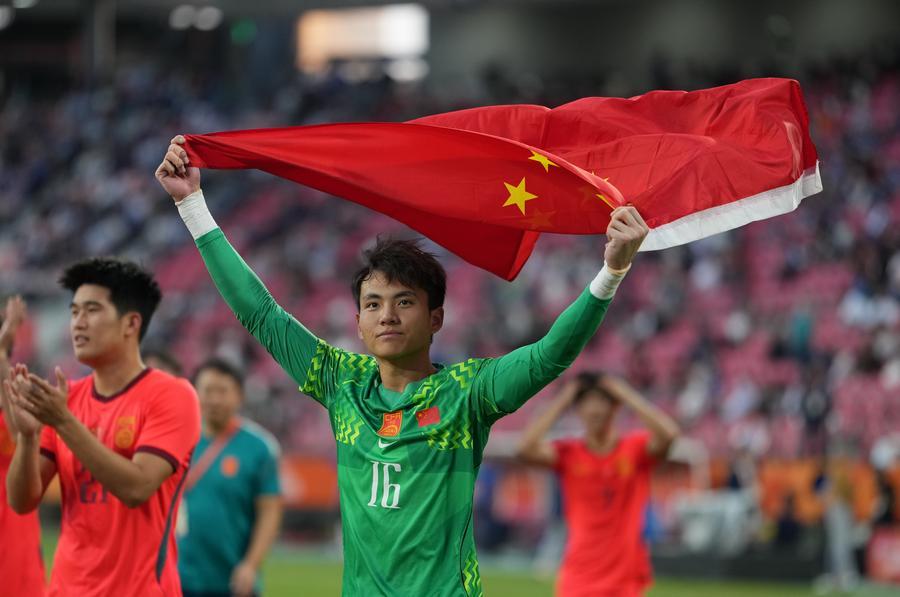
As the celebrations began, Li Hao wrapped himself in the national flag. Then he put on the shirt of Li Zhenquan, the injured teammate who had followed the team through the tournament from the sidelines.
For these players, the question was already shifting from what they had achieved in Nagoya to what would come next. The bronze ended a 28-year wait, but their next challenge will be to build on that success in senior football.
Before the penalty shootout, Li Hao had a simple message for his teammates. "Just take your kick. However you take it, we'll win," he said.
The confidence was not simply born in the moment. Penalty shootouts had been part of the team's preparation throughout the tournament.
"When we draw in practice, we practice the penalty shootout. We practice them on a daily basis," coach Antonio Puche said.
That preparation paid off.
Li Hao saved two Uzbekistan penalties, while China scored four of its five spotkicks. After Liu Haofan missed the opening attempt, Peng made no mistake with the decisive penalty.
"Before the shootout, I felt we would win. I felt my teammates would score and I could make some saves," Li Hao said.
During the celebrations, Puche lifted Li Hao high into the air as the two met and embraced, with their teammates gathering around them.
Asked about his own performance, Li Hao remained pragmatic, even a little self-critical.
"It's not perfect. I still conceded two goals. When I don't concede, that's when it's perfect," he said. "It's not just me. The whole team played well."
That collective mentality carried China through the tournament.
The team topped its group with one win and two draws, beat Thailand 3-0 in the quarterfinals and took the lead against the Republic of Korea in the semifinals before losing 2-1.
Against Uzbekistan, China scored through Hu Hetao and Wang Yudong, twice surrendered its lead, ultimately having to rely on penalties.
"These players have a fantastic future," Puche said. "We need to work, we need to push them, because we have players with big quality and big heart."
One shirt
Li Zhenquan was not on the pitch at Toyota Stadium, but his presence could be felt throughout China's campaign.
The defender suffered a serious left ankle injury during a training camp in September, underwent surgery and was ruled out of the Asian Games.
His teammates continued to carry his shirt through the tournament. After the bronze-medal match, Li Hao wore it for the team picture.
The celebrations continued in the dressing room, where Puche and his players danced together after the match.
For Li Hao, those celebrations reflected what had carried the team through the tournament.
"I think the most important thing was our unity, our collective effort and our execution. Every part of it was crucial, including the coach's tactical arrangements," he said.
Holding the national flag after the match was particularly memorable.
"Wearing the national shirt made me feel very proud. But holding the flag in my hands felt completely different," he said.
Peng Xiao described the medal as the most valuable of his career, but immediately looked ahead.
"For Chinese football, I think this is also a starting point," he said. "I hope future teams can stand on a higher podium step."
For many of these players, Saturday's result was another step in a development path that began when they were teenagers.
Puche has known many of them for years. In 2023, several were part of China's U20 team that reached the quarterfinals of the AFC U20 Asian Cup but fell short of qualifying for the FIFA U20 World Cup.
Their progress continued in 2026. At the AFC U23 Asian Cup in Saudi Arabia, China reached the final and finished runner-up after losing to Japan. Months later, the same generation reached the last four again at the Aichi-Nagoya Asian Games.
The team has also developed a clearer footballing identity.
Under Puche, China has often relied on defensive compactness, disciplined positioning and quick transitions, rather than possession for its own sake. China, however, showed it could adjust, pressing higher in its 3-0 quarterfinal win over Thailand and competing closely with the Republic of Korea before losing to a late goal in the semifinals.
The results do not mean China has closed the gap with Asia's stronger teams, but it has given this generation repeated experience in high-level continental competition and a clearer understanding of how it wants to play.
Maintaining perspective
China's last Asian Games men's football medal before Nagoya came in 1998, when it beat Thailand 3-0 for bronze. The squad included players such as Sun Jihai, Li Weifeng and Zhao Junzhe, several of whom went on to become key members of the national team that qualified for China's first and only World Cup finals appearance in 2002.
It gives this generation a useful historical reference.
For most of the group, which also included three senior players — Wu Xi, Zhang Yuning and Zhu Chenjie — the U23 chapter is now closed.
That makes the comparison with the 1998 generation relevant, but not predictive. The players from that squad used their Asian Games experience as part of a longer path toward the senior national team.
Commentator He Wei cautioned against treating the result as proof that Chinese football had suddenly "stood up". Instead, he pointed to the value of winning meaningful international matches and building confidence through competitive experience.
Peng Xiao said the team wanted to take the experience back to their clubs. "We hope that the effort has made our fans proud," he said. "We just want to keep making Chinese football better and better."
Li Hao offered an even simpler answer when asked what comes next. First enjoy the victory, he said. Then think about the league.
