

Descendants of US veterans, young generations see value in cooperation, need for deeper ties across the Pacific
For those living Flying Tigers — a group of volunteer US pilots who came to China as early as 1941 to help fight against the invading Japanese troops — traveling back to China for this year's events marking the 85th anniversary of their great deeds is demanding due to their advanced age.
Yet some still delivered video messages to remind China and the world how the US service members fought alongside the Chinese people, forging lasting bonds.
"I am Captain Harry Moyer, Air Force Flying Tiger. I was born in Akron, Ohio."
Moyer, who turns 106 in October, made the remarks in a brief video message provided by the Sino-American Aviation Heritage Foundation.
Starting in 1941, the Flying Tigers' mission was undertaken by the First American Volunteer Group, which was disbanded in July 1942. The US 14th Air Force continued the group's mission the following year.
READ MORE: Flying Tigers exhibition in San Francisco honors US-China wartime friendship
Moyer was first dispatched to Italy in 1941 for combat duties, and he arrived in China in January 1944 when he and his group were transferred to the US 14th Air Force in China under the command of General Claire Chennault.
"My main mission in China was to escort (bombers) from India into China as they proceeded on their bombing missions," Moyer said in his message.
In 2023, President Xi Jinping wrote a reply letter to Moyer, fellow Flying Tigers veteran Mel McMullen and Sino-American Aviation Heritage Foundation Chairman Jeffrey Greene, saying that it was his hope that the spirit of the Flying Tigers would be passed down to the next generation of peoples of both countries.
This year, Moyer was unable to attend the 85th anniversary commemorations in China, and his son Peter Gresham Moyer flew to China in his place as part of a US delegation of Flying Tigers family members.
"Before I left, I was visiting with him. He wanted me to make sure that I express my gratitude for what he did, because he was just one person," Peter told Chinese reporters.
"There were many, many people that did what he did, but he just has so much respect for the Chinese people and wanted to do whatever he could to help them," he added.
In Nanjing, Jiangsu province — a city that suffered Japan's brutal massacre that claimed over 300,000 Chinese civilians — the Flying Tigers descendants, including Peter, attended the launch ceremony of the Commemoration of the 85th Anniversary of the Flying Tigers Coming to China on July 16.
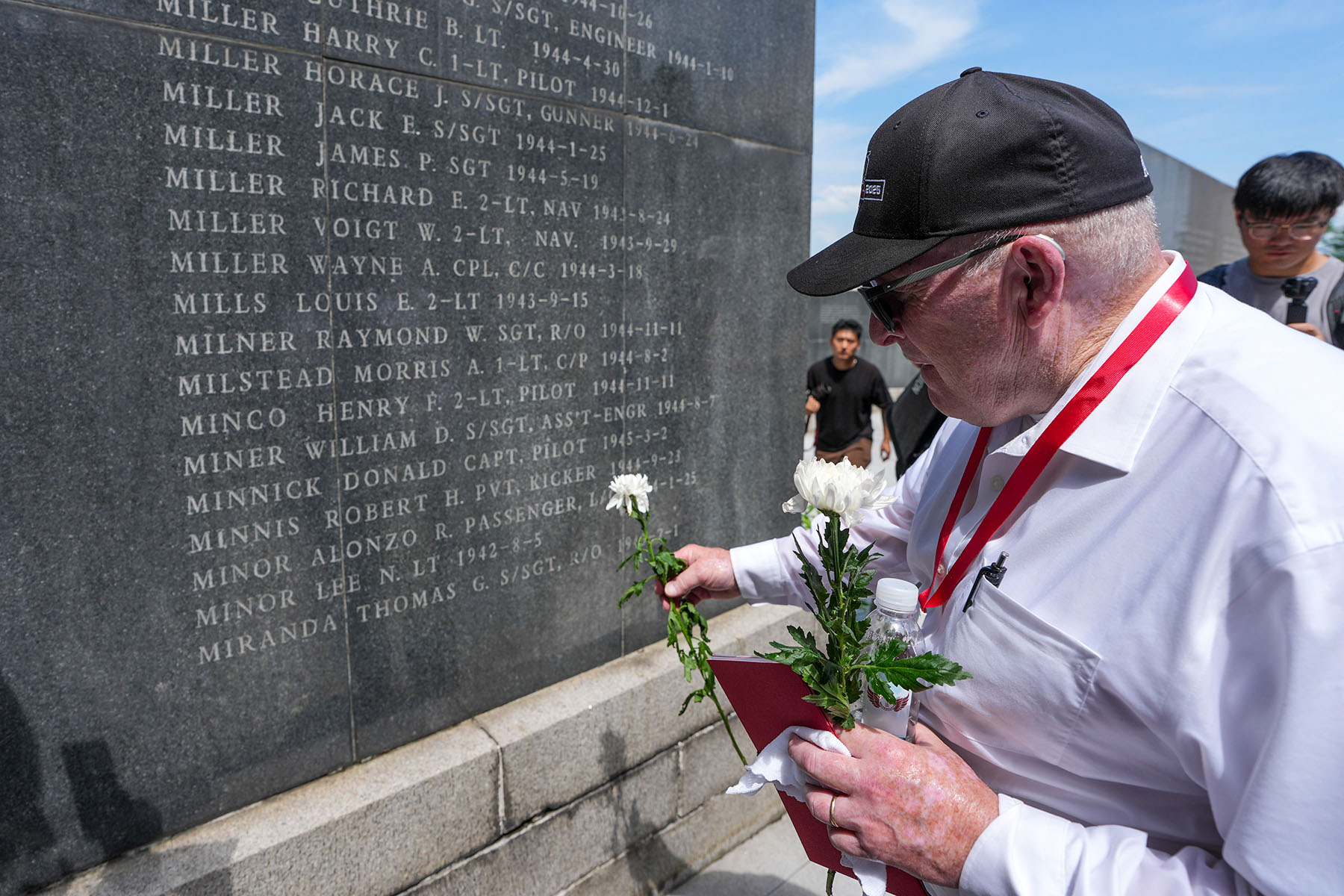
They also visited the Memorial Hall of Nanjing Anti-Japanese Aviation Martyrs, seeing an exhibition presenting relics and photos related to the Flying Tigers.
"I'm very emotional and overwhelmed by the respect and the thankfulness that the people of China have shown me," Peter said about the moment he saw his father's picture there.
"It gives me great pleasure to know that he's one of the people who have been recognized," he added.
Zhu Feng, dean of the School of International Studies at Nanjing University, said the history of the Flying Tigers "should not be forgotten" as it is a testament to the unity and collaboration between the two countries against the Japanese invasion.
"The heroic contributions made by the Flying Tigers are a precious legacy that we will always honor, and they represent a shining chapter in China-US relations," he added.
Unforgettable moments
Greene has dedicated decades to preserving and building on the Flying Tigers legacy, keeping close contacts with the veterans.
In Liuzhou, Guangxi Zhuang autonomous region, Greene was brought to tears when speaking about Flying Tiger Arthur Chin, an American-born Chinese and the first American-born ace of the US Air Force during World War II.
Greene was talking to Flying Tigers family members at the Liuzhou Military Museum, which features a permanent exhibition showcasing more than 1,000 historical relics of the Flying Tigers.
"I'm not sure the date (when the) Japanese bombed Liuzhou. Arthur was too badly burned to move," Greene recalled.
"He was married to a Chinese woman. His wife was on top of him while the house was being bombed. She was killed. She saved his life," Greene said as he wept.
He added, "I don't know whether in history, any nation, any group, any country would risk so much for a group of people who had come from a distance to fight for them."
"It's only between the Chinese people and the American pilots. It means everything to our future. It means that we can cooperate. It means that we don't have to fight," he said.
Chin went to New York for plastic surgery, returning to China in 1945.
During the war, by flying over China's southern and southwestern borders, US pilots explored and developed the highly risky "Hump Route" over the Himalayas to provide critical supplies to the Chinese troops fighting the Japanese invaders.
As for Chin, "he was too hurt to be a fighter pilot, but what he was able to do was flying the 'Hump'. He was put in charge of directing the Hump operations", Greene said.

Josh Vinyard is grandson of another "Hump" pilot, Jay Vinyard, who completed 87 supply missions over the Himalayas.
He said he feels very touched by the exhibition of the Chinese people breaking down rocks on the runways.
"When the Japanese bombed the runways, the Chinese people would work hard, work together. They would have mothers with children on their backs break rocks, and the people were just pulling things.
"They didn't have the equipment, they didn't have vehicles … It's a real testament to how hardworking and industrious the Chinese people are," he said.
When touring the museum in Liuzhou, he wrote in the guest book, "On behalf of my grandfather and the Flying Tigers, this museum is incredible and moving. May our friendship remain together for generations."
"We look back at history, and we remember China and America, our friends. We saved each other," he said.
Donald MacInnis, who was born in 1920 and passed away in 2005, was a Flying Tiger "coast watcher", working with his Chinese comrades to spot approaching Japanese supply ships. They would radio coordinates to the Kunming command in Southwest China, alerting them about the opportunity for bomber strikes.
Elyn MacInnis, Donald's daughter-in-law and a cultural expert who worked and lived in China for over 30 years, said, "This is a bond and a friendship that was forged in blood, and forged at the deepest level."
"What if I asked you: 'Would you die for someone else?' Well, we'd all be afraid. So they were young, and they were idealistic, and actually I believe we need more of that," she said.
"We need to remind ourselves that idealism is what makes our world a shining star, and we need to remember the work, the sacrifices that everybody made," she added.
Power of youth
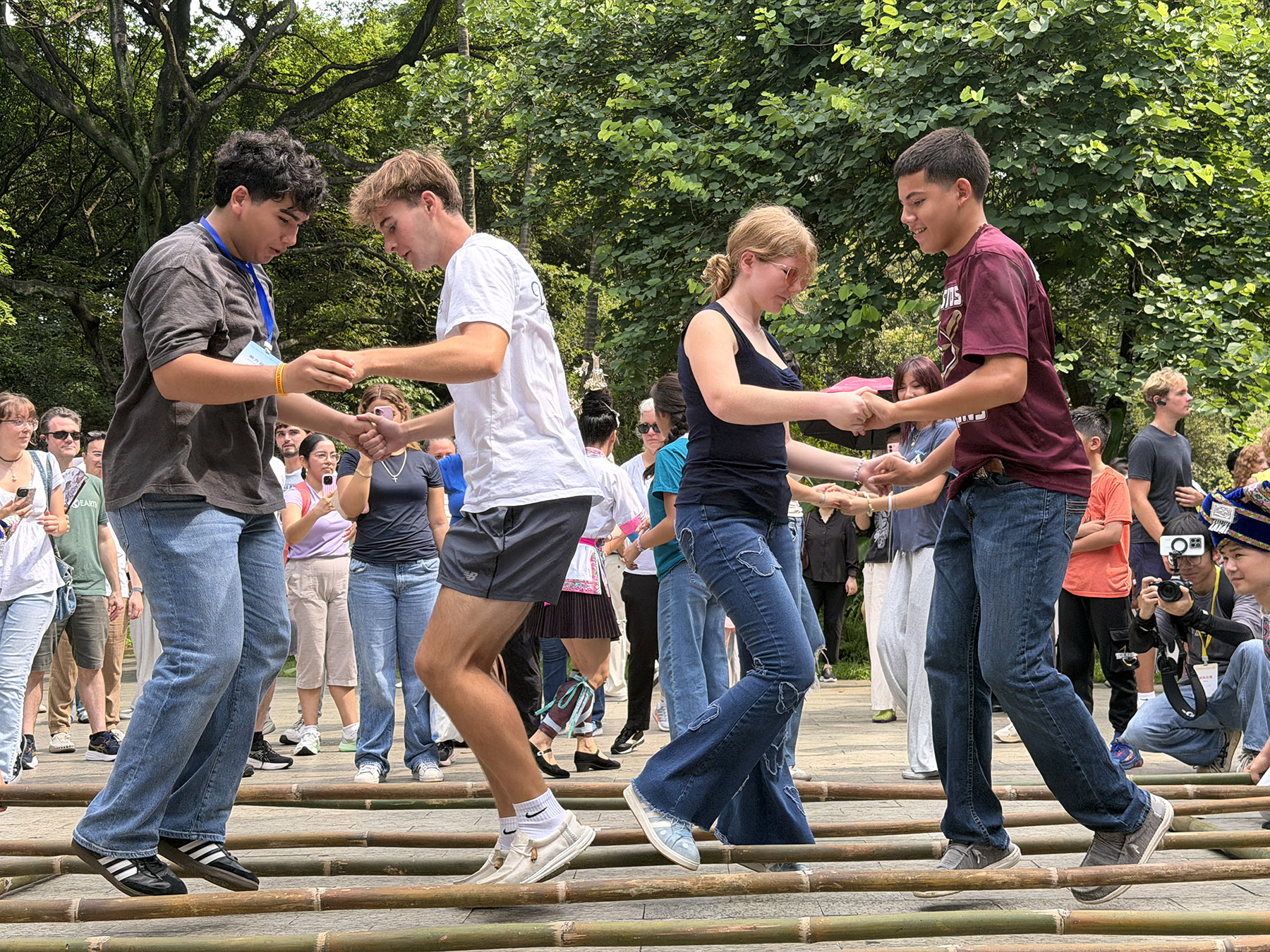
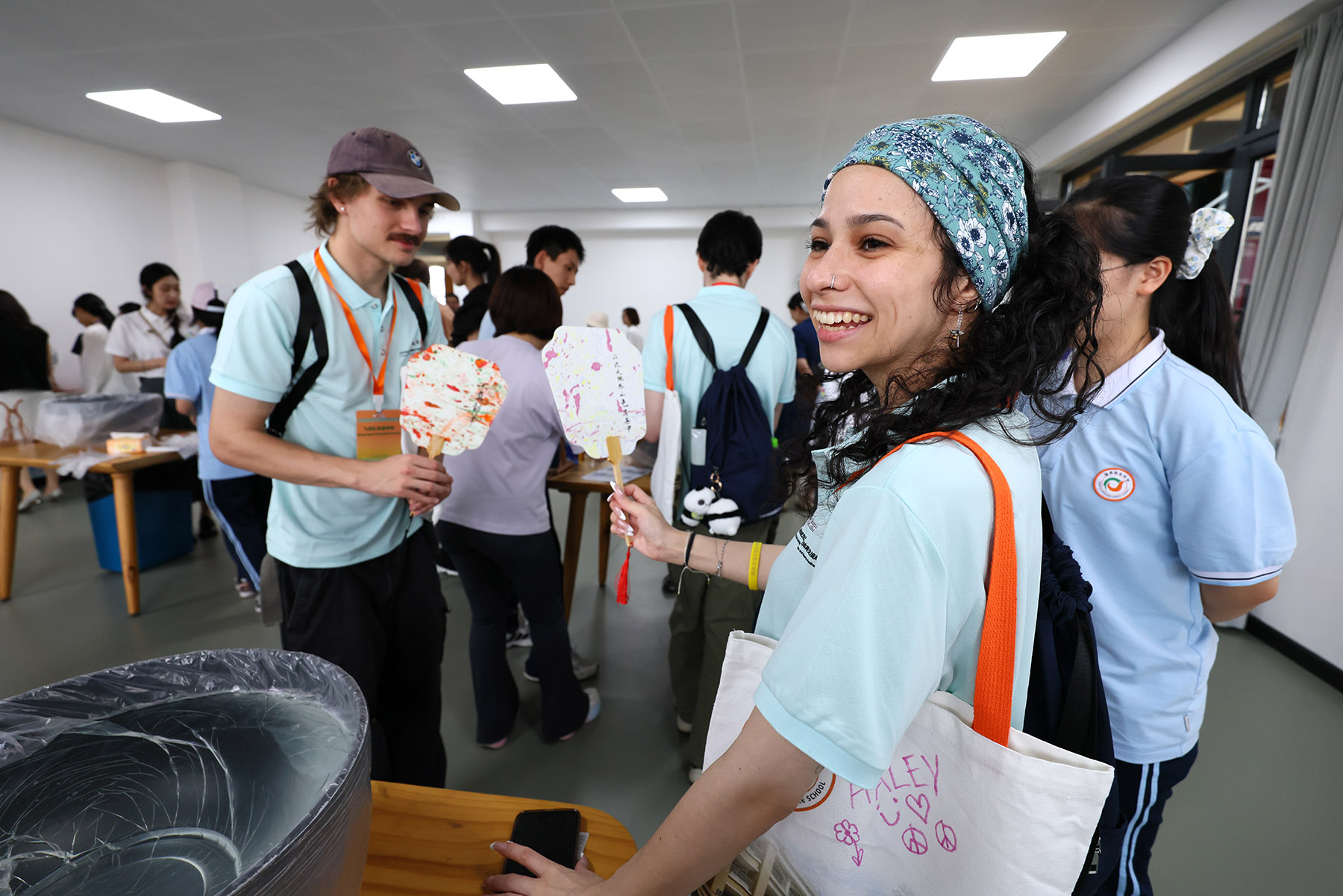
Thanks to the collaborative efforts between the two countries, more young people are traveling to each other's nations. They are playing a key role in building friendships, promoting cooperation and addressing challenges in fields like artificial intelligence.
In 2023, President Xi said in his reply letter that he was glad to see that Greene's foundation and Flying Tigers veterans have been tirelessly promoting the story of the Flying Tigers in both China and the US, and that an increasing number of young Americans have participated in the Flying Tigers Friendship Schools and Youth Leadership Program.
In July, the Wangjiang No 2 High School in Anqing, Anhui province, officially joined the Flying Tigers Friendship Schools Program.
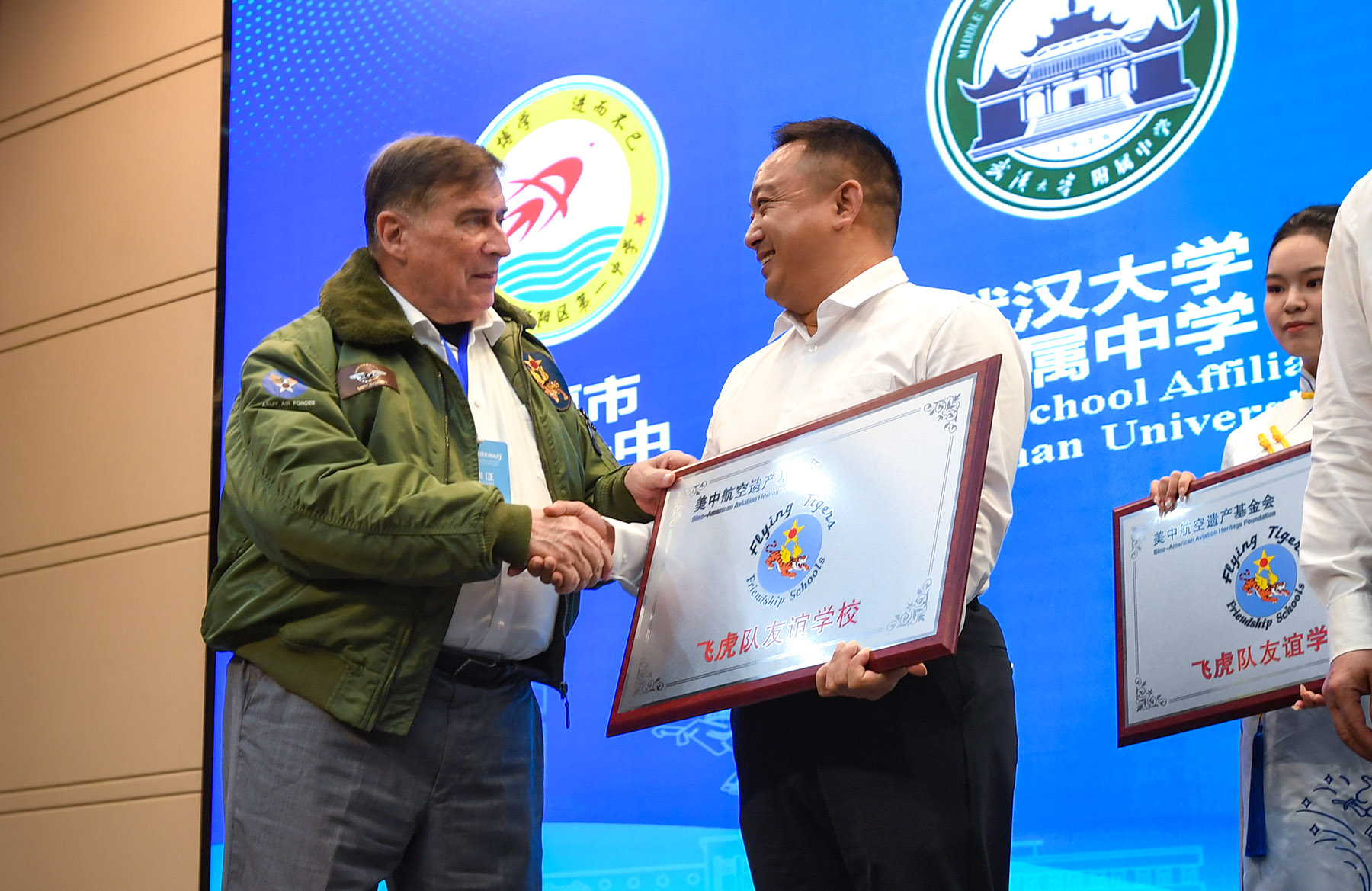
Clifford Long Jr, vice-chairman of the Sino-American Aviation Heritage Foundation, led a Flying Tigers delegation to the school and handed over the metal plate of the Flying Tigers Friendship Schools to one of the school's executives.
He is the son of Flying Tiger Clifford Long Sr, who passed away in 2019 at the age of 94.
"We are so honored that you want to become part of our Flying Tigers association and our student program," he said.
The Anhui section of the Yangtze River was a key supply route during the war, and several Flying Tigers planes crashed in the region due to combat or mechanical failures.
In 2013, local fishermen from Huimin village under Anqing's Wangjiang county retrieved parts of three Flying Tigers planes from the river, including landing gear, engines and fuselage sections. The local government soon built an exhibition hall to house these historical remains, and many local students visited the hall.
"Now the students are connected to the Flying Tigers, and you are the new 'Flying Tigers'," Long told the students.
ALSO READ: Photo exhibition honoring Flying Tigers to commemorate victory in WWII
Zhang Zixuan, a student at Anqing No 2 Middle School, spoke with the US delegation during their trip to Anqing.
"I used to learn about the Flying Tigers only in the classroom, but by talking face-to-face with their descendants, I truly felt the warmth of this cross-border friendship," he said. "I will do my part to preserve this hard-won peace."
At the Wuhan University of Technology in Hubei province, students from both countries took part in the 2026 Flying Tigers Youth Leaders Dialogue in July, a major event boosting the exchange of views on topics of common interest.
David Cornelis Howe, a recent graduate of mechanical engineering from Alfred University, took the stage as a speaker at a special session on cutting-edge technologies.
The session allowed college students from China and the US to discuss tech ethics and collaboration.
"I'm a mechanical engineer … There will be a lot of AI involved in my job," he said. "It's a really interesting topic I get to talk about because in the past the engineers had to do everything on their own by hand, and now we are in this new age where the computers can do everything for us."
"It's really important that China and America work together on large engineering problems, because we are the two most powerful technological countries in the world — we could really do some great things together," he added.
Contact the writers at zhangyunbi@chinadaily.com.cn
