

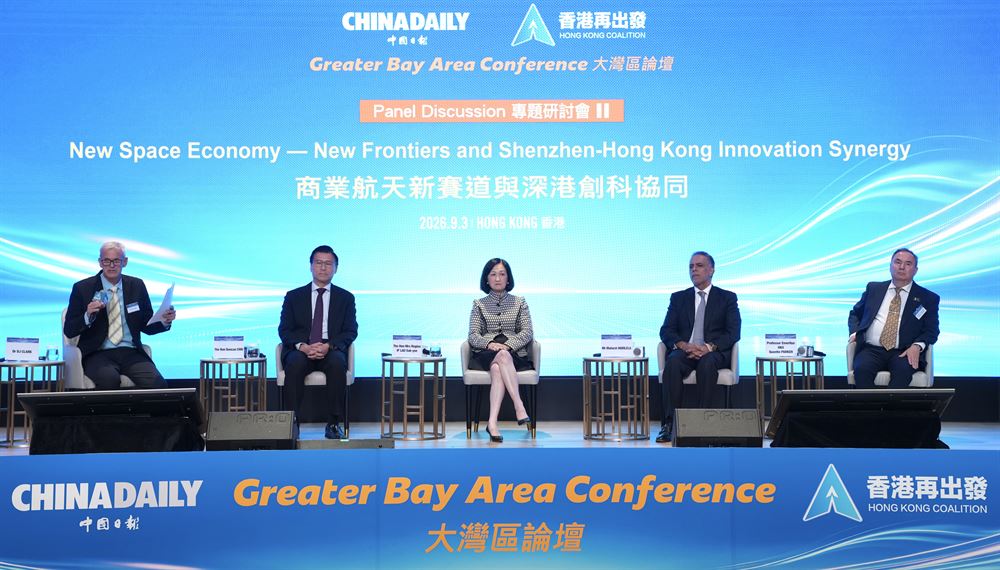
Hong Kong has significant advantages that enable it to seize the emerging opportunities in the commercial space sector and make unique contributions to the widespread adoption of space technology and the sustainable development of the space environment, insiders said in a panel discussion at the Greater Bay Area Conference 2026.
During the session titled “New Space Economy — New Frontiers and Shenzhen-Hong Kong Innovation Synergy”, Regina Ip Lau Suk-yee, convenor of the nonofficial members of the Hong Kong Special Administrative Region’s Executive Council, highlighted Hong Kong’s longstanding participation in the nation’s space ambition.
With the rapid development of China’s commercial space industry, the SAR will see a wealth of valuable opportunities, she added.
Since China opened its aerospace industry to the private sector about 10 years ago, the industry has grown to include as many as 600 aerospace companies, with about 200 based in Beijing.
China has become one of only two countries capable of recovering rocket boosters. It is vigorously exploring rocket reusability, which is expected to significantly reduce launch costs in commercial spaceflight and turbocharge the industry’s development, Ip said.
ALSO READ: HK's superconnector role highlighted at major GBA conference
Against this backdrop, Ip believes Hong Kong is well placed to support these companies through services such as capital raising, financial insurance, and legal arbitration.
The city can also leverage commercial satellite data for shipping, disaster detection, and carbon emissions control.
Duncan Chiu, a Hong Kong legislator representing the technology and innovation sector, said that in addition to rocket manufacturing and launches, there are other commercial sectors, including satellite manufacturing and operations, data businesses, and space tourism.
More new sectors may emerge in the future, and Hong Kong also needs to invest in these areas, he said.
READ MORE: Consolidating Hong Kong’s role in capital market connectivity
Chiu cited a collaboration between a Hong Kong university and a mainland satellite manufacturer, with the university responsible for satellite design and the mainland partner for manufacturing and operations.
In addition to remote sensing, he believes that space computing, an emerging and intensely competitive field, also holds great promise.
These are the areas where Hong Kong can help bridge academia with manufacturing sectors across the region.
Meanwhile, technological breakthroughs in various fields are creating a need for supporting regulatory frameworks; in some cases, legislation is required to clearly define the scope of business operations.
Hong Kong’s established strengths in regulation and legislation are expected to enable it to play a significant role in the new space economy, Chiu said.
Mahesh Harilela, founder of SpaceHK, said that while many places around the world are exploring opportunities in commercial space, Hong Kong has one invaluable resource — money tied in with professional services, regulation, and an understanding of diverse cultures.
READ MORE: GBA conference: HK education sector urged to embrace AI
In particular, family offices like his own, the Harilela Group, often hold “patient capital” that focuses more on long-term returns spanning 10 to 30 years.
Such resources make them well-suited as investors in the aerospace sector. Harilela urged the HKSAR government to establish a space industry office, which could build a collaborative platform, integrate resources, and encourage more family offices to get involved in the sector. Quentin Parker, professor emeritus at the University of Hong Kong and CEO and cofounder of NGO S3+1, said he believes Hong Kong has real potential to be a global leader in the new space economy and related fields, such as space sustainability, space traffic management, space situational awareness, and debris remediation.
He added that while Hong Kong has five universities ranked among the global top 100, the Guangdong-Hong Kong-Macao Greater Bay Area overall is home to nearly 200 universities, gathering talent in emerging fields such as artificial intelligence, biotechnology, and robotics — all closely linked to aerospace.
Parker called on all stakeholders to work together to protect the space environment, ensure its sustainable development, and enable communities worldwide to benefit from these groundbreaking technologies.
Contact the writer at bingcun@chinadailyhk.com
