

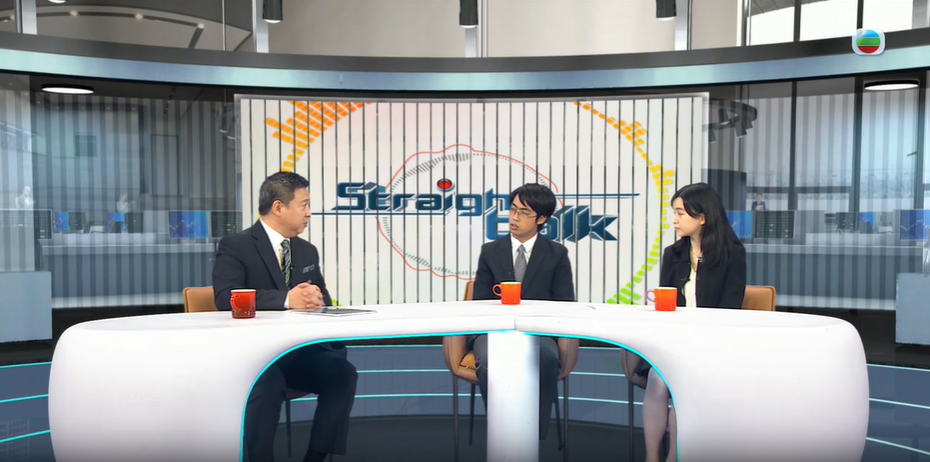
Chan: Good evening. I'm Eugene Chan and welcome to Straight Talk. Just last week, the DSE results were released and this year, 43 percent of the 42,000 candidates, roughly about 18,000 students, met the minimum entrance requirements for Hong Kong's eight public universities.
Among them, a record-breaking 24 students from 15 schools achieved perfect scores – 14 boys and 10 girls. Even more impressive, 11 of these top performers are Super Top Scorers, and joining us today are two of these outstanding Super Top Scorers, Luann Ma Tuen-hang and Vincent Ng Ka-wing.
They will walk us through their examination journeys and explore the question: can the Hong Kong DSE journey nurture Hong Kong's future leaders? Welcome to both of you, Luann and Vincent.
Vincent: Good evening, Dr Chan.
Luann: Thank you.
Chan: I'm very happy to see both of you because some of your past students have been here and now it's your turn today. So, congratulations to the great results you have achieved.
Vincent: Thank you.
Personal background
Chan: When someone says you are the Super Top scorers, that means you score five double-star in six subjects, pass the Citizenship and Social Development core subject and obtained double-star in the Mathematics Extended Part.
Vincent: Yes.
Chan: Luann, you can go first. Just tell the viewers which school you have attended and were the results that you've got is what you expected? Or was it a surprise?
Luann: Thank you, Dr Chan! I'm Luann from St. Paul's Co-Educational College and for my electives, I take Biology, Chemistry, Economics as well as the Extended Math Module 1. My results were definitely a surprise to me and I'm literally over the moon and overjoyed as for a lot of the subjects, I didn't really expect my results to be this good or because I didn't really know what the marking schemes would be like. So, it's definitely a surprise for me.
Chan: Right. And Vincent?
Vincent: Well, I'm Vincent from Queen's College and my electives are Physics, Chemistry, Economics and Mathematics Extended Module 2, and, same as her, I also didn't expect myself to get such a high score because Chinese has always been a weak point for me. And, so, being able to score well on that subject has been a great surprise to me as well.
Chan: Right. But how about all the preparations that you had at your school? I'm sure you had mock exams as well. I mean how well did you do?
Luann: Well, for me, I think I performed rather well in the mock examination. But I was still kind of nervous because my results especially for the languages subjects, they were quite unsteady and it may fluctuate a bit. I was also nervous about the new DSE papers: would they be more difficult than the past year? So, it was really a nerve-wracking process to wait for the results and also for the preparation.
Chan: Vincent, I know that you have core subjects and electives. When you choose an elective, you can share with the viewers, do you base it on for your passion or interest or purely your sort of academic strengths?
Vincent: Well, I think it's a mix of both actually because since like I was a junior form student, science has always been a strong point for me. I did decently well in my science examinations and I also got the opportunity to join the International Junior Science Olympiad in which I learned more advanced concepts taught outside of the DSE syllabus and I passed the Hong Kong screening in that test. So, it kind of it was kind of obvious that science was going to be something that I was going to be good at and it's also very interesting to see how science such as the Physics and Chemistry subjects I chose as they explain the natural phenomena around us.
As for economics, since I never had any experience studying it in my junior forms, it was mostly based off of my personal interests, as I believe economics can be a great way for us to understand human nature and society as a whole as well.
Chan: Right. Thank you for sharing. So, Luann, I will have to come back to you because you are from a very good school. I've got to declare I'm from that school as well. How would you describe the learning environment at the present day? Because a lot of people say that schools like that is very competitive. Did you study in a peer group or how did you actually, or would you say the healthy competition amongst your colleagues actually will make you better prepared for the DSE?
Luann: I would say that the learning environment in my school is definitely better than a lot of people would make it to be. At school, we would study in study groups. We would also share different notes and study materials and we would discuss some alternative methods to the same question. For instance, when I don't know a mathematics question, I would ask my friends and they would all be very happy and very eager to help me. And so, in general, I think we all pushed and motivated each other to become better versions of ourselves.
Chan: And Vincent, your school?
Vincent: Well, I'm from Queen's College and I have to say it's a very competitive environment. Yet, everyone there is very friendly. Everyone is vying for the top spot, yet they're all often like intellectual discussions and students often help each other out when they ever encounter difficulties. We also practice papers together, we do English speaking practices on a regular basis and it's just overall a very friendly environment where everyone is invited and everyone pushes each other to be the best version of themselves as well.
Chan: Right, so that means under such stresses people can still work together and do well together.
Vincent/Luann:Yes.
HKDSE prep for leadership
Chan: Right. And also another thing, I've done some background on both of you. You're both students of the Hong Kong Academy for Gifted Education. I must declare again, I'm the chairman of the Advisory Committee. I don't deal with you guys, but I'm kind of looking at the overall direction. The Hong Kong government is very good to our students because we fund the projects, we work with the schools and universities of Hong Kong to provide this off-school gifted educated program so that all of you can be better educated. So, do you think such government initiatives will help you to prepare better for this exam, Luann?
Luann: I would say looking back, I think joining the HKAGE has not only helped me develop academically but also more holistically as a person and it helped me explore more different aspects actually outside of the DSE curriculum. For instance, I joined courses ranging from forensic science to journalism or even workshops on how to manage my own stress. So, those definitely helped me during my study leave especially because I learned different methods like the Zen method to actually relieve my own stress and at the same time I could also explore my passions and interests outside of the DSE curriculum.
Chan: Vincent?
Vincent: I've also joined quite a few workshops HKAGE has offered and I think it's kind of more than academic on the academic level because I've joined talks that tell me about like the correct mindset when someone is trying to strive for success, and that has definitely helped me remain calm and let me cope with stress during my journey leading up to the DSE. Additionally, it has also allowed me to explore different career options because I remember joining a talk about the career prospects in the aviation industry and the work of like people from different industries has definitely opened my eyes up to different options and it encourages me to explore different career paths as well.
Chan: Right. I’m going to ask you, as both of you are top scorers, how would you view Hong Kong’s current education and examination system, in brief?
Luann: I would say it's definitely very exam-oriented right now and it's based on a very standardized marking scheme. At the same time, I can see that in recent years especially there has been more focus put on students’ independent critical thinking skills. For instance in this year's Mathematics paper I could see that there were some twists added to the classic past paper questions, so that the students who only rely on drilling past papers or only rely on memorizing question types, they would suffer if they don't practice their critical thinking skills on the spot. So, I think in terms of the problem-solving skills and critical thinking skills, the DSE is kind of evolving towards a new model and I believe that it will continue in the future.
Chan: Right Vincent, I'm going to ask you another area. With what you've been through, not only the sort of the core subject electives and with the HKAGE support, does it equip you with the resilience, discipline and mindset needed to be a good leader in the future?
Vincent: Definitely. When I'm taking the DSE there are like seven subjects mainly to take care of and so, time management becomes a really important thing for me to figure out because I have to allocate time for each and every subject. I have to do so many past papers in order to prepare sufficiently for the different exams and so it definitely requires a lot of time management and scheduling skills in order to deal with all of the different tasks at hand.
Additionally during the study leave period, I have to get myself to wake up and go to the library and study for hours on end and that requires a lot of discipline and also self-control. And I believe this process definitely allows me to develop like a strong mindset and a strong sense of discipline and I think that's really important for my future development as well.
Chan: Right. Luann, I mean we have no doubt about your academic abilities. What specific abilities or knowledge that you hope to use now or in the future to make an impact to our society?
Luann: Well, since I'd like to study medicine, maybe I'll talk more about the healthcare knowledge. In the past, I've joined a lot of health exhibitions or presentations. For instance, I will promote the importance of vaccination against influenza to the general public or to promote the importance of stroke prevention to a lot of domestic helpers.
And I think it's really meaningful and fulfilling to me how I can share my knowledge about medicine or knowledge about public health to groups that may be marginalized or they may be underprivileged. So, in the future, I would also love to work towards this direction to contribute to the public health sector of Hong Kong.
Chan: Vincent, yourself?
Vincent: Well, currently I'm trying to use my academic experience to help my junior form students through private tutoring as I believe helping younger students and students in general to get the grades that they want and ultimately get into the universities they want is a really purposeful cause.
Even in my secondary school years, I always tried to help other students. Whenever there's a classmate who is stuck on a certain concept or question, I always try to help them out. And I also volunteered to be one of the tutors for my school's Physics Olympia Team and I find that to be a very purposeful because I can help my junior form students prepare for their academic pursuits. So, that's something I'm working on right now and in the future I plan to use my medical expertise to meet the current medical demands that Hong Kong is facing right now.
Chan: I'm very happy to hear and hope both of you will continue to work hard not only for yourself but for the fellow students and the community. Let's take a short break now. We'll be right back with more Straight Talk.
Chan: Thank you for staying with us. We have been exploring the question of whether Hong Kong's education system can deliver our future leaders. We have Luann Ma Tuen-hang and Vincent Ng Ka-wing, two DSE Super Top Scorers with us this evening. So great to come back and talk to you both again. And in the first half we have listened to both your views on the education system and one very impressive statement I heard is both of you work closely with your classmates and you help one another and that's a very good thing to hear and good sign to see for Hong Kong.
Personal career planning & AI challenge
Chan: Let's look at your personal development. I think the viewers would have picked up that both of you will be doing medicine. So, Vincent, maybe you can start telling us what motivates you to do medicine because nowadays there has been a lot of comments in the community saying that all our top scores in Hong Kong are gravitated towards doing such prestigious professions like medicine and law. What makes you become a doctor in the future?
Vincent: Well, obviously the prestige is a big factor a lot of people consider. But for me personally, while I was growing up, I always had a relative who is a very professional doctor. And growing up, I always looked up to her because her compassion and professionalism of being a doctor really influenced me. And so I want to follow her path in helping other people. And also I think just being able to help society as a whole and meet the current demands is a very purposeful cause. And I believe it's one of the professions that I can feel that I'm truly contributing meaningfully to society. And I think that's a big thing.
Chan: Right. And you're going to which university?
Vincent: Hong Kong University.
Chan: Right, okay. And Luann?
Luann: Yep, same as Vincent. I'm also going to the University of Hong Kong to study medicine. Well, personally, I was admitted to the intensive care unit of Queen Elizabeth Hospital just one day after I was born because of a pneumothorax. So, it's basically a disease which has quite a high mortality rate for infants. I remember … well, my mom told me about the experience afterwards. So, I know how powerful doctors are in the sense that not only can they save one person's lives, but they can also restore hope and strength to a whole patient's family. So, I would also love to pass on and share this kind of love to those who need me in the Hong Kong community in the future.
And another reason is: I think that medicine is a very balanced career path forward for me. So, I am a student who loves both sciences and languages. So, while medicine obviously requires very professional medical knowledge, the sciences, there would also be the languages needed, like communication skills, how to emotionally connect with a patient. So, I think that this very balanced career path would be very ideal forward for me. And I also think that it's no surprise that many top scorers who are balanced in both the languages and sciences would love this subject as well.
Chan: Luann, I'm going to ask you a very personal question. Knowing that both your parents are in the medical profession, the same as your brother, as you told me, would you be worried that during your family conversation would be nothing but medicine? Would it be a bit boring for your family?
Luann: I would not have this concern. While, of course, I would be very happy to engage in such intellectual discussions. I think we also have a quite relaxing atmosphere within the family. Like we would talk about our worries or what happened every day, and we would also share some great chats regardless.
Chan: All right, okay, good to know. So, Vincent, I think you mentioned about some robotic courses that you did with the Hong Kong AGE earlier. And given the rapid development of AI in recent years, are you worried that AI might one day replace humans, especially what you're working on is going to work with humans a lot?
Vincent: Well, I like to think of it that way: AI is only a tool and it's just a matter of how we use it. AI is here to stay and nothing can really change that. So, the question is, are we going to approach the AI age with a prepared mind or an unprepared mind? In my view, I think AI is a great tool to augment our abilities, not to replace them. And so it's just down to how we treat it, how we use it, how we learn to adapt to the times. And so I think if we can truly learn how to best utilize AI and pair it with our own strengths, I think it can definitely be a great tool to help us develop further.
And especially for professions such as social workers, teachers, and doctors, the human connection between the professional and the patient is very important and it's something that machines and AI cannot replace. And ethical concerns are also a factor to consider and there always has to be a person there to supervise the use of AI because if it's just AI doing its own thing and it makes an error then the responsibility is kind of unclear, right? So, I think there's always going to be someone who is there to supervise AI. So, I'm not really that concerned.
Chan: Right. And Luann, how do you see with AI, especially with future medical professionals? I mean, you have a family of medical professionals. How welcoming or how engaging do you think the medical profession is towards AI?
Luann: I would say there are definitely many types of new medical technology that require AI, from drafting or submitting some reports to actually being the third hand in the operating room. And I would say that overall the healthcare industry is quite welcoming because it can increase the efficiency, the accuracy, as well as the precision of a lot of different procedures. But I also share his opinion that AI may not really replace the human touch of doctors right now. From practical concerns about the legal accountability to some more emotional connection concerns, because patients would definitely love more human connection between them and actual doctor.
Chan: Right. You know, as prospective medical students, how will you sort of expect the skills or knowledge that you would think young doctors will need to develop in order to work effectively along with all these AI technologies, Vincent?
Vincent: Well, I'm enrolling in the new HKU DMS program and it's a compulsory course for us to take and it’s like a short AI course. So, we need to get accustomed to the general uses of AI and I think a very important skill that doctors can learn is how AI works, how to properly use it and what are the strengths and limitations of AI and there's lots we can work on that, and theory is one thing and practice is another and, so, I think doctors should look into how AI can help them in the line of work and I think if they can figure that out they will ... their career prospects will still be promising.
Luann: Yeah, apart from staying really open-minded and trying different types of AI technology I think it's also utmost like really important for doctors to make sure that they use AI ethically because there are definitely a lot of privacy concerns or different controversies regarding the use of AI these days. So, it's very important that doctors can stay humble and also remember to use AI normally and ethically.
Chan: Right. Do you have any expectation that all your future lecturers and professors to sort of effectively blend technology with the traditional teaching method? Do you have any thoughts on that?
Luann: Oh, I would love that the education or my education journey ahead could be incorporated with a lot of different kinds of technology. In the past, I've visited the different medical schools of Hong Kong and I'm really happy to see that there have been some AI experiences for us as well as us wearing VR headsets to actually look at the human body from a different perspective. And I think that all of these are really great learning experiences for me because I can actually see the human body up close and it's a first-hand experience which would make the knowledge stay more impressionable.
Chan: Yes. Vincent, yourself?
Vincent: Well, similar to her, I also attended a medical training workshop where I got the experience of actually visiting medical educational institutions and I also got the experience to use VR headsets to experience how it would be for me to have visual impairments and defects. And I think it's just using technology and potentially even AI to make learning a more interactive and engaging experience that brings a lot of potential to education and it's a great way for ideas and concepts to stick.
Hong Kong’s future development
Chan: Right. Let's move on to another area I'm sure the viewers will be even more interested to know. Both of you have done well, chosen to stay in Hong Kong. I hope you haven't changed your mind yet. What are the factors that influence you to make the decision to stay in Hong Kong to study, Luann?
Luann: Well first of all I have grown up in Hong Kong for the past 17 years. So, I would say I have developed a sense of belonging to this very unique city. And apart from that, I can also see that there are a lot of unique problems that Hong Kong faces especially in the healthcare industry such as the shortage of manpower or the imbalance between the private and public sectors. So, having seen or maybe experienced these problems firsthand, I'm also really eager to make my own contributions to solve these problems.
Chan: Right, Vincent?
Vincent: Well, I have actually considered studying economics overseas in the UK especially and I've actually gotten conditional offers from colleges such as LSE and Imperial College. However, I find that staying in Hong Kong allows me to spend more time with family and staying overseas for my entire duration of my tertiary education would sacrifice that, and I don't really want that.
And I think that staying in Hong Kong actually has its own benefits aside from being able to stay with my family, it’s to contribute to Hong Kong as a whole. And actually choosing Hong Kong medicine is also something that goes a long way towards that because it also has an enrichment year where I can go to overseas exchanges. So, I can have a balance of both. I can go overseas to broaden my horizons and get to experience what it would be like to study in foreign countries while also being able to stay grounded and spend more time with family.
Chan: Luann, do you see Hong Kong, I mean Hong Kong now we're in, traditionally, we are international financial center. From your perspective, do you see us Hong Kong can diversify our identity through this global innovation and technology aspect?
Luann: I'm definitely quite optimistic about Hong Kong's future in terms of innovation and technology. First of all, we have lots of great infrastructure and new policies. Like I know the government is developing the Northern Metropolis or there's the Hong Kong Shenzhen I&T Park in Lok Ma Chau. And all of these new policies are really favorable to developing Hong Kong into such a center.
Apart from that, there is also a lot of new budding talents in Hong Kong, like youngsters who want to be entrepreneurs, who want to make their own startups regarding technology. So, I think overall I am quite optimistic about that.
Chan: Vincent, in short.
Vincent: Well, I take a slightly different view in that Hong Kong still has its limitations. Its cost of operation is quite high and so I would like to see Hong Kong collaborating with the Chinese mainland where cost is an actual advantage. And so leveraging that and fostering a greater bond and connection and collaboration would go a long way towards helping Hong Kong develop into an IT hub.
Chan: Right. I'm afraid that's all the time we have. And thank you Luann and Vincent for sharing your experiences with us. Both our students have demonstrated how their DSE journey can cultivate resilience, time management and the ability to perform under pressure, all essential traits for Hong Kong's future leaders.
Thank you for joining us on Straight Talk. I'm Eugene Chan and good night.
