

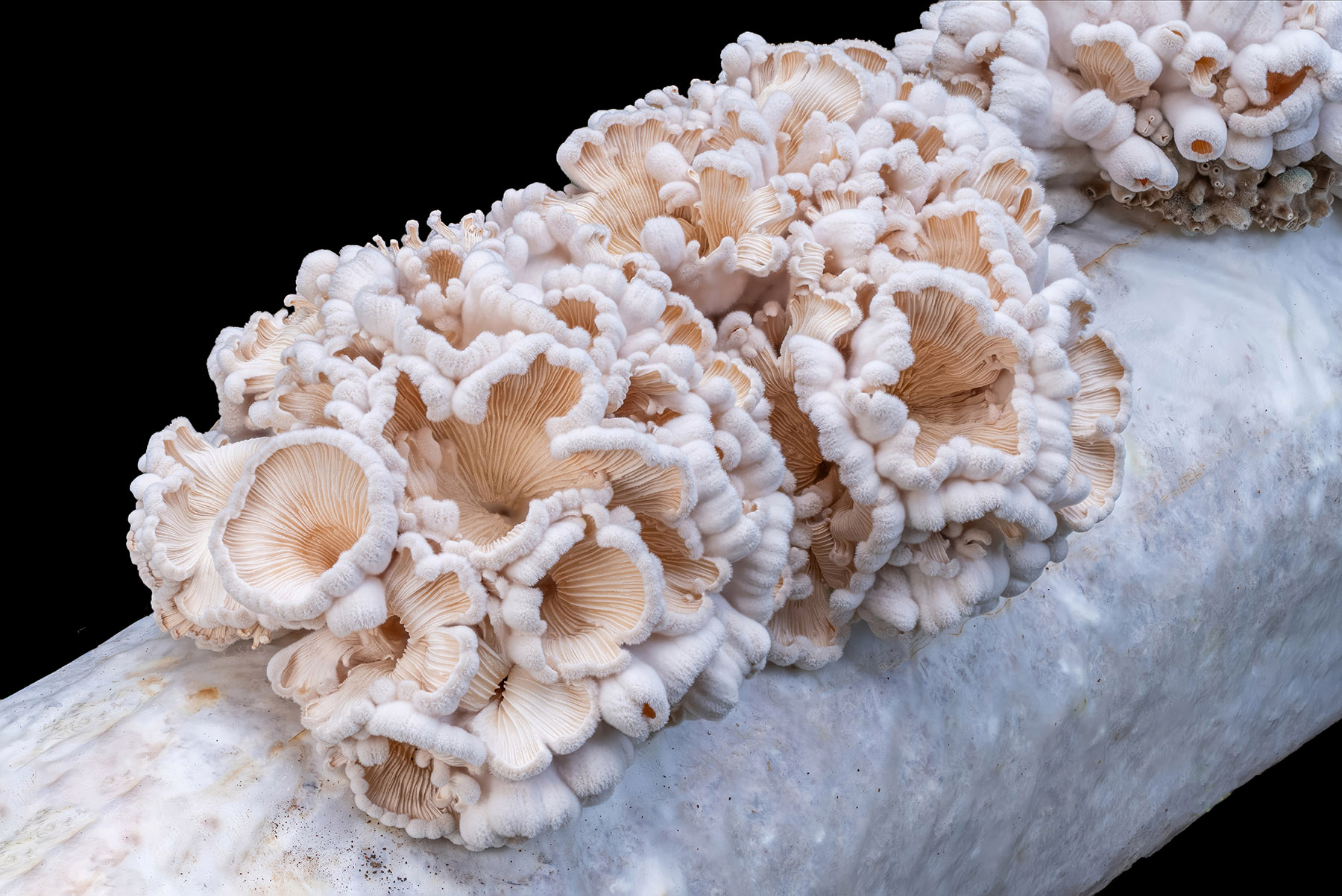
An unusual mushroom first found growing on an apple is moving closer to mass production, as Chinese researchers seek to turn the chance discovery into a new food product for supermarket shelves.
"We are still at the laboratory stage, producing only about 50 to 100 kilograms a day," said Zhao Qi, a researcher at the Kunming Institute of Botany under the Chinese Academy of Sciences who leads the team behind the project. Small-scale online sales have already seen repurchase rates of 50 to 60 percent, he added.
The story began two years ago, when a resident surnamed Deng in Zhejiang province found a white mushroom growing from an apple at her home. The unusual find caught the attention of Xu Rongju, a doctoral student at the Kunming institute, who asked her to send the apple to Kunming for further study. As the story spread online, the mushroom became an internet sensation, with netizens nicknaming it "Guojunwang" or "King of Fruit Fungi".
Xu identified it as Schizophyllum commune, an edible fungus known in China as baishen. Zhao said a spore carried through the air had likely landed near the apple's stem, where moisture and nutrients facilitated its growth.
Turning the chance discovery into something people would want to eat proved harder. Zhao's team isolated the strain and cultivated a first generation, only to find its texture tougher than baishen already on the market.
The researchers then turned to strains of the same fungus that had traveled much farther — aboard China's Shenzhou XII spacecraft. They crossbred the space-flown strains with the apple-derived fungus, seeking offspring that tasted better, grew faster and released fewer spores.
By the fourth generation, the mushroom had become crisp, but still produced too many spores for large-scale cultivation. Further breeding largely solved that problem, in the eighth generation, 97 to 98 percent were spore-free, Zhao said, although some crispness was lost.
While the team continues to refine the strain, small-scale commercialization has begun, with the mushrooms selling online for about 199 yuan ($29.5) per kg. Scaling up while lowering costs is the next challenge. Cultivation remains largely manual, but Zhao said the team plans to move toward factory-based production, automating the process from inoculation to harvesting. A full growing cycle is expected to take about 13 to 15 days.
Among those who have tasted the new strains is Deng, whose apple started it all. On July 23, she received the fourth — and eighth-generation mushrooms from Kunming — descendants of the fungus she had sent there two years earlier.
"The eighth generation tastes much better than the first. It's not nearly as tough, and it leaves a fresh, savory taste in your mouth," Deng said. She found it drier than mushrooms commonly consumed in Zhejiang and said she would recommend it to friends.
She has already shared much of what the researchers sent her with people around her.
The team is also looking beyond online sales. Zhao said arrangements are largely in place with Hema supermarkets to sell the fourth — and eighth-generation varieties.
But the apple has done more than produce a promising new food. It has changed the way Zhao's team looks for fungi.
As the story spread online, people began sending the researchers unusual fungi found around their homes, including mushrooms growing on coconuts and garlic. Varying specimens have now arrived from 18 provincial-level regions, and about 95 percent are usable for research, Zhao said.
The growing public network has expanded the reach of fieldwork. Researchers can visit only limited places for limited periods and may miss fungi that emerge at other times, while local residents can observe what grows around them through different stages.
Zhao likened the change to expanding a map: researchers once sampled at scattered points or along limited routes, while contributors across the country are turning those "points and lines" into a much broader surface.
The network is already producing scientific leads. Huang Haiyan, a mushroom enthusiast in Hainan province, sent more than 800 specimens over about 18 months. Zhao estimates that at least 30 could represent previously undescribed species.
"What the Zhejiang netizen sent us was more than a 'rotten apple'," Zhao said. "It was a key that opened the door to scientific questions."
Contact the writers at yanyj@chinadaily.com.cn
