

The Hong Kong Special Administrative Region’s first five-year plan is a major event and deserves attention and support from all residents. However, like the national 15th Five-Year Plan (2026-30), it is not just about economics. It is also very much about promoting the well-being and nurturing the growth of the younger generation so they become responsible and upright citizens, which should be among the priorities of the blueprint.
 One recent front-page feature story in China Daily was headlined Children’s Growth a Priority for Xi. In his letter to the Young Pioneers who had volunteered as guides at the Memorial Hall of the First National Congress of the Communist Party of China in Shanghai, and the Nanhu Revolutionary Memorial Museum in Jiaxing, Zhejiang province, President Xi Jinping encouraged the students “to follow the Party’s lead, carry forward the revolutionary legacy, enhance their knowledge and skills, and build their will and character”. There is a whole section on “Ensuring and Improving Public Wellbeing and Promoting Common Prosperity for All” in the Recommendations of the Central Committee of the Communist Party of China for Formulating the 15th Five-Year Plan for National Economic and Social Development, released late October 2025.
As an economist by training, I am quite sanguine about both Hong Kong’s and the Chinese mainland’s economy. In particular, the latter is much better prepared to face challenges than most economies. China is probably the most resilient and best-managed economy in the world. It is extremely competitive, not because it has a lot of excess capacity, but because it is very efficient. Because it is forward-looking, it is willing to invest in infrastructure that other countries often hesitate to fund. Because it sees the big picture, it has brought water from the water-abundant south to the arid north. Because electricity generation and usage fluctuate, China has doubled down on improving electricity storage and the efficiency of power transmission.
China’s planners break up regional barriers and forge collaboration among regions and cities. As a result, China is now not only the world’s top manufacturer but also the world’s top agricultural producer. Indeed, with only about two-thirds the amount of arable land of the United States, China’s agricultural output is now more than three times that of the US by value.
So, there is little to worry about regarding China’s economic future. By extension, there is little to worry about regarding the SAR’s economy. The city’s unique position as part of the vibrant Guangdong-Hong Kong-Macao Greater Bay Area and its strengths in terms of human capital, infrastructure, common law traditions, global connections, and the benefits of the “one country, two systems” principle leave little doubt that Hong Kong will do well economically.
However, I am worried about the mental health of our young. Statistics show that while Hong Kong’s overall suicide rate has come down to the lowest level in five years, the city’s suicide rate for those below 19 has jumped from 1.96 per 100,000 in 2015 to 4.72 in 2025.
Young people will be “the masters” of Hong Kong in the future. While the suicide rate among the young in Hong Kong is not particularly high by international standards, the trend is concerning. Sadly, oftentimes home and school, instead of serving as a sanctuary against troubles, have become the source of the problem. Pressures from study, expectations of parents and teachers, bullying by peers, all add up; physical and verbal abuse could come from parents, teachers and other supposedly influential people; well-meaning parents could hurt their children, and they could keep repeating the same mistakes day in, day out, without knowing it. Moreover, much anxiety could also stem from strangers far away through the internet, especially via social media.
One will always discover life’s treasures down the road if one persists with grace and reflections. This is character. Personal growth is true success in life. Medals and trophies are all very well, but personal growth is the greatest award of all
It is natural for parents and teachers to hope that their children and students will excel in their studies. But emphasizing performance in terms of marks and grades is often counterproductive. Parents and teachers must, in the first instance, show their love and support for their children and students no matter what their grades. Motivation, curiosity, reflection, and character are far more important than grades. The idea is to motivate children to make an effort to do better each day. Praise them for their efforts, for their reflections, for asking questions, and for venturing with answers, even though the answers may not be correct. Praise them for their trust and willingness to talk and share emotions and experiences. Praise them for being respectful, responsible, and resilient. Even the slightest improvement deserves affirmation. Every small improvement is a success. Treat them like peers and friends.
If parents and teachers guide their children and students to overcome difficulties, they will sense their love. Encourage them to express their emotions freely and openly, as long as these expressions do not hurt other people. It is fine to shed tears. Being truthful to oneself is important. Teachers and parents should teach their students and children that we may miss some instrumental goals in life, and that is fine. Sometimes one has to change course. That is just fine. The I Ching (The Book of Changes) advises: If a road comes to a dead end, change course and move on. One will always discover life’s treasures down the road if one persists with grace and reflections. This is character. Personal growth is true success in life. Medals and trophies are all very well, but personal growth is the greatest award of all.
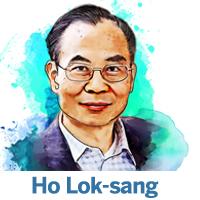
The author is an honorary research fellow at the Pan Sutong Shanghai-Hong Kong Economic Policy Research Institute, Lingnan University, and an adjunct professor at the Academy for Applied Policy Studies and Education Futures, the Education University of Hong Kong.
The views do not necessarily reflect those of China Daily.
