

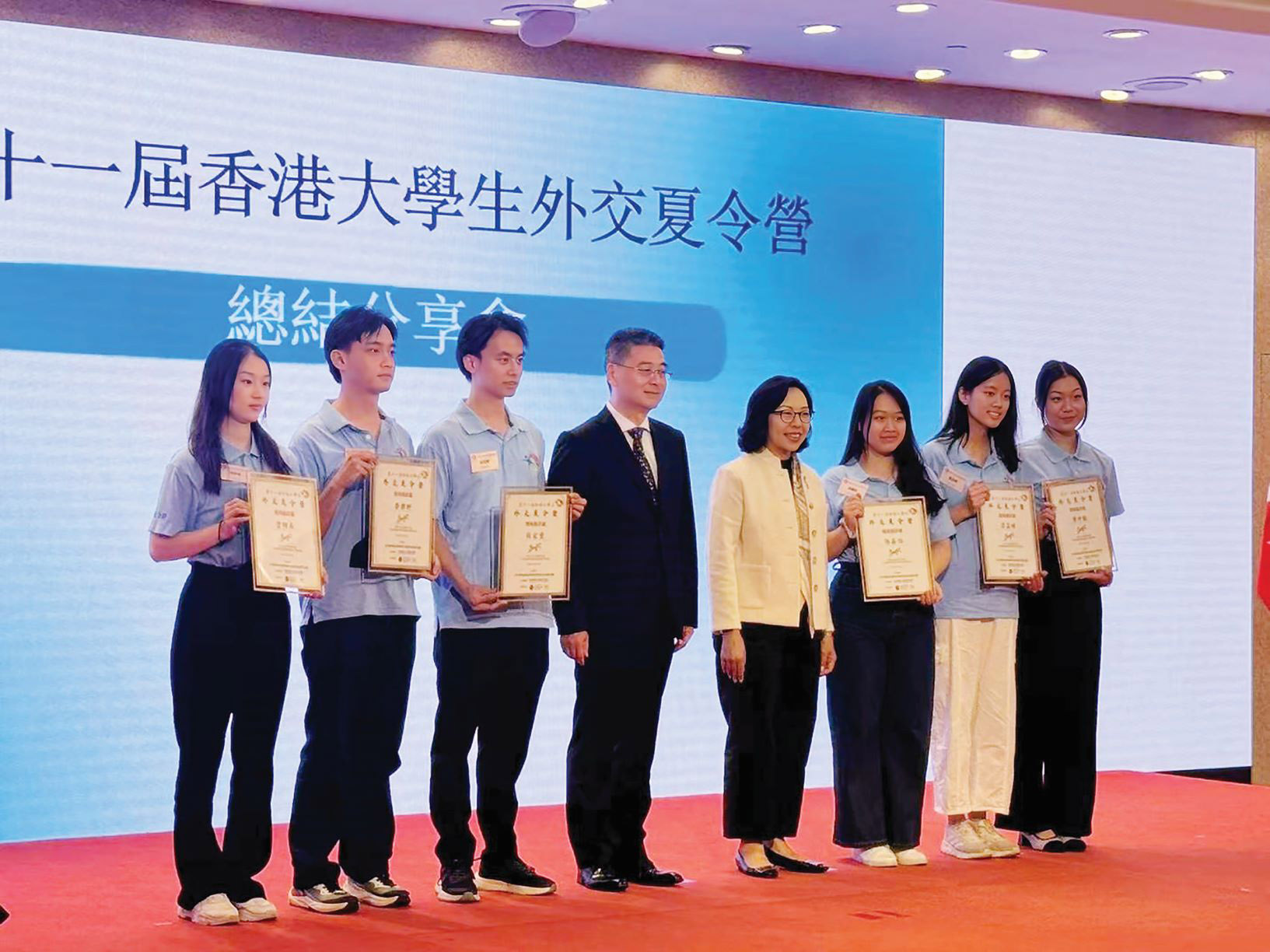
Dozens of Hong Kong students returning from a diplomacy-themed summer camp on the Chinese mainland said they gained valuable insights into national diplomacy and social dynamics.
During a sharing session on Wednesday, diplomats and officials encouraged the young participants to foster a sense of civic responsibility and national pride, and to pursue personal growth while contributing to the development of the Hong Kong Special Administrative Region and the country as a whole.
The “Friendship Diplomacy” Summer Camp was organized by the Commissioner’s Office of China’s Foreign Ministry in the Hong Kong SAR. Now in its 11th edition since 2011, and serving as the city’s only diplomacy-themed camp, the program aims at deepening Hong Kong university students’ understanding of national diplomacy and social progress.
READ MORE: Camp helps HK students gain insights on country’s wide-ranging diplomacy
This year, 37 outstanding students from 10 Hong Kong universities joined the nine-day trip, from Aug 2 until Monday, which included visits to Beijing and the cities of Kunming and Dali, and Jinping county, in Southwest China’s Yunnan province.
Jinping, renowned for the Honghe Butterfly Valley, receives targeted pairing assistance from the Ministry of Foreign Affairs under a national program. Students visited local patriotic education bases and Foreign Ministry assistance projects, gaining a deeper appreciation for the long-standing harmony and unity among various ethnic groups.
Students toured key institutions such as the China Foreign Affairs University and the Ministry of Foreign Affairs, as well as arts and cultural sites, enterprises and community service facilities. They also held talks with diplomats and local students and teachers.
Addressing Wednesday’s event, Hua You, deputy commissioner of China’s Foreign Ministry in the Hong Kong SAR, encouraged the students to foster a sense of patriotism and ownership, and to take pride in contributing to the nation’s development.
He said that students from Hong Kong — a bridge between the mainland and the rest of the world — can benefit from understanding global and national trends. He also urged them to become young envoys for people-to-people exchanges between China and the rest of the world.
Hua also said that as the nation’s 15th Five-Year Plan (2026-30) has laid out a new blueprint for Hong Kong’s development, the city’s younger generation will have great opportunities. He encouraged them to stay ambitious and pursue greater personal growth while serving the development of both the SAR and the country.
Hong Kong SAR Secretary for Home and Youth Affairs Alice Mak Mei-kuen said the camp has helped students better understand national progress and broaden their global outlook. She said she believes that through such activities, students have come to realize that diplomacy is not just a strategic matter but also touches daily life.
She said the nation’s diplomatic approach reflects the Chinese value of harmony in diversity, and she hopes students will also adopt this value as a life principle.
Mak further urged students to share their experiences with peers and communities, using their personal stories to tell good stories of China, including Hong Kong.
During the sharing session, students reflected on how the camp inspired their personal growth as well as their ideas concerning Hong Kong’s future progress. Many drew connections between what they learned during the trip and their own respective majors, including business, law, medicine, accounting, Chinese-language education, social sciences and history.
Chan Yim-chi, a business student at the Chinese University of Hong Kong, said she found the visit to Yunnan’s agricultural firms and discussions with local stakeholders the most memorable. She said she was impressed not only by the abundant local agricultural resources but also by the creativity of businesses, with some turning walnuts into high-margin products like protein drinks and face masks.
She said Yunnan firms expressed an interest in using Hong Kong as a springboard to enter Southeast Asian markets. Drawing from her internship experience in helping mainland firms go global via Hong Kong, she said she is considering how young Hong Kong people can better use the city’s advantages to help more mainland companies expand overseas.
ALSO READ: Youth Pulse forges cross-cultural dialogue
Many students said that they now realize that diplomacy is not just about state-to-state relations or high-level talks, but also involves issues like food security, climate change and civilization-building, which affect everyone’s life.
“Not all of us will become diplomats, but no matter what positions we hold in the future, we can all play to our strengths,” said Bobby Chan Wong-wai, a student at the City University of Hong Kong.
He called on his peers to take on more responsibility, linking their personal growth to the needs of the country and playing a greater role in bridging Hong Kong, the nation and the world.
Contact the writers at amberwu@chinadailyhk.com
