

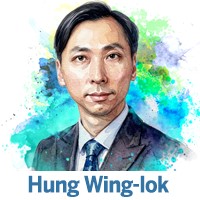
Hung Wing-lok says the city needs to establish practical strategies and develop talent to offer wisdom and sustainable solutions
Since its launch on June 15, the public consultation for Hong Kong’s inaugural five-year plan has sparked a wave of bold and practical ideas for building a greener society and more resilient economy. These insights reflect the exact macro-level thinking and long-term vision the Hong Kong Special Administrative Region needs. Central to this trajectory is the necessity of consolidating Hong Kong’s unique positioning and active engagement in global governance within the context of evolving international relations.
Amid intensifying geopolitical dynamics in recent years, there is a growing consensus on the need for more effective global governance to secure long-term peace and prosperity in a fast-changing world. To address this, the State Council Information Office of the People’s Republic of China published a landmark white paper in June detailing China’s principles, proposals, and actions in the global arena. Notably, the paper underscores the necessity of fostering more effective dialogue among global civilizations.
Under the unique institutional framework of “one country, two systems”, Hong Kong serves as a useful bridge for cross-cultural exchange between Chinese and Western civilizations. This position is also highlighted by the national 15th Five-Year Plan (2026-30), which presents a strategic blueprint for the country’s high-quality development and international cooperation. The plan places a strong emphasis on advancing high-level opening-up and building a global cultural dialogue network. With a dedicated chapter for the special administrative regions of Hong Kong and Macao, the plan firmly supports Hong Kong’s integration into national development and expects it to play a role in advancing the nation’s high-level opening-up and facilitating international cooperation.
To that end, Hong Kong must first establish a clear strategic direction before launching its global outreach initiatives. In the summer of 1998, the Singaporean diplomat and geopolitical consultant Professor Kishore Mahbubani published a thought-provoking essay in the American bi-monthly The National Interest, titled “Can Asians Think?”. The article highlighted that while Asian cultures, particularly China’s highly developed and vibrant civilization, thrived and captivated the world with technological prowess prior to the 15th century, the tides had shifted by the 19th century. Through rapid industrialization, Western nations established global political and commercial hegemonies, forging a “Western-centric” narrative that positioned Western civilization as the ultimate benchmark of human progress. Consequently, for decades, modernization became synonymous with Westernization — a trajectory that Hong Kong closely followed.
Hong Kong thrived as an East-meets-West metropolis against the backdrop of Western dominance and economic expansion. Today, however, the United States-led global governance paradigm displays increasing limitations and fractures. Hong Kong can no longer afford a unidirectional focus on Euro-American civilizations. While continuous engagement with the West remains vital, it is equally important to explore new horizons, especially within the Global South. In this changing international landscape, Hong Kong’s capacity for cross-cultural dialogue has become a strategic asset. Redefining how to bridge Chinese and Western civilizations, while driving multidimensional exchanges across political, economic, and educational spheres, carries profound historical significance. Cultivating a receptive local mindset toward international engagement is essential for Hong Kong’s global integration and its role as a cultural and civilizational bridge.
Hong Kong should also proactively lead the way in fostering people-to-people ties and city-to-city exchanges. Compared to Chinese mainland cities, Hong Kong enjoys distinct advantages, such as widespread visa-free entry and an international, English-speaking environment that makes foreign guests feel genuinely welcome. However, the city has remained relatively passive in promoting itself within the realm of global governance. This summer, while traveling in the Xinjiang Uygur autonomous region, I noticed numerous advertisements and promotional billboards for major conferences on regional cooperation and digital development with Central Asian countries. In contrast, Hong Kong has long marketed itself primarily as an international financial center, inadvertently undermining its potential as a global intellectual hub.
The city could transcend its traditional reputation as a mere “shopping and dining paradise” to reposition itself as a pivotal forum for addressing global challenges and generating actionable insights for the international community.
In addition, the city’s inaugural five-year plan offers significant latitude for developing innovative and pragmatic connections between Hong Kong and other international urban centers. A pertinent example is the relationship between the Greek capital, Athens, and Hong Kong; as leading regional maritime hubs, both cities maintain vast potential for maritime commerce and sociocultural convergence within the broader context of shifting China-European Union trade dynamics. Similarly, public discourse surrounding China-Philippines relations must not be exclusively defined by maritime issues in the South China Sea. There is substantial scope for Hong Kong and Manila to convene strategic discussions addressing shared anticorruption efforts, regional macroeconomic challenges, and collaborative initiatives within the Global South. Cultivating these bilateral ties is indispensable to advancing authentic multilateralism within contemporary international relations.
Diversity remains the essential attribute of human civilization in the 21st century. Over the next five years, Hong Kong must align with national strategies and expand nongovernmental exchanges. As the global economic, governance, and civilizational landscapes undergo structural shifts, Hong Kong can leverage its robust regulatory frameworks and professional expertise to bridge civilizational divides. More international and regional organizations are likely to set up offices in Hong Kong. By deepening multicivilizational exchange, Hong Kong will continue to consolidate its status as a core hub for advancing human progress and global civilization initiatives in the coming decades.
In response to a changing global landscape, Hong Kong needs to proactively establish practical plans and develop talent to offer wisdom and sustainable solutions for global governance challenges. Reflecting on its rapid transformation over the past century, the city possesses immense potential to enhance its international standing. To ensure success, both government and society must be adequately equipped for this transition.
The author is a lecturer at the School of Governance and Policy Science, the Chinese University of Hong Kong.
The views do not necessarily reflect those of China Daily.
